The Work Beneath the Work: Cultivating Leaders for a More Human Public Service
by Chia Nah Nah
Last updated on 29 October 2026

Developing Singapore’s public service leaders has been a core function of the Civil Service College (CSC) since its inception. In the past two decades, how this work has been carried out has shifted discernibly: from the individual leader to collective leadership; from command-and-control authority to relational, human-centred leadership; from siloed, function-based expertise to systems thinking and boundary spanning partnerships.1
As CSC enters its third decade, there are three lines of inquiry that we would like to explore for insights: what have we learnt about growing leaders, which assumptions beneath that work are still relevant for the world that our leaders are walking into today, and what might leadership development need to become next?
What Do We Mean by Leadership?
In CSC’s context, leadership is defined as a process of influence whereby the dynamic persuasive interaction between leaders and followers results in leadership happening. This process has the facilitative effect of creating a shared purpose, alignment of efforts and a level of mutual commitment.2
Leadership is context-dependent. It must respond with agility to its operating environment to facilitate change.
Leadership is intentional. Before forming their intentions, leaders need to know what they stand for — their interior quest or purpose in life. Given their outsized impact, leaders must test the ‘goodness’ of their intentions and purpose.
Leadership is relational. It occurs in relation to other people and within a community. It is in the connections and spaces between people that change can happen.
Leadership is not defined by the exercise of power, but by the capacity to increase the sense of power among those led. The essential work of the leader is to create more leaders — moving away from concentrating power in one person towards expanding the capacity for leadership at a broader level.3
As the Public Service faces multifaceted challenges that are complex, ambiguous and beyond the problem-solving capacity of a small group of leaders, leadership development has shifted from the individual to the collective.
‘Collective leadership’ is an umbrella term for a wide range of different expressions of leadership — such as “shared, distributed, plural, networked, collaborative, integrative, and complexity leadership” (Watters, 2022). It involves multiple individuals engaging in leadership roles, often in dynamic constellations within a network and across different levels, all contributing knowledge, skill and meaning to the task at hand.
2006 to 2012: The First Evolution
Turning Inward – Why Inner Work Became Foundational
Since its establishment as a statutory board, CSC’s signature leadership milestone programmes have been spearheaded by the Institute of Policy Development (IPD), now known as the Institute of Public Sector Leadership (IPSL). Its programmes have given opportunities to cohorts of leaders to grow and gather, and to build networks across public service agencies. Traditionally built around governance and policy topics, with a strong focus on deepening content knowledge, these milestone programmes have drawn on the experience and expertise of guest resource people ranging from ministers, senior public servants to industry experts. As the city state developed and the operating environment changed, so did the view of what skills were required in response to the evolving context. There was a growing resonance, as early as 2006, where IPD had started to take steps to address the focus and balance of leadership, as well as governance and policy coverage in an apex milestone programme for leaders.
In January 2010, the Centre for Leadership Development (CLD)4 was formed to advance leadership development in the Public Service and to develop a Public Service point of view about the work.5 It partnered with IPD to review CSC’s milestone programmes, integrating a personal leadership module into the curriculum for every level of leaders in stages. Its first experiment —the Leadership Development Programme, was designed for newly absorbed Administrative Officers without policy and governance components.
Working with collaborative partners such as Impact International and Roffey Park International — CLD’s practitioners learnt their craft in areas such as humanistic psychology, group dynamics, psychodynamics, and self-managed action learning. These principles and practices still underpin much of how CSC designs its learning experiences today.
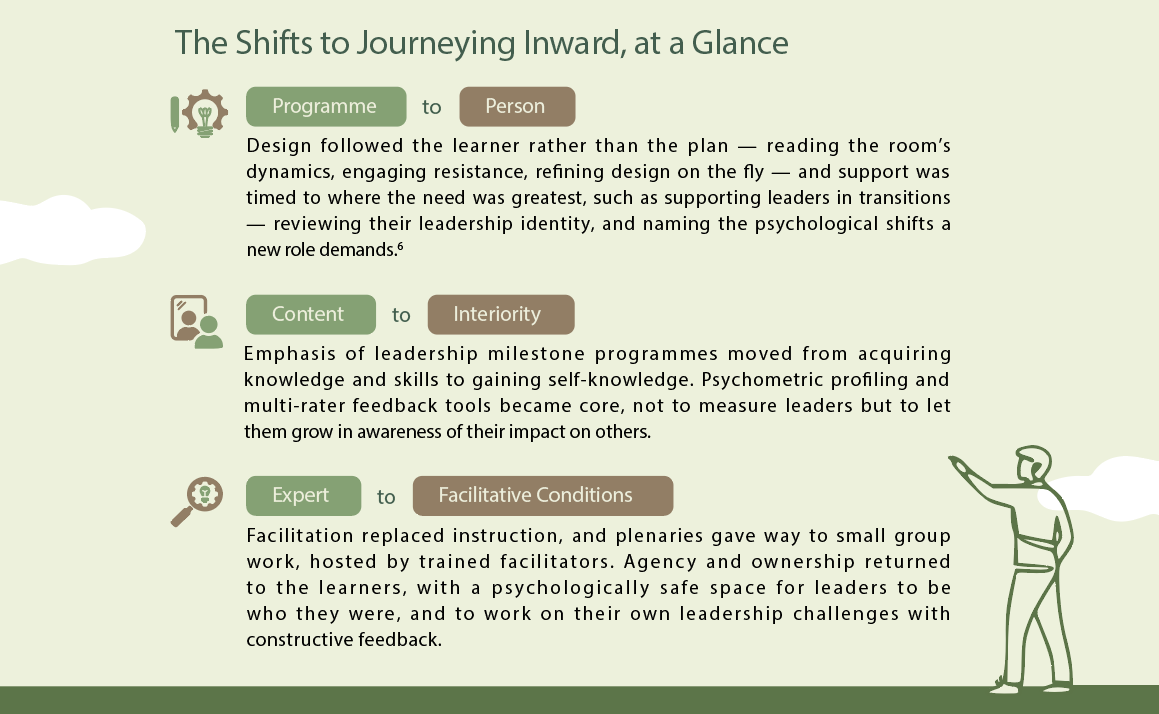
What the practitioners learnt in this first phase reads, in retrospect, as one discovery made many times over: the learner, not the programme, should be the focal point of the design. Attention shifted from our programme agenda to what was actually happening in the room. Data from profiling instruments were held up like mirrors to the leaders. Plenaries were complemented with small group work, where leaders could be more transparent with one another, working through their leadership challenges through a facilitated process of reflection-action-learning cycle. The facilitator stopped being the source of knowledge and became the one who created the conditions for the leaders to path find their own solutions. With demand outstripping the supply of programme spaces, the positive feedback ratings, the ‘aha’ moments experienced by the learners, and the rise in requests from agencies to learn from CSC – these indicators signalled that CSC has reaped some developmental yields in supporting leaders to develop self-awareness through their interior journey.
2013 to 2020: The Second Evolution
Innovating Outward
In 2013, the CLD merged with the Centre for Organisation Development (OD) to form the Institute of Leadership and Organisation Development (ILOD). The integration of these two centres into a single Institute would strengthen CSC’s ability to support public service change and transformation. This move parallels the Public Sector Transformation work initiated by Mr Peter Ong, the former Head of Civil Service from 2010 to 2017.7
Specifically, ILOD was set up to:
increase the depth of leadership capabilities and breadth of perspectives across the public service to meet the increased complexity in the changing leadership landscape,
build capacity and capability in our leaders for leading change and transformation, and supporting them in their transformation efforts, and
develop and strengthen organisational capacity for ongoing change and transformation. Taken as a whole, CSC ILOD’s intentions were to intervene at multiple levels of our system for a more multi-faceted, multi-pronged and coordinated approach, which would maximise the efficacy of each supporting intervention beyond what it could have achieved in isolation.8
The merger widened the lens of leader and leadership development. Leadership development moved from the individual leader to collective leadership, and from intrapersonal and interpersonal work to groups, teams, systems and cross-boundary work. It also moved the work off CSC’s own premises: ILOD began consulting with agencies in their contexts, using diagnosis, design and dialogue to strengthen organisational effectiveness and the ongoing capacity to change. The practical consequence was a change of unit — the group or the team, rather than the individual leader, became the basic unit of analysis for diagnosis and intervention.
Much of the inspiration — for this expansion of work from a single leader to a community of leaders, and the elevation to a higher system level for impact — could be attributed to the strategic thrusts of the Public Sector Transformation (PST) initiative9 steered by Mr Peter Ong,10 of which he had laid the structural conditions (PST, One Public Service, WOG leadership) for whole system work and collective leadership to take shape while Mr Leo Yip, the former Head of Civil Service from 2017 to 2026, explicitly named11 and institutionalised those developments with a coherent leadership identity under the banner of “collective leadership”.12
ILOD had also looked outward by bringing in global thought leaders for systematic capacity building. One of the most influential thought leaders that ILOD had successfully forged a strong partnership with was the late Dr Mee-Yan Cheung Judge, a Senior Visiting Fellow of CSC beginning in 2012. A pioneer of the “Self as Instrument” and also OD, she was pivotal in supporting the first phase of the Singapore Public Sector transformation, and also in inspiring ILOD in fulfilling its mandate and in cohering the two disciplines. The cross-pollination between the two disciplines created the conditions for the practitioners to work more integratively, and consequently set off a run of innovations. As a microcosm, ILOD was mirroring the first thrust of PST, which was “To deliver seamlessly as One Public Service”, because future, complex challenges require separate entities to work beyond organisational boundaries.
The most instructive of one such innovation began as a problem to be solved. In 2016, ILOD offered a Leaders Building Leaders (LBL) initiative to the Ministry of Social and Family Development, largely to relieve over-subscribed demand for CSC’s leadership programmes for first-time managers by developing the agency’s own capability. It worked — but not in the way that ILOD had intended. The people who grew most were not the first-time managers being developed. They were the experienced middle managers (MMs) who had facilitated others’ development. In helping others to learn, the MMs had become students of their own leadership. By 2022, under the leadership of Mr Leo Yip, LBL had been adopted as a whole-of-government movement across the Public Service.
The same years asked something harder of senior leaders. In 2020, ILOD worked with the Public Service Division (PSD) to raise awareness of mental health across the Service, training leaders and supervisors to notice officers at risk and to route them to support. What moved the needle was not the training. At a public service forum, two senior leaders spoke candidly about their own mental health struggles. They broke a vulnerability threshold — and made it possible for the rest of us to hear that it was “ok to be not ok”.
The COVID Effect: A Season of Experiments
Following Singapore’s Covid-19 restrictions in April 2020, CSC moved its leadership milestone programmes online within months. It was a season of experiments. Leaders were working from home and needed perspectives quickly.
CSC ILOD ran everything from theme-based webinars to an inaugural virtual conference on Leadership and Organisation Development, reaching more leaders than our physical infrastructure ever could prior to the Covid-19 pandemic. Experimentation became hallmark qualities of officers and leaders through the pandemic years: making quick adjustments, testing out new ways of working in the virtual spaces, being comfortable with not knowing, and learning from failure (e.g. programmes came to momentary halt when internet outage happened). There was also uncertainty as the nation adjusted to the pandemic, adapting to various permutations of hybrid work arrangements. It was an opportunity for learning, experimenting and adapting to evolving circumstances for CSC.
Then the rules relaxed, and leaders came back to their workplaces. The pivot back to in-person was as swift as the pivot away had been — it signalled to CSC that in-person connections really mattered to leaders, or rather, connections really mattered to humans. The work of convening both online and in-person communities took a different shape and emphasis as Covid-19 illuminated for us what public service officers, including leaders, missed about being together.
2021 to 2025: The Third Evolution
Tending to and Strengthening the Conditions
The years following the Covid-19 pandemic tested the Public Service with a markedly different leadership landscape — heightened concerns about mental well-being and resilience, the shift to hybrid and flexible work, growing societal complexity, and the need to sustain organisational cohesion despite greater uncertainty. The then Head of Civil Service Mr Leo Yip reinforced and deepened an already evolving leadership development agenda — one that treated leadership not simply as individual capability, but as a shared condition for organisational health and renewal. The Leadership Competency Framework (LCF) and the 360-degree feedback gained sharper relevance as leaders needed clearer expectations, stronger self-awareness, and more transparent feedback for their impact on people and systems. The LBL movement became even more critical in a dispersed and demanding workplace, strengthening a culture where leaders coach, mentor, and grow one another rather than leave development to formal HR processes. The emphasis on one integrated Public Service leadership community also took on renewed urgency, calling leaders to work across boundaries, steward talent collectively, and build organisations capable of learning, adapting, and caring for people in a more complex post-pandemic world. Together, these shifts moved leadership development beyond building capable individual leaders towards cultivating a learning-oriented leadership system.13
These shifts also sharpened CSC’s role in translating the Public Service’s leadership agenda into lived developmental experiences. If leadership was increasingly understood as a condition for organisational health and whole-system capacity, then development could no longer be confined to formal programmes for a select few. CSC’s task was to make leadership development more accessible, more relational, and more responsive to the realities leaders were carrying in a more emotionally complex workplace.
Democratising leadership development has been a CSC leadership philosophy since 2012. From 2021, it became a significantly more achievable endeavour. Virtual learning, thrust upon us by the pandemic, transformed not only the modality of leadership development, but also the scale, range and reach of what CSC could offer.
The proliferation of virtual offerings had widened CSC’s intellectual and global reach, connecting it with a more diverse range of disciplines and thought leaders, opening new avenues for cross-border collaborations in leadership development. One noteworthy exploration in 2022, which eventually led to a formalised partnership, was CSC’s introduction of the Clear Leadership Course to the Singapore Public Service. Based on the seminal work of Dr Gervase Bushe,14 the Clear Leadership workshops have consistently been over-subscribed since its inaugural run in April 2024. The hike in demand for the course has also signalled the growing interest in leadership transformation in the context of partnerships and collaborations, the desire of leaders to lead learning while performing, to elevate their communication skills and to achieve relational mastery.15
Since the pandemic, loneliness and mental health have moved from the margins to the centre of concern, in the Service and beyond it. Leaders name these struggles more readily now, and mental health support has become part of the employment relationship rather than the exceptional provisions made for a few. CSC intentionally incorporates well-being components into its leadership development experiences including personal retreats, walks and energy management segments — to support leaders to become more aware of their mental and psychological states.
Beyond the programmes, CSC has also elevated leaders and practitioners thinking on mental health from a deficit-based lens to a more strengths-based lens. ILOD organised the biennial Leadership and Organisation Development conference in April 2024, focusing on the theme of “Flourishing Organisations: Moving Beyond Performance”, as part of its ongoing efforts to signal the importance of mental health and well-being in the larger public service, by paying attention to how we can support leaders in creating the conditions for a flourishing workforce.
As part of supporting the Public Service’s emphasis on developing collective leadership, CSC began to consolidate its team-based interventions in 2025, focusing on the health and effectiveness of top or senior leadership teams and on the conditions that support such teams to flourish. It has also piloted its first team-coaching support in its apex senior leadership milestone programmes, with plans to extend it to other senior leaders in 2026. Team development is not a new offering; what is new is a coherent set of research-based frameworks to guide it.16,17
As the LBL movement grows, it also offers experienced public service leaders to contribute and find meaning without conventional vertical progression. With PSD’s support, CSC has piloted a Directors Leadership Series for experienced Directors of six to twelve years’ standing in end 2025 — to refresh their leadership journey, and to look at what else their careers might hold. Forward planning of this kind gives leaders in midlife a longer runway to be more choiceful about strengthening their career fitness: time and space to consider their next vocation, invest in new interests, and widen their choices before they need them.
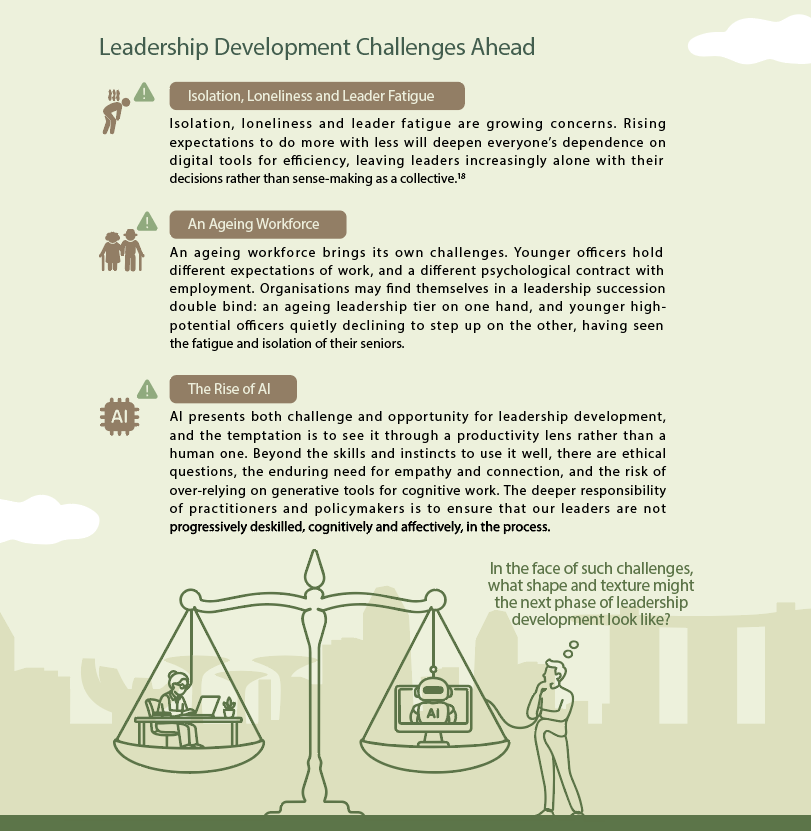
Charting the Next Frontier for Leadership Development
The next chapter of CSC’s work is to preserve the inner capacities that make leadership human, multiply the relationships through which leadership becomes collective, and to renew the institutional conditions that make continual adaptation possible.
Seen through an OD lens, the work ahead is not a choice between developing individual leaders and transforming systems. It is a nested task: to preserve the inner capacities that allow leaders to learn, discern and remain human; to multiply the relationships through which leadership and collective intelligence can emerge; and to renew the institutional conditions that make adaptation possible. These capacities are mutually reinforcing.
Preserve the Inner Ground: Forming Leaders’ Interior Worlds
Enabling leaders to journey inward will continue to be a foundational practice in leader development work. Leaders’ attentiveness to their inner life, their identity, thoughts, emotions, motivation and purpose will remain a core part of developmental work. Self-knowledge or awareness intelligence is what gives their leadership weight. Habits that support leaders in their emotional regulation (e.g. nature walk), reflective practices, journalling, energy management, and the courage to ask for feedback, will continue to be embedded in various leader development offerings to develop more whole leaders.
Leaders will need more than an expanding repertoire of competencies. Before leaders can hold the complexity around them, they must become more capable of noticing and working with the complexity within them. They need the capacity to examine the assumptions from which they act, make meaning of experience and remain open when familiar identities or solutions no longer suffice. It is the capacity to stay present to discomfort, resist the impulse to defend one’s stands, and to make responsible choices without full certainty. Vertical-development approaches similarly emphasise challenge, exposure to different perspectives, and structured reflection as conditions for developing more complex ways of making sense of the world (Kegan, 1980).19
“During times of unprecedented change, learning becomes the best option for leadership…Both leading and learning are adaptive processes (Rainey and Hanafin, 2023).20 Strengthening leaders' capacity to learn will be an imperative adaptive quality, especially in times of transitions or complexity. CSC’s leader development efforts focused on where the need is greatest and the window to learn is widest — which is why leadership transitions will remain central to our work, and attentiveness to how leaders learn (e.g. David Kolb’s experiential learning theory) will remain a priority in leadership development. To support leaders to focus on learning rather than only on performing, it would be key to raise leaders’ awareness and management of their competence compulsion,21 a tendency for people to want to see themselves as competent, and for others to see them as competent. Such tendencies can cause people to react towards information or feedback that they need for learning, instead of staying in the zone of curiosity.
Boundaries management may need to become a more salient skill for leaders to develop. Leaders who constantly put others’ needs ahead of their own risk neglecting their own responsibilities and becoming overwhelmed. Rituals and practices that promote inner spaciousness such as personal retreats, short sabbaticals, should stay part of the work. At a public service level, we will need to help leaders manage their energy and their boundaries, not just their workload.22
While not new, CSC will continue to keep developing leaders in two key aspects, for more whole leader development – helping leaders to be in touch with their emotions and have greater somatic awareness. Growing in one’s capacity to identify one’s emotions is a precursor to emotional expressiveness (e.g. “I feel”). This has been associated with demonstrated empathy, a key tenet of relationship management. Being in touch with one’s emotions opens up new ways of being that could support a leader’s effectiveness.
Somatic awareness in leader development recognises that leadership is not exercised through cognition alone, but through presence, emotional regulation, attention, posture, breath, and the capacity to stay grounded under pressure. This matters because leaders do not only communicate through what they say; they shape trust, safety and connection through how they show up. In complex and emotionally demanding environments, somatic practices help leaders move from reactivity to more conscious responses, strengthening their self-awareness, resilience and relational impact.
The use of AI will make our leaders faster. It may also relieve them of the struggle through which wisdom is formed — the difficulty that builds resilience, the ambiguity that sharpens judgement, the connection that deepens empathy, the responsibility that shapes moral agency. We will need to contend with the risk that our leaders could become more efficient, but less discerning; more connected, and less humanly present. Our task is to make sure that the leaders we develop are not quietly deskilled of their judgement, empathy, resilience and moral agency along the way.
As we step into the age of not knowing, awareness intelligence, and the capacity to experiment, learn and change, as well as the courage and discernment to make responsible choices, will become increasingly critical. In an accelerated and chaotic world, our impact and significance may not be how fully leaders extract the productivity gains from the latest tech tools or how well leaders keep pace. It may be how faithfully we protect what it means to remain human.

Multiply Leadership: Growing Collective Capacity through Building Relationships
Individual leader development strengthens intrapersonal capacity, while leadership development strengthens the social capital and interpersonal conditions through which people can act together (Day, 2000). Leadership becomes something generated through trust, mutual responsibility, dialogue, coordination and shared meaning – not something possessed only by a few people in senior positions.
Leaders of the future do not lead from position or intellect alone, but who have the humility to create conditions where the intelligence of the collective can multiply. What we need are not more heroes, nor more leaders who align through compliance and conformance. We need a more diverse cadre who are willing to come together in service of a purpose greater than their own — for the Public Service, and for the nation.
The intentional sharing of power — as a generative act of growing more leaders, in groups and teams — will need to take centre stage. It does require leaders to exercise generosity and open up opportunities for other incumbents to step into leadership roles, implicitly acknowledging that another person may have the better set of skills or capabilities to be able to exercise leadership more effectively at any given point in time.
CSC’s task is no longer only to form capable leaders, but to strengthen the relationships through which effective leadership can emerge among them. The purpose of connection is not to create easy alignment. It is to create relationships strong enough to hold disagreements, differentiation and collective learning.
As a neutral entity, CSC is strategically placed to convene gatherings that are human-centric and purposeful— within a system and across systems. How we show up with one another is the one thing AI has not learnt to replicate: AI can map a network, but it cannot form a community where there is love, care and friendship. Communities and friendships can also serve as human-centric strategies against isolation and loneliness, and against over-dependence on generative AI as a thinking partner.23
Renew Institutional Capacity: Building Institutions to Sense, Experiment, Learn and Adapt
Leaders are developed not only to perform within existing structures, but to anticipate change and to steward the conditions that let teams and institutions flourish over time — which is to say, to renew institutional capacity rather than rely on individual heroics.24 CSC has a responsibility to support the design of leadership systems rather than to allow for dependence on exceptional individuals.
CSC has been introducing organisation agility to senior leaders through round tables, executive masterclasses and dialogue sessions through the expertise of its Senior Visiting Fellow Dr Christopher Worley and is working at introducing the work to the public service to strengthen our capacity for change. According to Dr Worley and colleagues, agility is not merely a quality of individual leaders. It is an institutional capability that leaders help to build and sustain: the collective capacity to sense-make, test possible responses, learn quickly, implement or act coherently and repeat the process over time, while remaining anchored in public purpose. The desired outcome is sustained public value, institutional effectiveness and trust.
The future of leadership development needs a new narrative, one that is collectively created and imagined by a system of leaders and policymakers, rather than by a few positional leaders. Dialogic OD25 treats organisations as meaning-making systems in which multiple realities need to be surfaced and explored. Change occurs not merely because people have a good conversation, but because prevailing assumptions are disrupted, core narratives change, or a compelling new image of what is possible emerges. (Bushe and Marshak, 2009). What are the assumptions and core narratives that need to give way to this new narrative?
The next season may require practitioners to partner policymakers and stakeholders to convene a whole system dialogic process, to co-create a new image of what leadership in public service could look like, and co-construct a value proposition that draws capable officers to desire the responsibility and privilege of senior leadership, in service of the nation.
CSC’s contribution to the leadership development work in the Singapore Public Service has palpably evolved in the last two decades. The enduring contribution of leadership development may therefore lie not in any particular programme, method or technology, but in the cultivation of three forms of capacity: discerning leaders, generative relationships and agile institutions. At its heart, this journey reflects CSC’s passion and commitment to the work beneath the work: developing leaders and leadership for stewardship, renewal, and a more human Public Service.
ABOUT THE AUTHOR
Chia Nah Nah is Director and Senior Principal Consultant at the Institute of Leadership and Organisation Development (ILOD), Civil Service College. She has two decades of experience in leadership, organisation and people development, partnering agencies to strengthen leadership capability, organisational effectiveness and culture. She pioneered the Leaders Building Leaders initiative for a ministry in 2017, an organisation approach to develop leadership capacity through coaching, mentoring and peer learning. Her current work focuses on generative conversations, leadership learning and presence, mentoring, team development, systems psychodynamics, and building adaptive leadership for an increasingly complex operating environment.
NOTES
Watters, Aurora de Souza. (2022). Collective Leadership: A Shift Towards Leadership in Plural.
De Souza Watters, A., Khoo, E. W., Law, A., & Soon, S. (2024). Public Service Leadership: Purpose, Practice, Perspectives. Civil Service College, Singapore.
Caramela, Sammi. “The Management Theory of Mary Parker Follett.” Business.com (opens in new tab). 22 February 2018. Retrieved via https://www.bing.com/search?q=find+https%3A%2F%2Fbranch.business.com%2FBDC-55%2Farticles%2Fmanagement-theory-of-mary-parker-follett%2F&cvid=e22b801a18fe43dab53c6deb415435da&gs_lcrp=EgRlZGdlKgYIABBFGDkyBggAEEUYOdIBCDQyOTZqMGo3qAIAsAIA&FORM=ANNAB1&PC=U531 (opens in new tab)
The Centre for Leadership Development (CLD) was formerly the Civil Service College Consultants (CSCC).
CSCC Review 2007 Confidential File – CSCC141.9.02.V1
Charan, Ram, Stephen Drotter, and James Noel. (2011). The Leadership Pipeline: How to Build the Leadership Powered Company. https://www.google.com.sg/books/edition/The_Leadership_Pipeline/xGxj0QEACAAJ?hl=en (opens in new tab)
Leo Yip. “Speech by Mr Leo Yip at the 2018 Administrative Service Dinner and Promotion Ceremony.” Public Service Division, 3 April 2018. https://www.psd.gov.sg/newsroom/hcs-leo-yip-2018-administrative-service-dinner-and-promotion-ceremony (opens in new tab)
Paper on the Formation of the Institute of Leadership and Organisation Development. Submitted to the Board of Directors Meeting on 15 May 2013
Peter Ong. “Speech by Head, Civil Service Mr Peter Ong at the 2017 Administrative Service Dinner & Promotion Ceremony.” Public Service Division, 6 April 2017. https://www.psd.gov.sg/newsroom/hcs-peter-ong-2017-administrative-service-dinner-and-promotion-ceremony (opens in new tab)
Peter Ong. “Speech by Mr Peter Ong at the Public Service Leadership Dinner.” Public Service Division, 27 October 2015. https://www.psd.gov.sg/newsroom/hcs-peter-ong-2015-public-service-leadership-dinner (opens in new tab)
Leo Yip. "Speech by Mr Leo Yip at the Public Service Leadership Dinner." Public Service Division, 8 November 2017. https://www.psd.gov.sg/newsroom/hcs-leo-yip-public-service-leadership-dinner-2017 (opens in new tab)
Refer to note 7.
Leo Yip. "Speech by Mr Leo Yip at the 2023 Annual Public Service Leadership Ceremony." Public Service Division, 19 October 2023. https://www.psd.gov.sg/newsroom/speech-by-mr-leo-yip-at-the-2023-annual-public-service-leadership-ceremony (opens in new tab)
Research provides “…clear support for the conclusion that the top team, rather than the top person, has the greatest effect on organisational functioning” (p.150) from O'Reilly, C. A., III, Snyder, R. C., & Boothe, J. N. (1993). Effects of executive team demography on organizational change. In G. P. Huber & W. H. Glick (Eds.), Organizational change and redesign: Ideas and insights for improving performance (pp. 147–175). Oxford University Press.
This includes the 6 Team Conditions framework, a research-based model developed from decades of work by Drs J. Richard Hackman and Ruth Wageman, later extended by Martine Haas and Mark Mortensen; and the Leadership Team Effectiveness (LTE) instrument developed by PSD and CSC with INSEAD.
Global statistics indicate that roughly 1 in 6 people (about 16%) worldwide experience loneliness. Recognised as a global health threat, chronic loneliness is now linked to an estimated 100 deaths every hour—amounting to over 871,000 premature deaths annually—due to its severe toll on cardiovascular and mental health. See: https://www.who.int/news/item/30-06-2025-social-connection-linked-to-improved-heath-and-reduced-risk-of-early-death (opens in new tab)
Kegan, Robert. (January 1980). Making Meaning: The Constructive-Developmental Approach to Persons and Practice in The Personnel and Guidance Journal and Petrie, Nick. Vertical Leadership Development-Part 1: Developing Leaders for a Complex World. Center for Creative Leadership. https://ccl.org/wp-content/uploads/2016/10/VerticalLeadersPart1.pdf (opens in new tab)
Rainey, Mary Ann, and Hanafin, Jonno. (2023). Leadership in the Age of Not Knowing: Strategies for Leading in a Learning Way. NTL Institute.
Bushe, Gervase R. (2010). Clear Leadership: Sustaining Real Collaboration and Partnership at Work. Davies-Black Publishing.
Gallup. (2026). State of the Global Workplace. https://www.gallup.com/file/workplace/707798/state-of-the-global-workplace-2026-download.pdf (opens in new tab)
Petriglieri, Gianpiero. “How to Make Better Friends at Work.” MIT Sloan Management Review, 12 February 2024. https://sloanreview.mit.edu/article/how-to-make-better-friends-at-work (opens in new tab)
Dr Christopher Worley’s definition of Organisation Agility is the built-in capacity and learned capability to repeatedly orchestrate sufficient and timely change that sustains high performance as internal and external circumstances warrant.
Dialogic Organization Development (Dialogic OD) is a modern approach to organisational development that emphasises changing the conversations that shape everyday thinking, behaviour, and organisational realities, rather than relying solely on planned, top-down interventions typical of diagnostic OD. Bushe, Gervase R., and Marshak, Robert J. (2009). Revisioning Organization Development: Diagnostic and Dialogic Premises and Patterns of Practice. Journal of Applied Behavioral Science 2009 45:348. Retrieved via https://www.gervasebushe.ca/revisioning.pdf (opens in new tab)