
How Adult Learning Is Changing in a Transformed World
by Terence Ho
Last updated on 29 October 2026

Insights from the Institute for Adult Learning (IAL), Singapore’s national centre of excellence for adult learning, highlight the need for relevant, continual learning that is embedded into organisational workflows and practices at every level.
Introduction: Shift in Learning and Capability Development
Seismic shifts in the context, content and modality of learning are transforming adult learning today. They are accelerating trends towards more industry-relevant and flexible modes of learning that bring tangible gains to organisations and individuals. Increasingly, the focus is on work-embedded learning, team-based capability development, and the integration of formal, non-formal and informal learning. Learning institutions and training providers must likewise move beyond just classroom delivery towards supporting learning in the flow of work.
These shifts call for frameworks and mechanisms to recognise skills demonstrated at the workplace, in addition to formal training credentials. There is also a need to equip learners to deal with uncertainty, empowering them to become co-creators rather than just passive recipients of knowledge. To be effective in this new context, learning institutions cannot operate in siloes — they must partner with a range of stakeholders, as part of a learning ecosystem embedded in industries, organisations and communities of learners.
Driving Forces of Change and Disruption
Adult learners today face significant disruption and uncertainty arising from technological change, geopolitical rivalry, supply chain disruptions, demographic transition, climate change, and other forces. To stay relevant to the current needs of organisations and learners, learning systems and institutions must become more responsive to external driving forces.
Changes in Skills Requirements Arising from AI
Since 2022, the most palpable impetus for change has been the emergence of generative and agentic AI models of ever-increasing capability. By taking over not just routine cognitive work but also complex reasoning and creative tasks, such as research, writing and coding, AI is changing the role of human workers and how they contribute at the workplace. What skills now matter, and hence what people need to learn, are changing.
A 2026 joint study by IAL and the Burning Glass Institute (BGI) of approximately 15.3 million job postings in the US and Singapore from 2020 to 2025 found rapid changes in skills requirements in both countries, with Singapore recording a rate of change 2.4 times higher than the US.1 While entry-level roles have been particularly affected, skills requirements are evolving across all experience levels, suggesting broad-based workforce transformation.
Organisations and individuals must learn to leverage AI tools and agents for improved productivity and performance. But AI has also increased the premium on critical thinking, judgement and empathy, making these skills essential for adding value at the workplace. These can be cultivated through courses on leadership, communications and teamwork, and can be reinforced at work through structured feedback, personalised or group coaching, mentoring, and communities of practice.
New Possibilities in Technology-Enhanced Learning
In tandem, learning institutions must consider how best to harness AI to support teaching and learning. Technology holds considerable potential to customise learning and make it accessible to learners around the clock via AI tutors and chatbots, and to support immersive learning via role-playing or augmented reality environments.
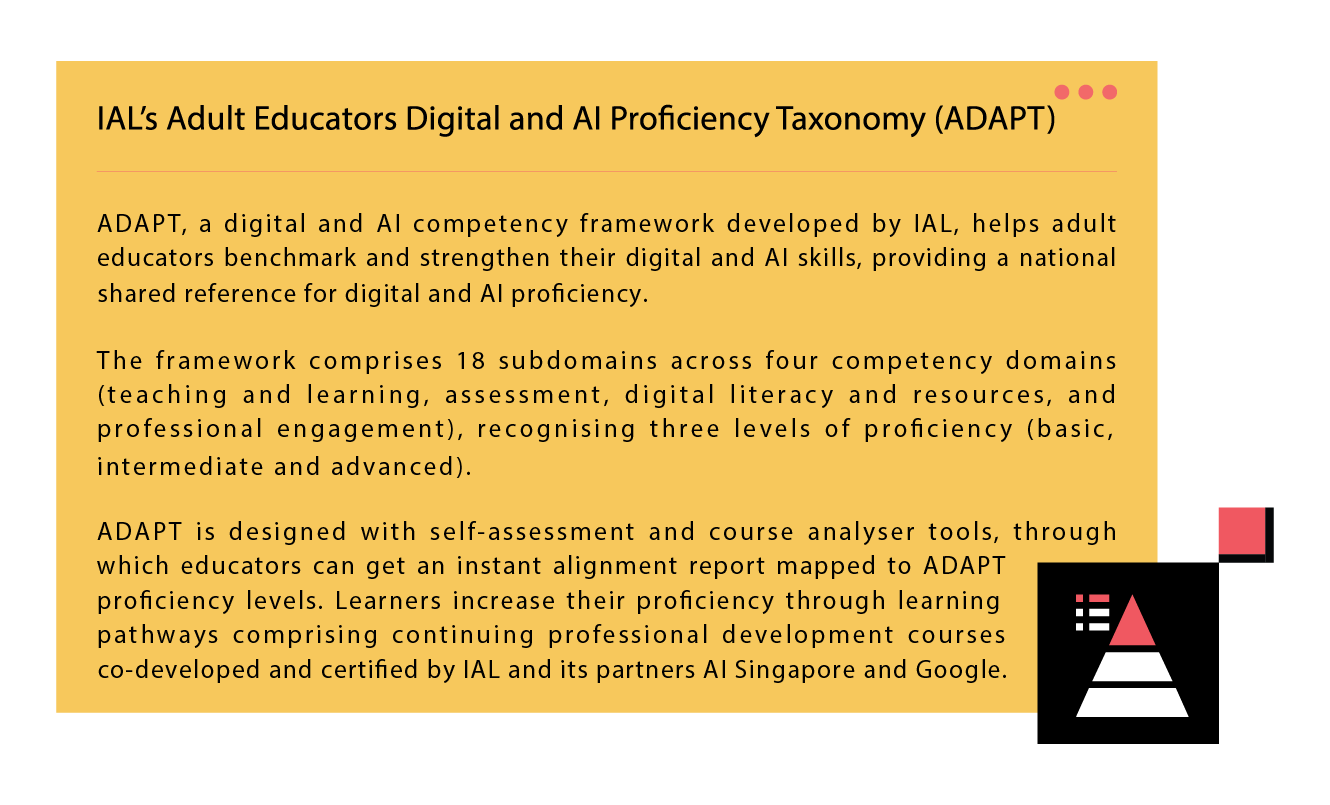
As AI takes on more of the routine load in curriculum design, delivery and assessment, it frees educators to exercise higher-order professional judgement and expand their practice beyond instruction into mentoring and convening — motivating, guiding and inspiring adult learners, and facilitating activities that encourage cross-disciplinary learning. Here is where educators can add the most value, particularly as learning agility, cross-disciplinary learning and self-management are becoming increasingly important.
Fractionalisation of Jobs and the Changing Employment Relationship
AI is likely to spur the fractionalisation of jobs, where traditional job roles are disaggregated into various tasks that are then distributed to AI and human workers for more optimal productivity. This could accelerate trends towards gig work, where employers maintain contingent rather than permanent workforces, and workers are compensated for specific tasks.2
However, most organisations will still require a core team of employees who are tied to the organisation and may be flexibly deployed for a range of tasks. Here, job redesign will play an important role in deriving synergies from teams of human workers and AI bots. Increasingly, learning and development must dovetail with organisational priorities and work redesign. Learning institutions can support organisations in redesigning work and reskilling workers through repeated cycles of change. For instance, IAL guided manufacturing firm Cragar Industries through a structured work transformation project to convert an existing Finance Executive role into a new Business Data Analyst role.3
Emerging Frontiers in Learning and Organisational Development
Supporting Flexible, Modular and Just-in-Time Learning
As AI shortens the half-life of occupational knowledge, learning institutions must update training programmes and curricula more frequently using labour market analytics of job postings, market intelligence and horizon scanning.
“Labour markets now require far more agile updating of skills than traditional qualification systems often provide.”
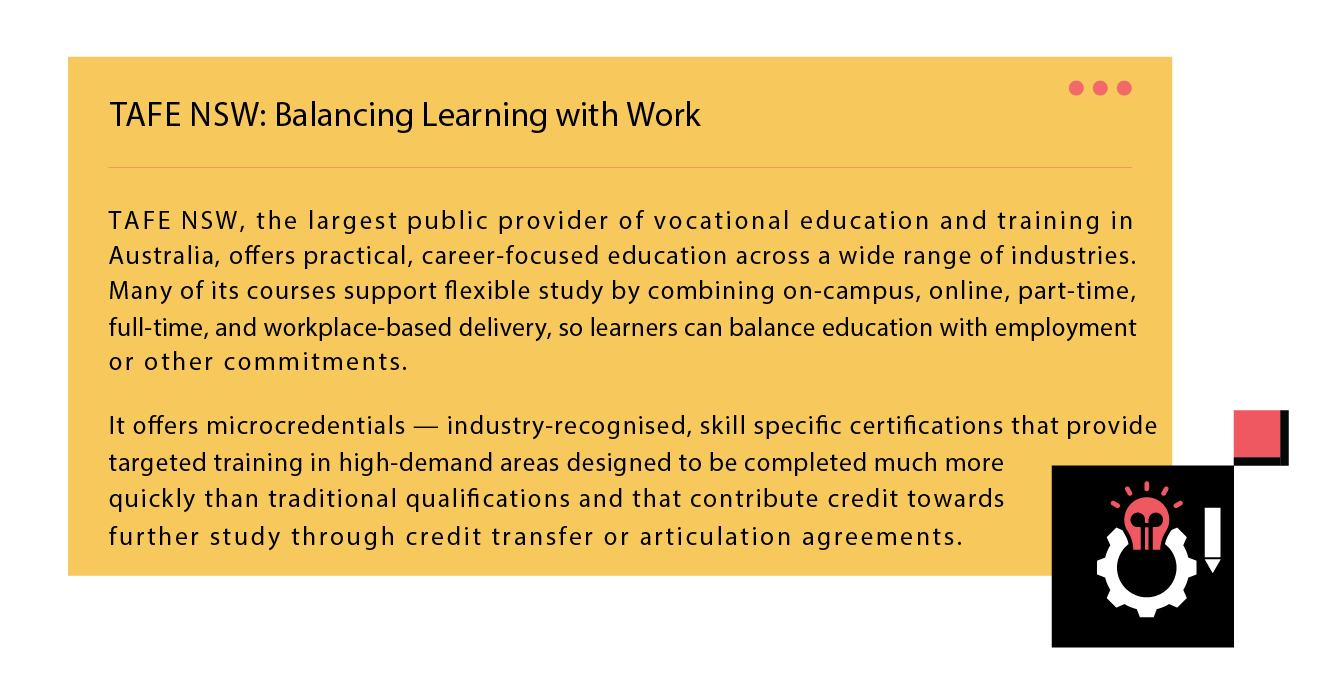
Concurrently, microcredentials are gaining popularity. The Organisation for Economic Co-operation and Development (OECD) (2026) observes that labour markets now require far more agile updating of skills than traditional qualification systems often provide.4 Small, modular courses can be launched more quickly than full qualification programmes that require considerable time for institutional approval. Such credentials support flexible, just-in-time learning catering to working adults who cannot afford to take significant time off from work. Often, these credentials can also be stacked towards larger qualifications.
“Much of what people learn in formal training is not applied at work, often because there is no opportunity to practise what they have learnt.”
Embedding Learning in Work and Organisational Context
It has long been recognised that the bulk of learning takes place on the job rather than in the classroom. In the early 1980s, the US-based think tank Centre for Creative Leadership developed a 70:20:10 model which suggests that 70% of learning comes through hands-on experience, 20% through social learning and only 10% through formal training courses.5
Likewise, it is well established that training is more relevant and effective if it addresses actual challenges learners face in the workplace, rather than if it is treated as a standalone exercise detached from work. Research suggests that much of what people learn in formal training is not applied at work, often because there is no opportunity to practise what they have learnt.6
“When learners grapple with real-world issues rather than hypothetical situations, they get to weigh competing considerations and exercise judgement and empathy.”
Today, technology is driving changes in processes that make it even more imperative to connect training with work. The task for learning institutions is hence twofold: to increase the industry relevance of training, and to partner employers to embed learning in the flow of work.
The first task can be achieved by designing curriculum and classroom time around the sharing of work experiences, or projects where learners can apply their skills towards solving actual work challenges. Where possible, this should move beyond the theoretical by giving learners the chance to implement their projects at work. When learners grapple with real-world issues rather than hypothetical situations or sanitised case studies, they get to weigh competing considerations and exercise judgement and empathy.
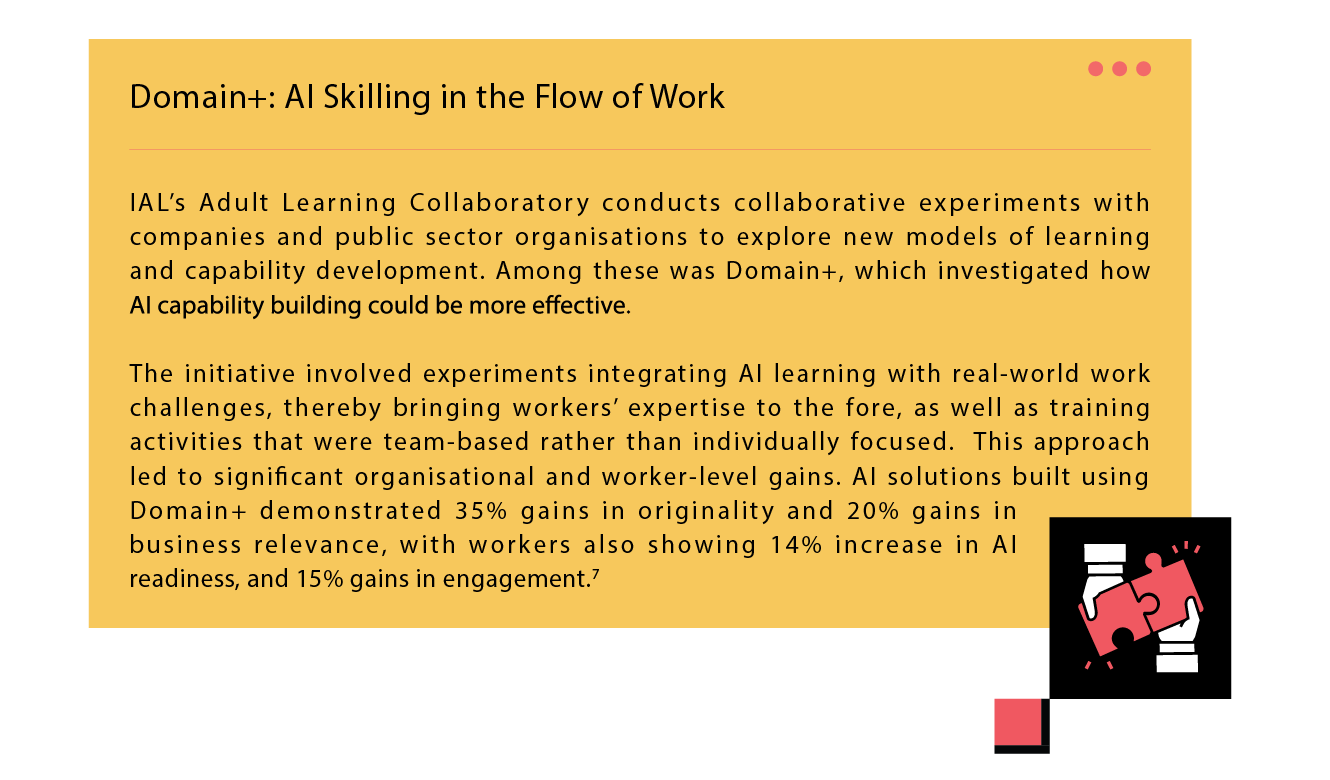
The second task entails identifying opportunities for timely learning interventions in the flow of work. This form of learning is highly contextual and requires close engagement with supervisors, line managers and operational leads. Workers and supervisors, as the domain experts, must co-create learning in complex, fast-changing environments. External trainers or consultants can help with facilitation by partnering learners and teams to co-develop and customise learning solutions that meet organisational and individual needs.
Strengthening Workplace Learning Architecture for “Learning Organisations”
Beyond one-off interventions, learning institutions can support organisations in formalising and strengthening workplace learning.
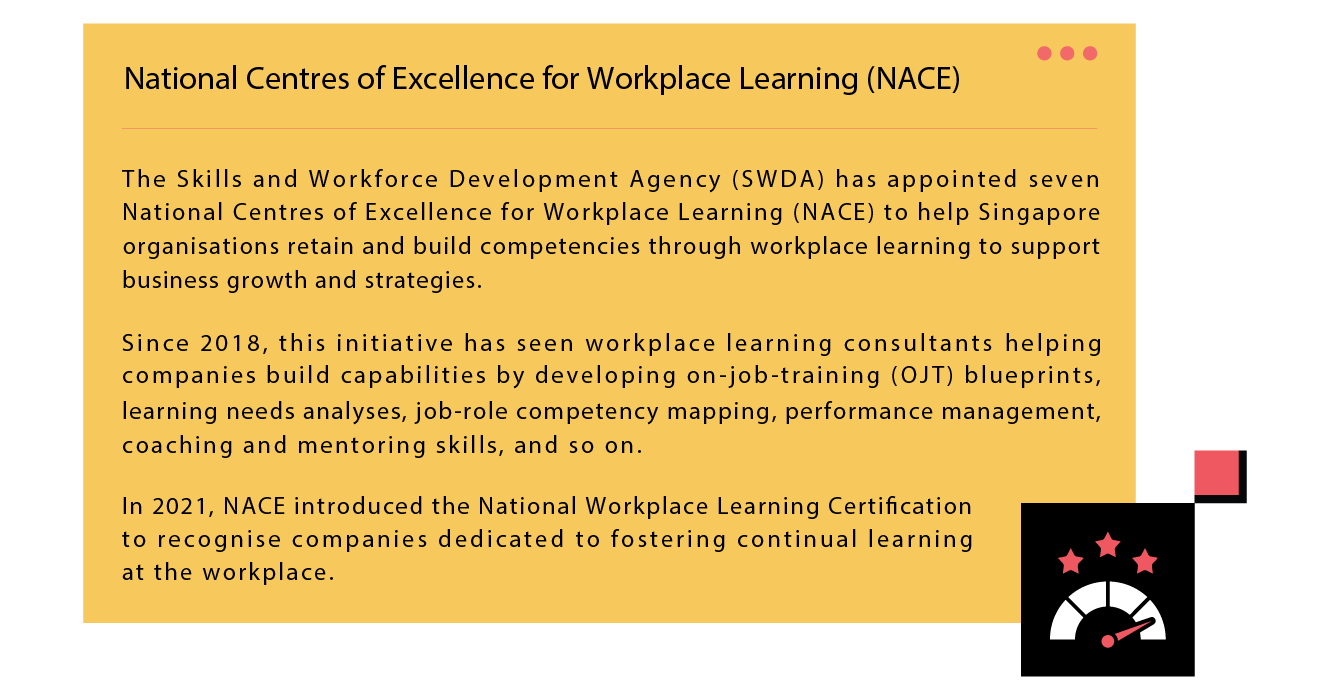
While workplace learning has always been important, it has become more urgent than ever. As AI drives transformation across the workplace, it has become an integral part of organisational development and change management to continually redesign work and equip workers for new job requirements. This demands that organisations develop effective learning architecture.
“Learning must be situated within the broader organisation, and not treated as an activity set apart from its regular work.”
Findings from IAL’s Skills and Learning Survey provide insights into why investment in training often does not lead to improved workplace performance.8 It turns out what matters is whether workers are motivated to engage in deep learning and pursue skills mastery. Such motivation is shaped by the learning environment at work, including whether management practices support worker autonomy.
Learning must be situated within the broader organisation and not treated as an activity set apart from its regular work. To be successful, enterprises must become learning enterprises, with learning built into their corporate DNA. For instance, organisations could adopt a Plan-Do-Act-Adapt methodology where there is continual experimentation and adaptation to improve workflows and processes. By dovetailing people development strategy with business strategy, the former is elevated from an optional activity to a core priority that is integral to organisational success.
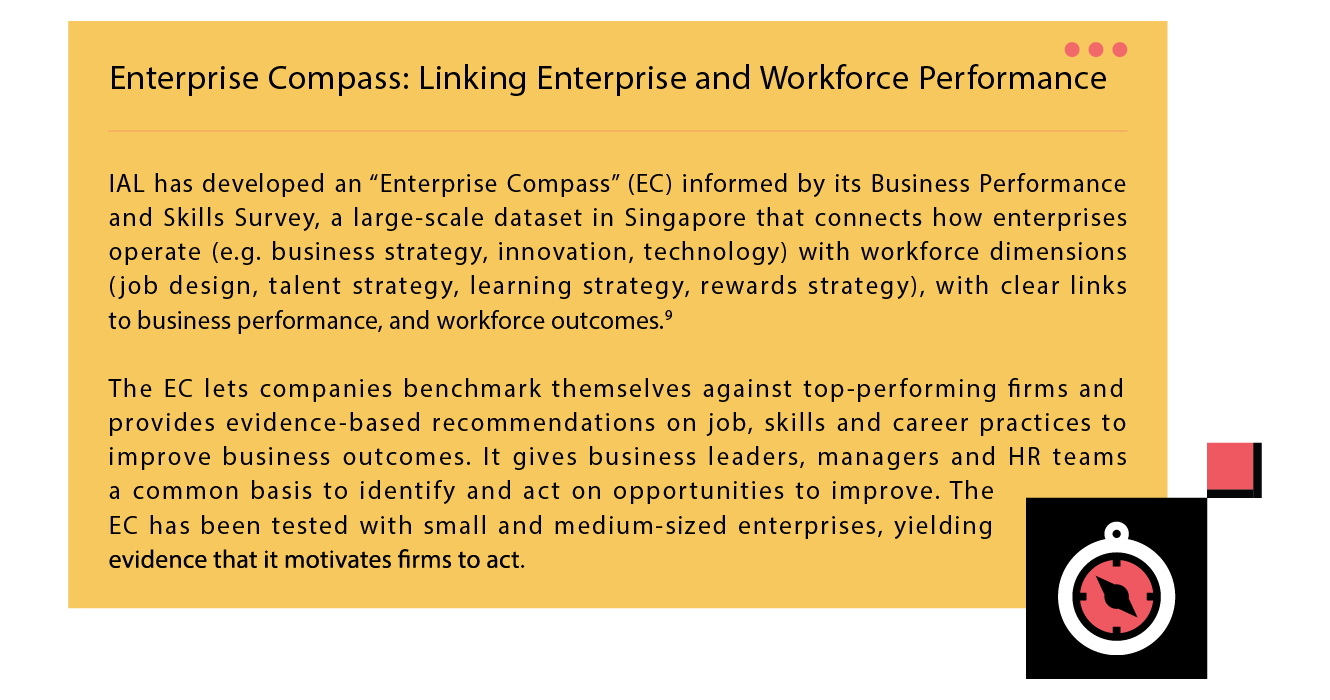
Leadership is critical for a learning organisation: leaders provide resources and backing for learning and experimentation, and set the tone for the organisation. Learning institutions must therefore engage an organisation’s senior leaders to ensure buy-in, define learning goals and objectives and ensure alignment with the organisation's strategy. HR professionals, line managers and unions, too, are key in enabling learning within organisations by activating mindsets, securing training resources, embedding learning in work, and creating conducive environments for learning and experimentation.
It is helpful for organisations to set aside protected time for learning and experimentation, particularly in teams. This way, learning does not appear to be an additional imposition on top of work. Learning together in teams helps to keep workers engaged and motivated by emphasising the relational aspect of learning.
Workplace Skills Validation and Credentialling
While traditional courses often include exams or assessments leading to formal credentials, there is a growing need to validate competencies acquired on the job and demonstrated at work. Learning institutions, besides supporting workplace learning, can play a role in this nascent area of sectoral skills credentialling.
“There is a growing need to validate competencies acquired on the job and demonstrated at work.”
IAL has established a framework for the skills credentialling of adult educators, and is now piloting sectoral skills credentialling in sectors such as healthcare, in partnership with regulatory agencies and unions. If successful, this could be replicated in other sectors. Validating skills acquired through work would support a more seamless integration between classroom learning and workplace learning.
Skills passports could be made more comprehensive and relevant by combining formal academic credentials with workplace-validated skills credentials, using a common skills taxonomy. This could in turn support performance-led and skills-first employment practices spanning hiring, deployment, learning and development, career progression and remuneration.
“Organisations must be able to depend on the instincts and confidence of their workers to make sense of the evolving environment and co-create solutions to unfamiliar problems.”
Learning for Adaptation and Innovation in Emergent Scenarios
With organisations having to operate in an increasingly volatile, complex and ambiguous world, learning should aim to equip ‘worker-learners’ to navigate uncertainty. In the emergent contexts commonly encountered today, there may be no tried-and-tested solution or best practice to fall back on. Organisations must be able to depend on the instincts and confidence of their workers to make sense of the evolving environment and co-create solutions to unfamiliar problems.
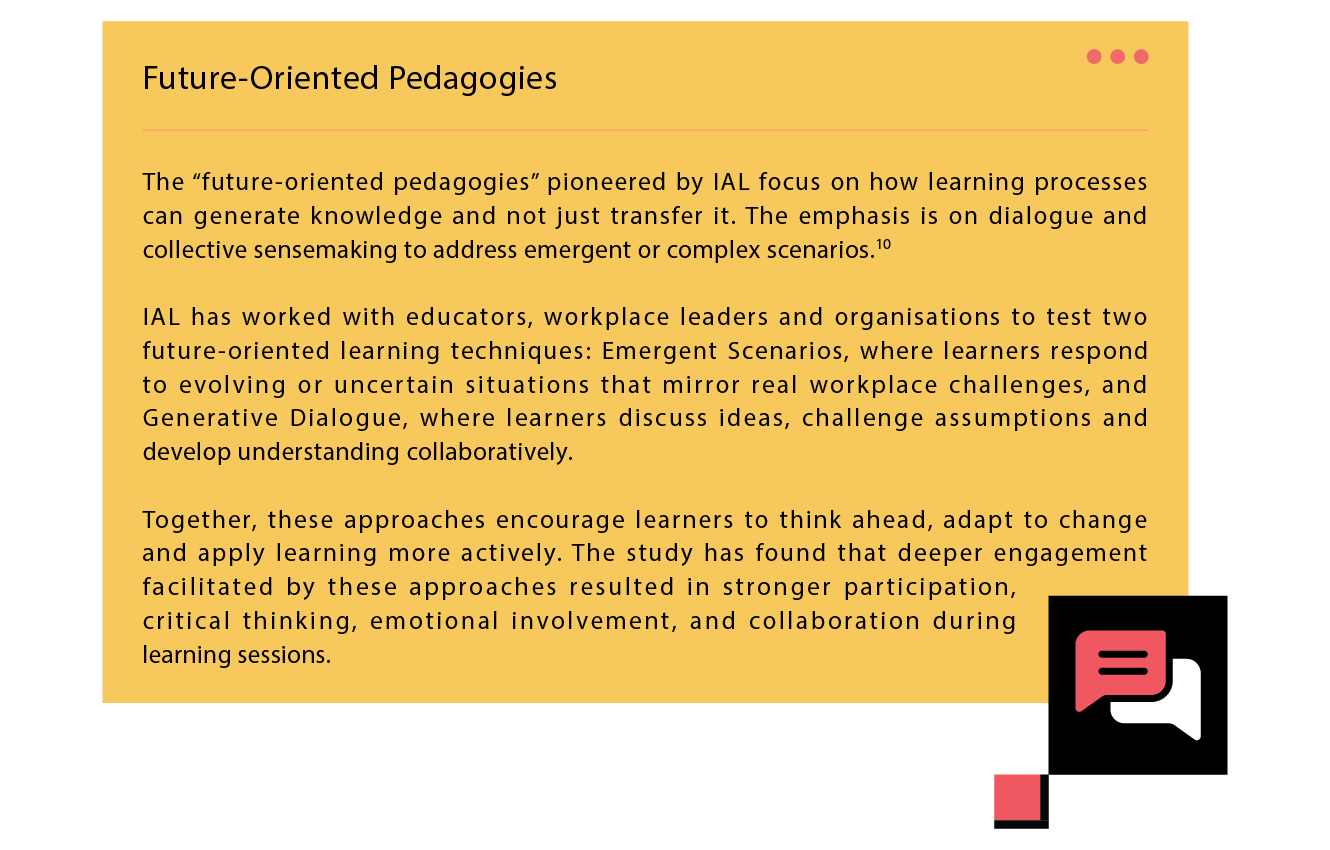
A further benefit of this approach is encouraging ground-up innovation, tapping on the skills and expertise of workers throughout an organisation to drive change. This is particularly important in a fast-changing environment where senior leadership lacks the time and ground knowledge to come up with all the solutions themselves.
Supporting Learning Communities and Ecosystem through Technology and Partnerships
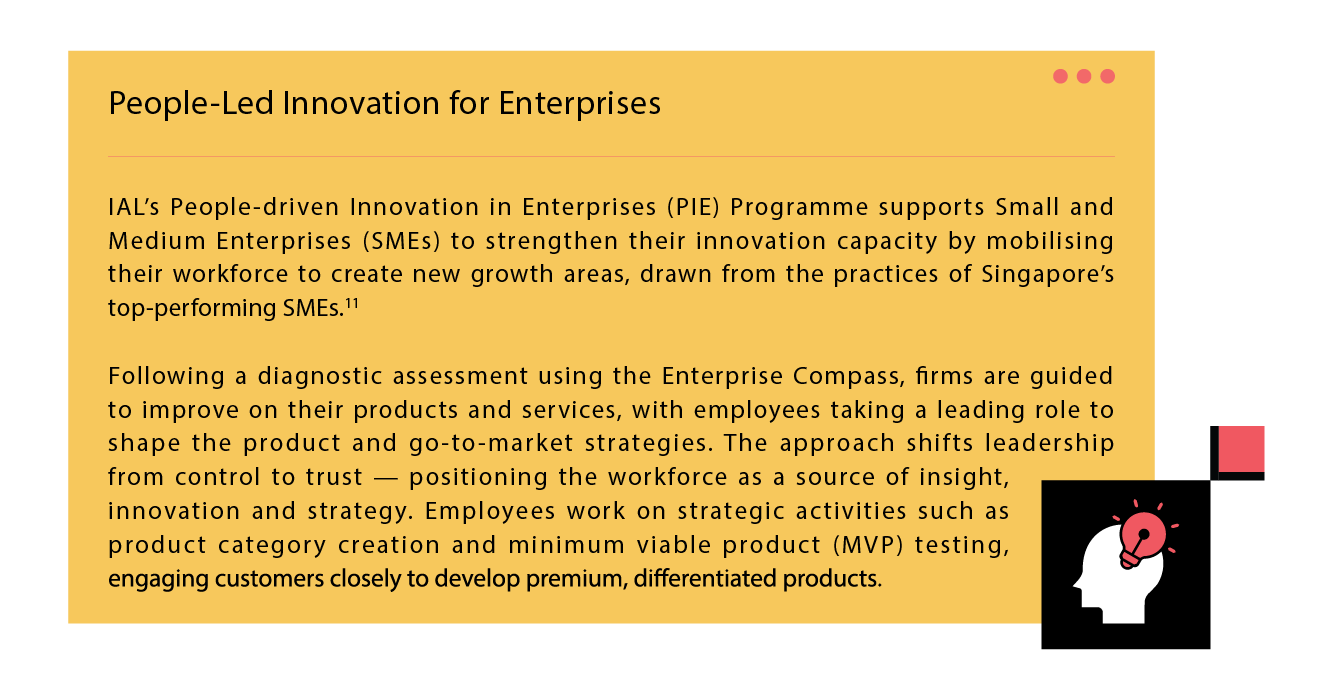
Learning institutions should seek to build enduring learning communities designed for sustained participation, allowing learners to enter, leave and re-engage throughout their careers. They can leverage technology to blend physical and digital communities, enabling collaboration at scale.
Rather than merely providing instruction, the institution then becomes a platform that connects learners, educators, employers and technology. This requires partnering other stakeholders in the ecosystem, including business associations, professional bodies, unions and policymakers. Learning organisations can also serve as conduits to match ed-tech products and platforms with specific learning needs, helping to customise learning solutions to meet organisational priorities.
Conclusion
The changes brought about by technological advances, as well as heightened uncertainty and complexity in the operating context, point to a future where learning institutions will be defined less by what they deliver, and more by how they enable others to learn, adapt and perform.
As factual knowledge becomes cheaper and more abundant, the comparative advantage of adult learning institutions will shift towards cultivating uniquely human capabilities, helping organisations adapt to change, curating trustworthy learning, and building the ecosystems needed for lifelong reskilling.
They will have an expanded role in supporting organisations and individuals not just in formal learning, but also learning in the flow of work, and activating mindset changes and people-driven innovation. This will necessarily entail broader and deeper partnerships with other stakeholders in the learning and development ecosystem.
ABOUT THE AUTHOR
Terence Ho is Executive Director and Associate Professor (Practice) at the Institute for Adult Learning (IAL), Singapore University of Social Sciences. He is also an adjunct faculty member of the Lee Kuan Yew School of Public Policy, National University of Singapore.
In his public sector career from 2002 to 2020, Terence served in research, policy and leadership roles at the Ministry of Trade and Industry, Ministry of Education, South East Community Development Council, Ministry of Finance, and Ministry of Manpower. He was a Board Member of the Workforce Singapore Agency (2017-2020) and the Building and Construction Authority (2016-2021). He is currently a Nominated Member of Parliament and a Board Member of the Civil Service College.
A Straits Times bestselling author, Terence has written four books, three book chapters, and over a hundred opinion-editorials published by major news organisations, since 2021.
NOTES
Lee, S. H. K., Yang, S., Saleh, Y., Chen, L., & Geyn, I. (2026). Navigating AI-Driven Skill Change: A Comparative Analysis of Seven Job Roles in Singapore and United States Labour Markets. Institute for Adult Learning, Singapore University of Social Sciences, and Burning Glass Institute. https://www.ial.edu.sg/resources/publications/skills-first-publications/research-and-analytics/ai-driven-skill-change/ (opens in new tab)
Tomaszewska, R. (2025). Transformation of the labour market in the age of artificial intelligence: AI-driven job matching platforms and new employment models. In 2025 IEEE International Conference on Data Mining Workshops (ICDMW) (pp. 1–6). 10.1109/ICDMW69685.2025.00302 (opens in new tab)
Yang, S., Ong, D.J., Yap, J., & Lau, B. (2025). Building a skills-first organisation through work transformation: Case study of Cragar industries. Institute for Adult Learning, Singapore University of Social Sciences. https://www.ial.edu.sg/getmedia/60bf5cb0-c682-4c06-86dc-8cd334f7abb5/SUSS-IAL-Work-Transformation-Report_Cragar-Industries.pdf (opens in new tab)
OECD. (2026). Developing vocational education and training with artificial intelligence. OECD Reviews of Vocational Education and Training. OECD Publishing. https://doi.org/10.1787/e9f76b4e-en (opens in new tab)
M. McCall, M.M. Lombardo, & R. Eichinger (1988). The Lessons of Experience: How Successful Executives Develop on the Job, Center for Creative Leadership.
Hughes, A. M., Zajac, S., Woods, A. L., & Salas, E. (2020). The role of work environment in training sustainment: A meta-analysis. Human Factors, 62(1), 166–183. https://doi.org/10.1177/0018720819845988 (opens in new tab). Blume, B. D., Ford, J. K., Baldwin, T. T., & Huang, J. L. (2010). Transfer of training: A meta-analytic review. Journal of Management, 36(4), 1065–1105. https://doi.org/10.1177/014920630935288 (opens in new tab)
Sadik, S., Chia, Y., Fu, W. L., & Ho, Y. Q. (2026). Domain+: Mobilising expertise for the AI age. Institute for Adult Learning, Singapore University of Social Sciences.
Sheng, Y. Z., Chia, Y., & Sadik, S. (2025). Skills pathways and deep learning in Singapore’s workforce: Insights from the Skills and Learning Survey 2. Institute for Adult Learning, Singapore University of Social Sciences. https://www.ial.edu.sg/getmedia/5b98d60d-2f92-4603-8633-0b50e9e76907/22-Skills-Pathways-and-Deep-Learning-in-Singapore-Insights-from-SLS(Final).pdf (opens in new tab)
Tan, J., Sadik, S., Sheng, Y. Z., & Chia, Y. (2025). Do skills and training drive business performance among Singapore SMEs? An investigation using the Singapore Business Performance and Skills Survey II. Institute for Adult Learning, Singapore University of Social Sciences. https://www.ial.edu.sg/getmedia/9059e298-26ca-4957-8210-86b3defe525f/9-BPSS2-Final-Report-13112025-JT_2.pdf (opens in new tab)
Lim, W.M., Pang, P. (2026). Future-Oriented Pedagogies: Unpacking the Key Techniques and Making Them Visible. Institute for Adult Learning, Singapore University of Social Sciences. https://www.ial.edu.sg/resources/publications/research-publications/future-oriented-pedagogies-unpacking-the-key-techniques-and-making-them-visible/ (opens in new tab)
Institute for Adult Learning. (2026). From Ideas to Impact: How People-Driven Innovation Sets to Rewire SME Growth. Institute for Adult Learning, Singapore University of Social Sciences. https://www.ial.edu.sg/resources/happenings/from-ideas-to-impact-how-people-driven-innovation-sets-to-rewire-sme-growth/ (opens in new tab)