Teaching Governance: The Long Game
by June Gwee
Last updated on 29 October 2026

From technical knowhow to understanding context, engaging with empathy, collaborative learning, and beyond, the cultivation of Singapore’s public officers has been driven by the need to anticipate and address the nation’s evolving demands.
Governance, in Singapore’s context, is defined as “the manner in which the Government, working together with other stakeholders in society, exercises authority and influence in promoting the collective welfare of society and the long-term interests of the nation”.1
When the Civil Service College (CSC) became a statutory board in 2001, it inherited three decades of governance education that had grown alongside the nation: shaped by Singapore’s unique circumstances and development, and informed by broader shifts in thinking about governance and public policymaking as a field, reflecting the changing demands placed on those who govern.2
At CSC, what is taught, and how it is taught, hinges on core and inseparable questions: what is worth knowing about public governance, how the knowledge is best acquired, and what kind of thinking and judgement we are ultimately trying to cultivate in public officers. While governance education is for all public officers, the focus, and hence instructional strategies, may differ in accordance with the roles and responsibilities officers are expected to carry out.
First Foundations: Knowledge Acquisition and Transfer
In the era of colonial administration, men were prepared to govern more by convention than design. A university education was considered sufficient foundation; practical governance was acquired through experience: by shadowing, observing and working with those already practising it, and absorbing its unwritten conventions. Embedded within this practice is the tension of whether governance is a science transmittable through systematic instruction, or an art cultivable only through apprenticeship and accumulated judgement.
Singapore’s self-government in 1959 changed everything. The fledgling government established the Political Study Centre in the same year as an institutional approach to re-orientate public officers away from governing by fiat on behalf of the Crown towards serving Singaporeans and building a nation. To bolster technical training, the Staff Training Institute was set up in 1971.
With economic development a priority at the time, planning and project analysis capabilities were needed in public policymaking. To address this, public officers’ practitioner insights were combined with the specialist knowledge of academics and professional experts, through collaborative initiatives in governance education. In an early partnership, the Asian Institute of Economic Development and Planning conducted a “Techniques of Project Development and Analysis” programme jointly with the Staff Training Institute. Experts from universities and professional bodies gave lectures for more advanced courses.
Governance education in this early phase was based on a knowledge acquisition model, driven by the urgency of building up a common foundation of skills and knowhow across the civil service. Governance knowledge was treated as a fixed body of content that could be neatly structured, broken down into discrete units, systematically delivered and stored. The role of the instructor was to transfer expertise into the minds of the learners who would absorb, retain and apply it. Learning was an individual, pragmatic and cognitive endeavour.
Understanding Context; Learning Socially
By 1993, after more than two decades of nation-building, the urgency of survival had given way to deliberation: there was now room for deeper analysis, broader consultation, and more open debate. Policymaking was also maturing. While the governance and policy experiences of other countries offered valuable lessons, such solutions could not be transplanted wholesale to Singapore, given the different social, political and economic realities.
This meant that teaching public officers technical skills on project analysis and management was not enough. They needed a keener appreciation of the context in which policies were made, including an understanding of Singapore’s operating environment, and what would be workable and acceptable to citizens. There were new expectations for public officers to continually refine and improve the policies under their charge.
While the central premise of building a strong and capable Public Service had not changed, this new thinking shifted governance pedagogy. Governance could not simply be taught, it had to be learnt, actively and experientially. The new goals were:3
To develop among public officers a deep understanding of the key factors which are the cornerstones of Singapore’s continued survival and success. These fundamentals must be debated and internalised, and from time to time changed to fit changing circumstances, so that public officers share the same goals and values.
To build a value system, a sense of esprit de corps, camaraderie, and a sense of tradition among senior public sector leaders. They must have a shared spirit of service to the nation, competence, dedication and integrity, and the public must continue to expect this of them.
To bring officers up to date with the latest ideas, thinking and trends in a world of rapid change.
To work together with the private sector to make Singapore a success, especially since private and public sectors are now to join hands to build the external wing of the economy.
Governance and policy knowledge was not only transmitted from instructor to learner but also constructed through conversations and context. This shifted learning from knowledge acquisition to learning through interaction and dialogue. Knowledge was not regarded as stored in individual minds so much as built and re-built through human interaction as officers participated in discussions to solve messy, real-world, context-specific problems alongside others.
An important instructional method introduced at this time was the case method, a learning approach made popular by Harvard University to teach decision-making in business and government. Unlike a lecture, a well-crafted teaching case raises real questions with no final answer. The narrative of the teaching case offers a schema for critical thinking, interpretation and judgement. Real-life dilemmas with compelling trade-offs ground policy discussions in concrete, lived situations relevant to policy practice. Case studies and the case method frame governance as an art as much as a science. Policymaking is a continual, iterative process that goes back-and-forth, sometimes ending in failure, simply because no policy decision is valid for all time. Every decision is made within a specific context and circumstance.
The adoption of the case study and case method marked a turning point in governance education: a deliberate epistemological shift from knowledge acquisition to knowledge construction. The case method encouraged re-examining and revaluating existing policies in response to new circumstances, and anchored policymaking practices in Singapore’s context.
Pursuing Principles and Possibilities
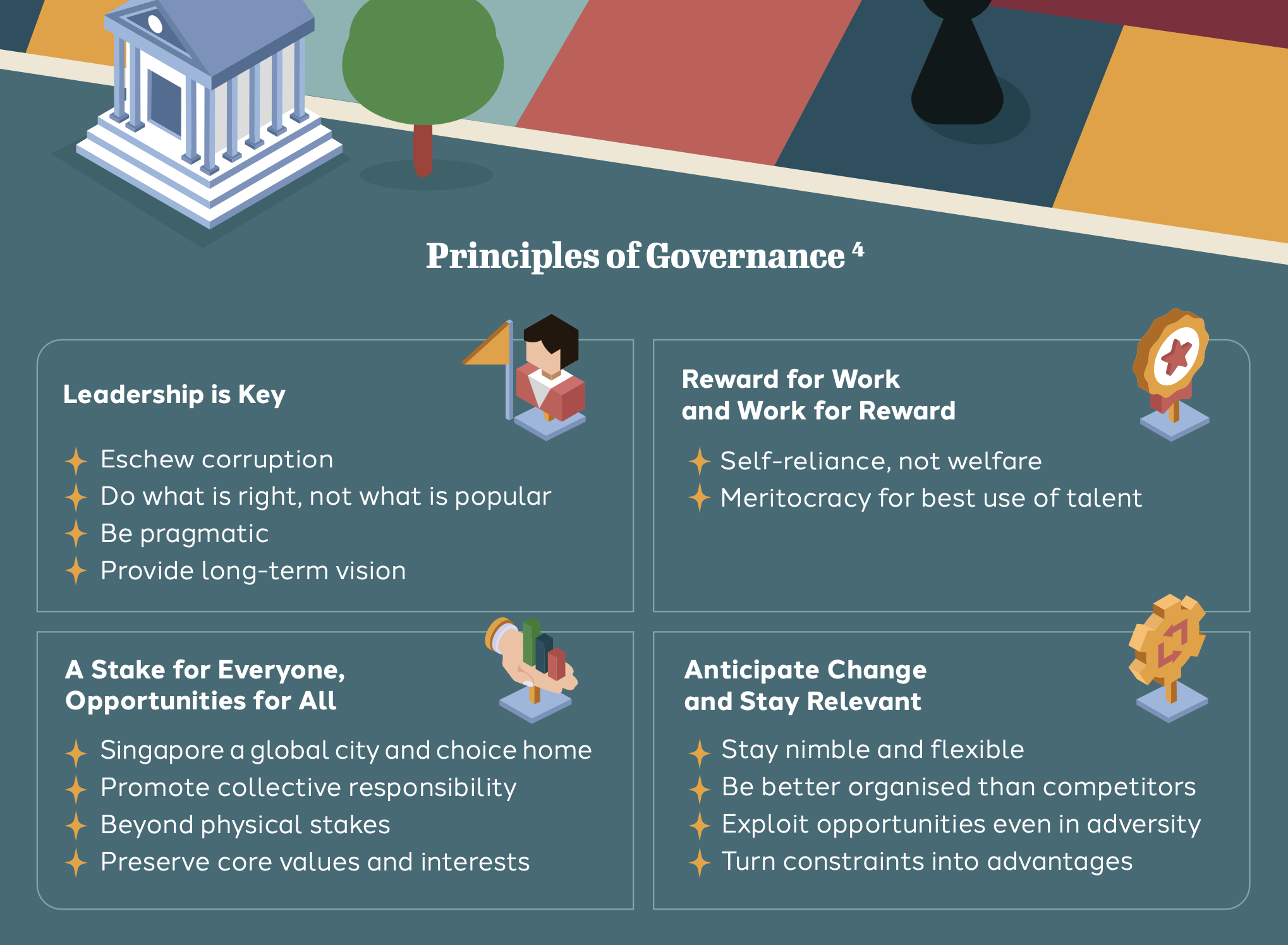
By 2001, when CSC was established as a statutory board, Singapore’s approach to public governance, including the principles of governance and public service ethos, had become even more defined. Teaching governance became about conveying values and beliefs on what makes Singapore tick, and what its national concerns and long-term interests are. The articulation of Singapore’s principles of governance in 2004 would shape how CSC thought about governance education, including the role of institutions and policy innovations, for years to come.
Economic thinking was introduced into the governance and policy curriculum, with a focus on its application in public policy. Evidence-based analysis, industry and stakeholder engagement, as well as structured policy design frameworks, became core elements of how officers were taught to approach policy problems. Behavioural sciences, then still an emerging field, was also incorporated as a new lens for policymaking.
Underpinning this expansion of governance curricula were two complementary thematic pillars. The first was sense-making: building a rigorous knowledge base around the rationales behind past and present policy decisions, the principles of good governance, and Singapore’s governing context. The second was generative: using this foundation not merely to inform, but to challenge assumptions and provoke new thinking. The goal was not simply to explain how Singapore governed, but to equip officers with the intellectual tools to ask harder questions and imagine better answers. Together, these pillars reflected a maturing philosophy: that governance education is not just about transmitting what is known, but about expanding what is possible.
The Making of a Public Officer
In its first decade, CSC’s curricula developed a distinct set of instructional elements, each with its specific purpose, that continues to define governance education today:
Team bonding activities cultivate shared public service ethos and esprit de corps. Held within the first few days of a programme, they let learners bond and develop mutual trust: pre-conditions for intellectual risk-taking. For real learning to take place, governance conversations and discussions during the learning process are candid, honest and sometimes uncomfortable.
Seminars let external experts, such as those in academia, share their disciplinary knowledge, theoretical frameworks, empirical research, and new trends in governance and policy thinking. Practice without theory risks mistaking familiarity for wisdom and continuity for correctness. Seminars introduce emerging and cutting-edge knowledge, expand learners’ conceptual thinking, and offer alternative mental models with which to interpret the complexity of governance and policy work.
Study trips immerse learners in different governance environments and make governance concepts tangible. Through carefully designed encounters, learners see another country’s governance environment and policies up close and network with their policymakers. This provokes thinking on governance and what is particular to Singapore’s context.
Case studies and the case method remain central as a teaching tool as well as a means for collaborative learning and participative knowledge construction. The insights that emerge — co-built, captured, tested against reality, refined, and shared — contribute to a growing body of collective knowledge about how Singapore governs which may then be taught to new generations of public officers. Crafted and delivered well, the case method can convey the ambiguity and complexity of a policy situation.
Fireside chats are intimate conversational sessions with senior public sector leaders who have shaped Singapore’s policies and institutions. They represent cognitive apprenticeship with a master practitioner in its most direct form. Unlike formal lectures and seminars, fireside chats are unscripted, creating space for officers to ask leaders about dilemmas they have navigated, judgements exercised under pressure, and mistakes made. Hearing a senior leader speak candidly about a policy crisis or decision gone awry makes governance feel lived, consequential, and achievable in a way no textbook or case study can. Such encounters spark genuine interest in policy work, strengthen officers’ sense of vocation and professional identity, and build confidence that they too can grow into the challenges ahead. The learning impact is as much motivational as it is cognitive — shaping not just what officers know, but who they are becoming.
Winning Hearts and Minds
The second decade of governance education in CSC (2011 to 2021) demanded a rethink of both what governance means and how it should be taught. Singapore’s watershed 2011 General Elections signalled a shift in the relationship between government and citizens. Latent tensions in the nation’s governance model were sharpening, with robust economic growth accompanied by deepening inequality and widening social divisions. The gap was not just between policy intent and outcome: there was a divide between what government was achieving and what citizens were feeling. It was no longer enough to teach public officers to engage citizens more effectively; they had to be able to listen, to engage with empathy, and to co-create with other societal stakeholders.
Governance curriculum responded accordingly. Programmes incorporated public engagement approaches, as well as citizen-centric policymaking practices that bring government closer to the communities. Co-creation initiatives and best practices were used to facilitate discussions at leadership and policymaking programmes. To provide a more complete and integrated understanding of the machinery of governance, a number of additional elements were also added to governance education at CSC, including: complexity theory, a deeper grounding into the structure of government, the policy development and evaluation cycle, and sector-specific policymaking concepts.
If governance was to become more citizen-centric, the approach to teaching governance also had to be more humanistic to cultivate empathy, sensibility and relational capacity. By this point, the arc of governance education had moved through two distinct phases of learning. The case method had cultivated analytical judgement — teaching officers to think rigorously about complex problems, to sit with ambiguity, and to reason through competing values and trade-offs. Fireside chats had added a motivational and identity-forming dimension — sparking genuine interest in governance work, building confidence, and inducting officers into a professional community through direct encounter with those who had lived the hardest decisions. However, neither could fully replicate the conditions of real decision-making under pressure — the incomplete information arriving in real time, the weight of consequences, the stress of the clock, and the emotional and physiological dimensions of governance.
Games and simulations filled that gap — and in doing so, added affective and physiological dimensions to the learning cycle. Unlike with the case method, games and simulations place learners “inside” a hypothetical, fixed scenario. Decisions have a consequence in the game world. Learners encounter the scenario only when they enter class and do not have time to prepare: this forces them to act under pressure, with incomplete information, just like in the real world.
Cities of Albion
Cities of Albion is a policy simulation game commissioned by the National Population and Talent Division and built by Nanyang Polytechnic with inputs from CSC's Applied Simulation Training Unit.
.png)
Played over 90 minutes in teams of six, it immerses participants in whole-of-government decision-making — having them manage trade-offs across ministries to achieve shared national outcomes under real-world constraints.
The game is designed to surface the full texture of policymaking: resource constraints, competing needs, time lags, population dynamics, and public pressure, followed by structured reflection linking gameplay to actual policy work and public service challenges.
Games like The Troubleshooters, the Persona Card Activity, How Does Singapore Make a Living, Too Many Cooks, and Mars High School place learners inside the dynamics of real governance challenges, making abstract concepts tangible and immediate. Through games, cognitive work spreads across people, tools (technology), roles and an environment — what cognitive scientist Hutchins (1995) describes as distributed cognition5, where learning emerges from how a system performs.
The Long Game Continues
CSC's approach to governance education is distinctive not because of any one method. By combining the analytical rigour of the case method, the lived wisdom of fireside chats, and the visceral, embodied learning of games and simulations, governance education completes the arc of preparing officers for governance not as a technical exercise but a human one — developing the wisdom to think clearly, the purpose to serve meaningfully, and the grit to act decisively under pressure. These methods are combined and sequenced to address the gaps in each approach. At every inflection point in CSC’s history, there has been a conscious decision to lean into new methods and adapt to new demands, without discarding what came before. The instinct is to hold the tension, draw on the complementary strengths of multiple disciplines and push the boundaries of emerging andragogyvi to deepen the impact of governance education. This is, and has always been, the long game: building not just capable officers, but an institution that grows wiser with each generation it teaches.
Underlying CSC’s approach is an enduring conviction: that governance is neither pure science nor pure art, and neither is the education that prepares officers for it. The science lies in the rigour — analytical frameworks, competency models, evidence-based policy design, and structured reflection. The art lies in the judgement — knowing when the framework does not fit, exercising situational judgement, when to hold firm and when to adapt. Taken together, they constitute CSC’s philosophy for teaching governance: not as a body of knowledge to be transmitted, but as a practice to be embodied.
This philosophy becomes indispensable when AI and uncertainty are changing the context of governance. The challenge now is not whether machines can think, but whether human institutions can continue to exercise wisdom, responsibility, and collective judgement in an environment shaped by machine-generated knowledge.
What will have to keep transforming is CSC — staying agile in pedagogy, embracing digital enablement, and activating learning in communities and at the workplace, so that governance education remains relevant beyond the classroom, in moments of rapid change, new transitions, failure, and unexpected developments — the moments that matter most.
ABOUT THE AUTHOR
June Gwee is Senior Principal Researcher at the Institute of Governance and Policy at the Civil Service College. Her research interests are in strategy and innovation, design management, and narrative development. Some of her publications include Policymaking Competencies in Continuing Education: Integrating Practice and Experience (2024), The Case Writer’s Toolkit (2018), Case Studies in Public Governance: Building Institutions (2012), and Art and Design for Strategic Management: Culture as Strategy (2008).
NOTES
“Context: Preserving our Fundamentals” in ETHOS, Vol 10, Issue 3, Nov, 2004, Civil Service College, Singapore, pp. 2-5.
The scholarly study of governance and public policy making can be traced to the 1854 Northcote-Trevelyn Report on the Organisation of the Permanent Civil Service and later Woodrow Wilson’s 1887 essay “The Study of Administration” in Political Science Quarterly,2(2), 197-222.
“Top govt officers must take courses before promotion”, The Straits Times, 30 April 1993, Page 1.
“Context: Preserving our Fundamentals” in ETHOS, Vol 10, Issue 3, Nov, 2004, Civil Service College, Singapore, pp. 2-5.
Hutchins, Edwin. Cognition in the Wild. Cambridge, MA: MIT Press, 1995.
Andragogy refers to the theory and practice of adult learning which emphasises self-direction, experiential learning, and relevance to real-world application.