Career Fitness: Developing Resilient and Agile Public Officers
by Lim Dun Lin
Last updated on 29 October 2026

The landscape of careers is changing. Longer lifespans mean longer careers. Job demands are changing with technological advancements accelerating, greater citizen expectations and a world order subject to unpredictable geo-economic dynamics.
In this environment, career development planning can no longer assume a singular, predictable linear path. With the skills and competencies required to excel in our existing roles constantly evolving, we should commit to continually upskilling and reskilling ourselves to stay relevant.
The challenge is how to equip people to stay “fit for their careers”, whatever circumstances they face. This calls for a more deliberate, continual, and shared effort between officers, supervisors, and organisations. Like physical health, “career fitness” demands regular attention, continual investment, and a proactive approach to staying strong and adaptable over time.
To address this challenge, the Singapore Public Service launched a Career Fitness Movement (CFM) in July 2025. Spearheaded by the Public Service Division (PSD), the movement helps public agencies and their officers unlock the opportunities of career longevity and meet evolving skill needs. It offers public officers a wide range of opportunities to move across functions and agencies, picking up new skillsets to adapt to different contexts. Through the CFM, the Public Service promotes proactive career ownership among public officers. The CFM also creates conditions for continual learning, career mobility and renewal – strengthening both individual career resilience as well as the agility of the public service workforce as a whole.
Anchored in the Public Service’s move towards Competency-Driven Growth,1 the CFM brings together a broader ecosystem of workforce development initiatives under a single, unifying movement. These initiatives include:
Expanding development opportunities for officers, such as gigs, Short-Term Immersion Programmes (STIPs), Talent Attachment Programmes (TAPs), and learning programmes through CSC to help officers deepen and diversify their skills.
An opportunities marketplace via the One Talent Gateway (OTG) (opens in new tab)2 platform, where officers can easily access cross-agency growth and development opportunities, and plan their career development journey.
Personalised career guidance and support via supervisors and the Public Service Career Coach Network (PSCCN), to support officers in their Career Fitness journey.
Within the CFM ecosystem, the Civil Service College partners PSD to develop frameworks, tools, and learning interventions that equip officers, supervisors, and organisations to build career fitness.
To design the right approach, CSC first examined what career fitness requires in practice. CSC’s research found that while several conditions matter, the most significant factor underlining career fitness is how responsibility for career development is understood and shared.
“Career fitness does not depend on any single individual. It is a shared responsibility between officers, supervisors, and organisations.”
Career Development Is a Shared Responsibility
Career fitness does not depend on any single individual. It is a shared responsibility between officers, supervisors, and organisations. Each of these three actors has a distinct and important role to play.
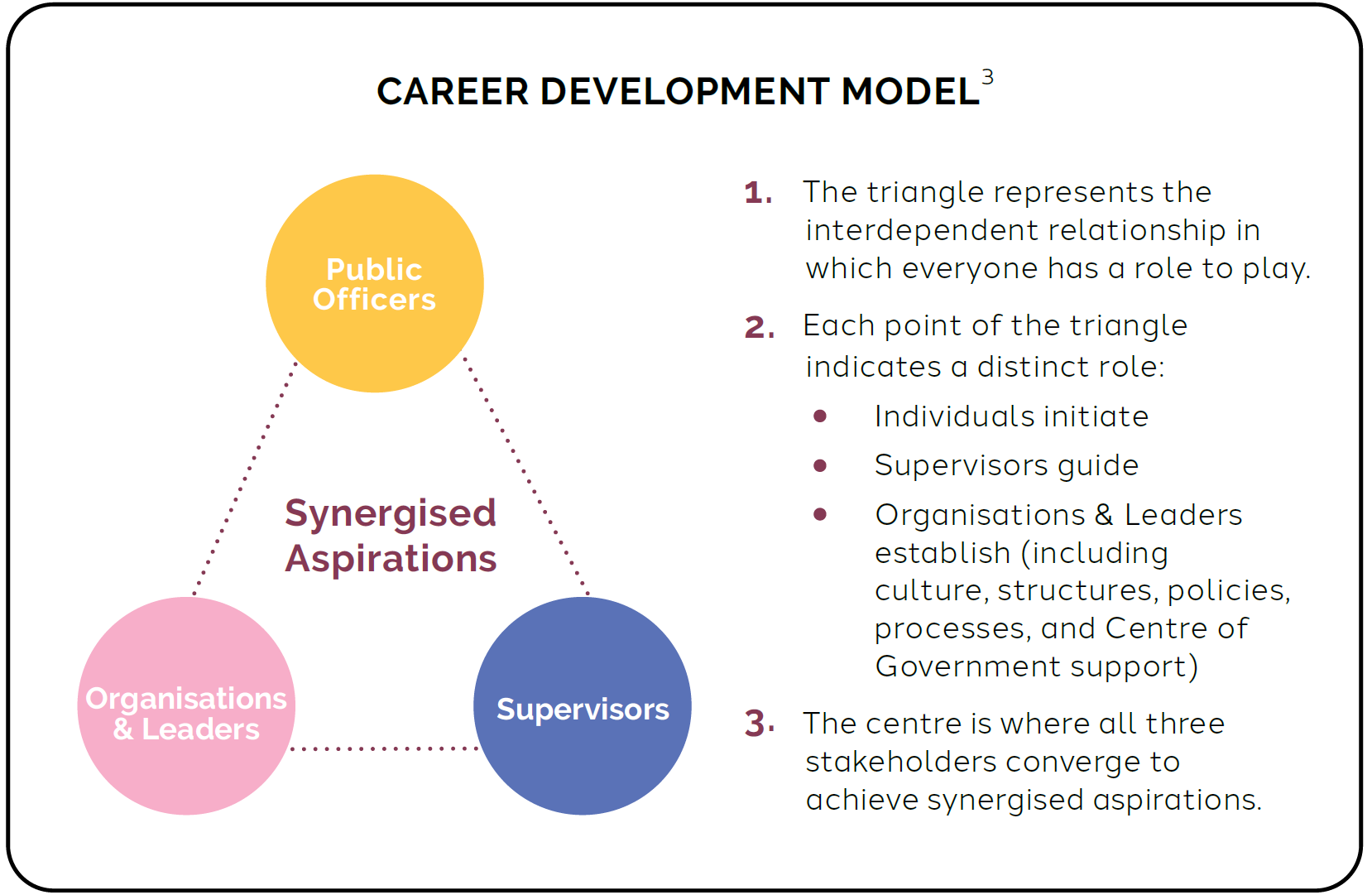
Figure 1: This triangle model of shared responsibility highlights that sustainable career fitness emerges when officers initiate, supervisors guide, and leaders enable, all working toward aspirations aligned with the needs of the public service.
“While performance conversations focus on delivering results today, career conversations focus on preparing officers for tomorrow.”
Individual officers must take ownership of their career development. This means proactively reflecting on their career goals and development needs at different seasons of life and taking action to develop their careers. This may include identifying learning opportunities to build new skills or deepen existing expertise. For example, officers may attend courses to strengthen competencies for future roles, volunteer for stretch assignments to gain new experiences, or take on job rotations to broaden their perspectives and prepare for new career opportunities.
Supervisors must guide and support their officers’ growth as part of leadership investment in a sustainable workforce development. Beyond managing performance, supervisors play an important role in guiding, encouraging, and opening up conversations about growth, movement, and possibility. While performance conversations focus on delivering results today, career conversations focus on preparing officers for tomorrow. For example, beyond discussing an officer's performance in their current role, supervisors should also explore their aspirations, potential career pathways, and development opportunities. This requires dedicated time and attention through regular career conversations.
Organisations must create conditions and opportunities for officers to grow and develop. This includes creating pathways, shaping supportive processes, building a culture that values development, and ensuring that leaders model the importance of career growth. Practically, this would mean among other things: fostering a growth mindset, enabling flexible work arrangements across different life stages, creating psychologically safe environments for career conversations, and encouraging lateral and cross-agency mobility. Together, these help officers grow, explore new opportunities, and build diverse career experiences.
From Framework to Action
Understanding who is responsible for the different aspects of career fitness is only the first step. CSC’s research reveals six Career Development Principles that spell out what shared responsibility looks like in practice. It has also identified a set of Knowledge, Skills, and Attitudes (KSAs), across individual officers, supervisors, and organisations. Underpinning the principles of career fitness, these KSAs guide the design of a principle-aligned curriculum and learning roadmap, grounding CSC programmes and resources to foster career fitness deliberately.
Six Principles for Career Fitness
Steer Your Career Path
Officers should exercise agency over their career journey and actively shape its direction. This includes reflecting regularly on career goals, reassessing them as circumstances change, and developing the self-awareness needed to make informed career decisions.
Embrace Continuous Growth
Officers should cultivate learning agility and engage in lifelong learning to respond to the evolving needs of public service. They actively seek and create opportunities to deepen their skills, expand their knowledge, and remain open to new ways of contributing.
Adapt Career Priorities to Seasons of Life
Officers should view career development as an integral part of overall personal and professional wellbeing. They pursue both career development and personal fulfilment by adapting their career priorities to suit the different seasons of life, while continuing to grow over the long term.
Enable Career Pathways and Mobility
Supervisors should provide clearer communication about expectations, opportunities, and possible career pathways, within and beyond agencies. They support informed decision-making by pointing officers to relevant resources and engaging in regular career conversations with genuine interest and empathy.
Establish Alternate Career Pathways
Organisations and leaders should foster a growth mindset that recognises multiple ways to grow and contribute. We should recognise that employees’ capacity can vary temporarily but grow over time. This includes supporting diverse work arrangements across life stages, creating psychologically safe spaces for career conversations, and encouraging lateral and cross-agency movement.
Synergised Aspirations
Career development should create win-win outcomes for both the individual and the Public Service. Officers' aspirations and organisational needs are not competing interests, but complementary forces that can be strategically aligned. When there is strong alignment between officers' aspirations and organisational needs, the result is both meaningful careers and exceptional public outcomes.
The career fitness principles represent a tangible shift away from traditional notions in career development. For example, the third principle recognises that career priorities shift meaningfully across the seasons of life. CSC's programmes4 for individual officers are hence designed around four life stages:
Exploration and skill-building;
Deepening expertise and professional identity;
Recalibrating priorities;
Sustaining meaningful career engagement.
This contrasts with traditional career development philosophy, which considers only the professional sphere, almost as if work were a person’s only consideration. Career trajectories are influenced by both professional aspirations and the realities of an individual's life circumstances. While some may seek accelerated growth and advancement, factors such as health, caregiving obligations, and personal commitments can shape the opportunities and choices available to them. Career development decisions therefore emerge from the intersection of professional ambition and personal circumstances.
Extending beyond individual support, supervisors are central to the Career Fitness ecosystem. The fourth principle recognises that meaningful career growth relies on regular, empathetic conversations, with supervisors playing a pivotal role. CSC offers dedicated programmes5 to equip supervisors with the skills and confidence to engage meaningfully with their officers on career development.
Similarly, leaders and human resource leaders play a crucial role in enabling Career Fitness across their organisations. The Career Fitness Playbook,6 developed by CSC, offers practical guidance, tools, and frameworks to translate the principles of Career Fitness into everyday practice in the organisation. It supports leaders and HR practitioners in fostering more effective career conversations, identifying development opportunities, and designing systems and initiatives that make career growth more visible, supported, and actionable.
Building a More Resilient Public Service
Like physical fitness, career fitness is something we must continually maintain, build on, and return to across the course of our career. What the CFM offers is not just a set of programmes or tools, but a shared understanding of what it takes for officers, supervisors, and organisations to grow together.
By fostering a shared commitment to career development, the CFM creates an ecosystem in which officers are empowered to learn, supervisors actively support growth, and organisations provide opportunities for mobility and development. Such alignment enables our precious human capability to be continually renewed and redeployed, strengthening the Public Service's capacity to adapt, evolve, and meet future challenges with confidence.
ABOUT THE AUTHOR
Lim Dun Lin is a Senior Learning & Development Specialist in the Innovation and Foundational Competencies (IFC) Team at the Institute of Public Administration and Management, Civil Service College. IFC’s work focuses on developing research, curriculum, and learning interventions that support the Public Service Career Fitness Movement. The team welcomes opportunities to exchange ideas and discuss approaches to advancing career fitness across organisations.
This article was written with input from the Workforce Development Department, Public Service Division.
NOTES
Competency-Driven Growth gives the Public Service a common language that brings greater clarity for officers to grow the competencies they need to perform at their jobs and build their careers, while strengthening recruitment and deployment across government — including internal rotations and secondments — so agencies stay agile and resilient amid the shifts ahead.
The One Talent Gateway (OTG) (opens in new tab) can be accessed via https://www.go.gov.sg/otg (opens in new tab).
CSC’s Career Development Principles were developed through foundation research and stakeholder validation, including a survey of more than 1,100 Whole-of-Government officers, focus group discussions, and interviews.
An example of a programme available is Career Fitness for Mid-career Officers. It is available to public officers at: https://www.learn.gov.sg/Learning/BrowseDetails?ProgCode=CR-P21CFR (opens in new tab)
Public officers can access programmes like Navigating Career Fitness for Your Staff via https://www.learn.gov.sg/Learning/BrowseDetails?ProgCode=CR-V21NCS (opens in new tab) and Wayfinding Career Fitness for Your Team via https://www.learn.gov.sg/Learning/BrowseDetails?ProgCode=CR-V21WCT (opens in new tab)
The Career Fitness Playbook is currently in development and will be launched in FY2027.