CSC's Digital Capabilities: From Quiet Bets to Big Moves
by Lam Kai Wah and Tan Zheng Yi
Last updated on 29 October 2026

The College has taken a 'try first' approach to developing digital skills —identifying evergreen capability areas, and experimenting early with learning interventions that may grow to become key moves in shaping the Public Service’s growing digital understanding.
As technology has come to shape the way we live and work, it has also come to inform citizens’ ever higher expectations of public service. To stay ahead of the curve, the Singapore Public Service has emphasised the development of digital capabilities. Indeed, for almost a decade, courses related to digital capabilities have been the most frequently attended programmes at the Civil Service College (CSC).
In the past decade, CSC’s approach to building digital capability in the Public Service has been characterised by a series of quiet bets that have later scaled up into significant system-wide shifts as technologies and their applications evolved. By initiating smaller experiments in offering pragmatic digital skills sought after by public agencies, CSC has been able to learn by doing; it has also sought to intentionally identify capability areas that would remain useful beyond any one technology cycle. Some of these early bids would later serve as the foundation for whole-of-government moves, such as mandatory digital literacy and AI capabilities.
Early Bets
In 2013, with the dawn of the age of big data driven by technology development and data democratisation,1 CSC sensed a strong need to build data analytics capabilities. As agencies were collecting more data to improve citizen services, they needed officers trained to make sense of that data and act on it. To address this, CSC introduced a Data Analytics (DA) suite to support managers and supervisors with this increased data use. These were early developments, made without the benefit of a clearly defined policy, but grounded in real and emerging needs.
When it was clear that demand for these skills was here to stay, a Digital Capabilities Team (DCT) was formally established within the Institute of Public Administration and Management (IPAM) in 2016. The team would determine what to skill officers on and what content to prioritise, ensuring that skills are built beyond the hype of one technology cycle.
By 2017, the Public Service’s demand for digital capability was growing quickly. At that point of time, many more public service agencies were digitalising their services and work processes. Public officers had to have the basic skills to operate these new digital systems confidently: to use digital platforms, handle online transactions, understand data, protect info, and work with tech teams to improve work processes.
With growing demand, CSC’s challenge turned from figuring out what to teach to how to scale the learning. The College had developed a curriculum framework, based on ground-up research, to build capabilities across three segments of the public service: Digital Leadership and Strategy, digital capabilities for non-ICT officers involved in digital projects or workstreams, and foundational digital skills for officers who simply needed to work effectively in a digital environment.
With this framework in place, CSC then sought partners who could help ground and realise the skilling: these ranged from Ministries and fellow public agencies committed to digitalisation, to subject-matter-experts from the private sector. Although CSC understood the perspectives of non-technical public officers, particularly from a learning and development viewpoint, we were not ourselves technical experts. Instead, our contribution was our tradecraft: how to take complex ideas and make learning them easy.
Laying Foundations for Service-wide Change
Our work developed at the right time. As part of the service-wide Public Sector Transformation (PST) movement, public agencies were required to develop and submit their digitalisation plans. The Smart Nation Digital Government Office (SNDGO) launched a Digital Maturity Index (DMI) that specified the traits of a good digital organisation and measured how agencies were faring against them. At the same time, the Digital Government Blueprint 1.0 was launched, establishing the ambition of the Singapore government to be “digital to the core” and described the end goals for a digitally transformed public service. While many agencies were starting with basic skilling, more progressive agencies already had their own digitalisation plans. The Blueprint gave these plans coherence both within agencies and across the Public Service — guiding agencies in building the skills, processes and systems needed to meet these goals in practice.
Working with partners such as GovTech and the Public Service Division (PSD), CSC developed a Data Analytics Framework, and subsequently a Basic Digital Literacy (BDL) Framework, to help all public officers meet a baseline of digital capabilities needed to deliver more productively. E-learning and quiz requirements were mandated by a government-wide SNDGO circular — as a concrete step in realising the Public Service’s digital aspirations for the general body of public officers.
CSC also worked with GovTech on the Job Relevant Digital Skills (JRDS) framework to help non-ICT officers innovate using technology in their day-to-day work. This focus gave rise to interventions across four areas: Digital Governance and Security, User Experience Design, Agile Project Management, and Data Analytics — the last of which had been underway since 2017. The Skills for Digital Transformation (SDT) framework was also developed to empower directors and managers in leading digital transformation efforts within their agencies. To offer public service leaders a broader global view, CSC also collaborated with institutions such as Accenture, NUS, INSEAD, and Harvard Kennedy School to bring in fresh perspectives on leading digital innovation, managing transformation, policy-operations-technology integration and understanding disruptive technologies.
Experimenting with Technology for Learning
In 2018, CSC launched its e-learning platform, LEARN, as a one-stop learning portal for all public officers, giving digital skilling much greater reach and accessibility. LEARN housed the modules developed across the BDL, JRDS, and SDT frameworks in a single online hub. LEARN also features curated learning interventions from third party vendors such as Harvard Business Publishing, LinkedIn Learning and Udemy, greatly broadening the scope of available learning content.
With LEARN, officers could now access the right learning interventions anytime, anywhere, and progress could be monitored, at scale. All this made it possible to roll out digital skilling more consistently across the public service.
CSC also experimented with learning for technology topics that had yet to become official priorities. Some of these were novel technologies at that time – such as robotic process automation (RPA) and machine learning. While these were familiar to the tech community, they were largely unfamiliar to non-tech public officers.
Topics like machine learning later became significant; others like RPA were helpful for a period of time; some, like blockchain, did not bear out their potential. CSC’s focus was to increase officers’ awareness of these technologies and skill them up to use them in delivering better outcomes, without overwhelming them with deep technical knowledge. By listening to our client agencies, we could better understand their operational realities, even as engagements with GovTech and private sector companies gave us a peek into technologies that had future potential to make a difference to the work of public service.
CSC has also been a partner, with PSD and SNDGO, in setting policy directions for digital capabilities, including determining which were ready to scale. This triangulation of realities-technology-policies has worked well, because we are involved in both upstream policy development and downstream implementation, giving us a broad view of policy priorities, agency realities, technology possibilities, and officers’ learning needs. CSC has therefore been in a position to design learning interventions that are not only aligned with policy goals, but also pragmatic and useful for implementation on the ground.
At the same time, CSC has kept a light but present touch on digital or technology-related areas that show potential but have yet to become national priorities. For instance, we might hold introductory awareness webinars, or collaborate with public and private sectors just to stay abreast of developments without applying the full weight of government policy. The principle has been to keep options open, until directions are clear.
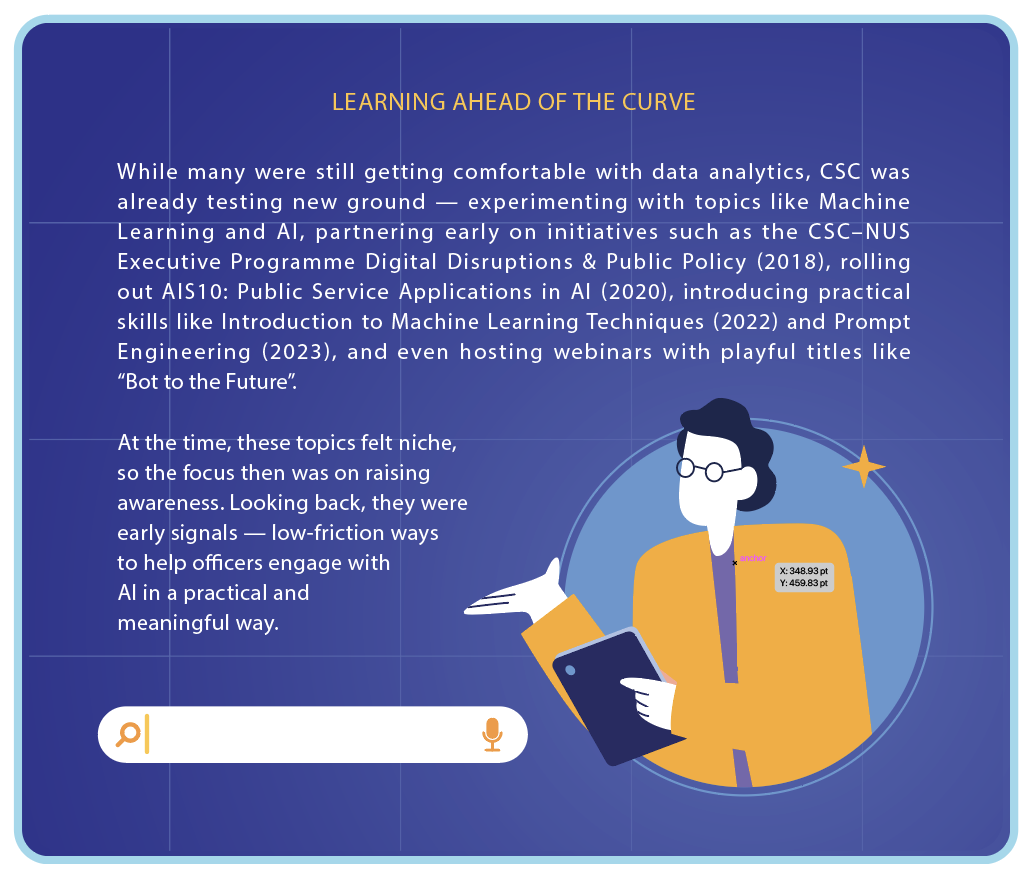
Indeed, CSC began exploring AI-related skilling even before AI literacy became mandatory in 2025. When ChatGPT, powered by large language models (LLMs), was released and took the world by storm in late 2022, CSC immediately started experimenting with the new skill of “Prompt Engineering” with forward-looking officers — with early large-scale webinars to share prompting tips, and then pilot classes. These experiments took off and demand grew rapidly.
By 2024, with 99% of officers having met the BDL digital competency requirements, the Public Service was ready for the next phase. In late 2023, the newly formed Ministry of Digital Development and Information (MDDI) was tasked with pushing digital skills development nationally and across the public service. It looked to CSC as its partner for the Public Service, since CSC had been consistently deepening its work in this space even as other public agencies were evolving their approaches to technology.
Staying Ahead of the Curve
In 2025, CSC collaborated with MDDI in PST Agile Squads2 to ensure the public service was positioned to tap on the potential gains of AI. This led to the formation of the Institute of Digital Government (IDG), a department within MDDI, with CSC as a formal partner.
IDG represents a structural move to close the gap between upstream policy and downstream implementation. It is a training academy set up to equip public officers with digital, data and AI skills to support citizen-centric government services. With policy and learning now coordinated, there is now a much better chance for policy intent to become real capabilities for officers. Regular discussions, chaired by senior sponsors, bring together upstream policy teams and downstream implementation teams to clarify what is being planned, what needs to happen on the ground, and where learning can support execution. These discussions are not just exploratory — they help align priorities and confirm deliverables that teams commit to. With this shared understanding and accountability, implementation can be better coordinated and more likely to deliver on the policy’s intent.
CSC’s digital capability-building initiatives did not happen overnight, nor did we simply wait for policy direction before acting. Instead, CSC has made educated guesses and experimental moves even as the pace and trajectory of technological change seemed uncertain. Through each wave of change, we have stayed curious, kept close to the ground, and made deliberate bets on what the public service would need next — focusing on ‘no regrets’ moves that are likely to be valuable regardless of how the technology evolves. This way of working has secured CSC’s relevance as a key contributor in equipping public officers with emerging skills to excel. Our partnership with MDDI through newborn IDG is not an overnight move, but a natural culmination of our consistent investment and involvement in helping public officers engage with the emerging technological capabilities they will need to do their work well. With policy and learning now working in closer step than ever, the conditions are ripe for CSC to do its most meaningful work yet.
ABOUT THE AUTHOR
At Civil Service College’s Institute of Public Administration and Management (IPAM), Lam Kai Wah is Institute Director and Tan Zheng Yi is Assistant Director and Lead Learning & Development (L&D) Specialist with the Strategic Human Resource (SHR) and the Digital Capabilities Team (DCT).
The DCT helps public service officers develop the confidence, mindsets, and skills to work effectively with emerging digital technologies, moving them from awareness to adoption, and from individual upskilling to organisational readiness. The team is supported by a group of L&D specialists, overseeing digital capability building for general public service officers in key areas such as artificial intelligence and data analytics. Their work goes beyond introducing new tools; it focuses on designing practical, accessible and relevant learning experiences that help officers make sense of technology and apply it responsibly in their work.
NOTE
Chung, Cheryl. “The Age of Big Data.” ETHOS Issue 09 (2011). https://knowledge.csc.gov.sg/ethos-issue-09/the-age-of-big-data/ (opens in new tab)
An initiative set up in 2025, PST Agile Squads are formed to look at how different areas of the public service could be transformed. Each task force-like team focuses on a specific area, identifying opportunities for change and exploring how the public service could work better, faster, or more effectively.