

The Transformative Logic of Community Empowerment
ETHOS Issue 28, Apr 2025

In Singapore, the dominant paradigm of how to enact social change has been characterised by interventions which are state or philanthropy-funded, centrally managed, professionally administered, carried out at scale and decided through competitive bidding so that the best agencies with the strongest interventions deliver the most impact. Each aspect of this paradigm is based on well internalised rationales that have become truisms:
- The state is prepared to provide for social needs, but charitable contributions can help to plug gaps and reduce the burden on the public purse.
- Volunteers are appreciated for reasons beyond defraying the cost of running programmes, but certain social services are best delivered by professionals who have deep expertise informed by research and acquired through extensive training.
- Where viable, a social business model helps reduce reliance on grants.
- While collaboration is ideal among charities, allowing some forms of competition between providers can help to improve quality and efficiency. Sometimes consolidating smaller players into fewer larger organisations eases administration.
- To improve sector-wide outcomes, services should be centrally administered to reduce duplication, coordinated across multiple agencies for a coherent overarching strategy, and scaled so there is greater impact.
This approach might be termed a 'service provision' paradigm. It combines the logic of administration and the logic of the market.1 Such a paradigm tends to regard citizens as 'clients' presenting problems for experts to resolve. As the government has expanded social welfare provision and professionalised its manpower, the paradigm has become entrenched in our common understanding of how to approach social issues. This paradigm is dominant for good reason—it predominantly works.
A service provision paradigm tends to regard citizens as clients presenting problems for experts to resolve.
The Logic and Limits of Service Provision
The problem with paradigms, however, is that there are always limitations. People use cognitive shortcuts, defer to established protocols, and apply institutionalised scripts based on unquestioned assumptions. While this facilitates quick consensus on appropriate action, they also limit viable alternatives from being considered seriously.
To illustrate what might be missing, take the example of a social issue close to the hearts of many: youth learning. If a family is concerned about their children not doing well academically, a popular solution today is to turn to private tuition. For low-income families that cannot afford tuition, there is a voluntary sector answer: our community self-help groups, along with every other social service agency (SSA) working with young people, will offer volunteer-run or subsidised tuition. From the service provision point of view, this solution is attractive because it is a clearly defined intervention with highly measurable outcomes that can be scaled if resources are put in place. Indeed, the solution can be effective—youths who just need some extra help outside the classroom will benefit. But for others, tuition fails to improve grades because their problems are more wicked—perhaps an incarcerated parent, drug abuse, difficult relationships with teachers, or all the above. When more challenges are discovered, more services are stacked on to address them.
Singapore, being well-resourced, can continue to redouble efforts and offer ever more service provision for a time. Today's youth receive counselling, mentoring, group work, financial assistance, and other interventions so comprehensive the approach is described as 'wraparound' care, coordinated as a seamless experience across multiple agencies. The operating logic seems to be: "If only there were more services, and if only we could improve the coordination of these services and enhance their quality, we should be able to solve these problems." However, to meet rising aspirations for ever more comprehensive administrative oversight, our social service system has grown bigger and more complicated.2
Researchers have pointed out that professional services can become a kind of 'disabling help'.3 It has been argued that experts can crowd out the ability of communities to self-organise and build capacity and capabilities to solve their own problems. Those who advocate for an 'asset-based community development' approach suggest that disadvantaged communities have an abundance of underutilised strengths and untapped skills if we know how to find and unlock them.
An unintended consequence of a service provision approach is that SSAs begin to primarily relate to one another as competitors. They focus on cultivating 'vertical' ties with funders and government agencies—because that is how they secure resources—while neglecting their 'horizontal' ties with their peers. Research points to turf issues being commonplace among SSAs even though they recognise the value of, and even desire meaningful collaboration with peer organisations.4 Anecdotally, policymakers can also find it challenging to encourage SSAs to take on meaningful work if there is no funding to compel them to do so.
Alternative Paradigms: What Might They Offer?
Even if the service provision paradigm has limitations, it might continue to be employed—because it is difficult to step outside what has become 'common sense'. There may even be attempts to solve problems created by service provision with even more services. For example, social workers are given individual-level tools (e.g. casework and counselling) to solve structural problems (e.g. poverty). This mismatch can escalate to the point where they burn out. Then we create services to help these service providers. Tellingly, there are now stress management courses that equip social workers with self-care techniques so that they can cope.
Alternative paradigms allow us to consider entirely different kinds of solutions. I present three approaches here.
1. Community Building and Collective Empowerment
The underlying logic of community building can be expressed thus: "How do we unlock the unrecognised strengths, hidden potential and untapped capacities of communities—so they can collectively figure out meaningful solutions that are respectful of their culture, uniquely suited to their circumstances, and offer a chance to overcome structural disadvantages?"
A simpler form of this approach is already in mainstream use, which is the call to empower citizens, communities and clients to participate meaningfully in the decisions that affect their lives.
- In experimenting with alternatives to private tuition, IPS Policy Lab has been partnering with SINDA and exploring with other Student Care Centres to determine whether youths can teach and learn from one another through self-directed, collaborative learning groups.5 Instead of subject tutors, we are considering learning facilitators who will provide guidance on where and how to access resources and focus on learning strategies—e.g. 'learning how to learn'.
- Beyond Social Services helped a mother who suffered from schizophrenia and was not able to care for or send her children to school. Applying an 'asset-based community development' lens, they engaged the help of her neighbours, whose children went to the same school, both to chaperone the affected children, and to check in on the affected mother.6
- Yishun Health has built 'caring communities', called Wellness Kampungs, in which community connectors help seniors come together to deliberate on and engage collectively in health and caring activities for one another, allowing the flourishing of diverse local responses, instead of imposing standardised programmes.7
Community-Owned Enterprise in Action: Southwest Arts and Music Project (SWAMP)
Glasgow's SWAMP engages in youth work through creative media. They operate a music recording room and an arts room in a refurbished government building. Their community centre also runs a food bank, thrift shop and woodwork shed. People can rent spaces for dance, exercise or meditation, and a cafe plays live music every Friday. They ensure that their tenant mix includes non-commercial or charity tenants so that families are not turned away because they cannot afford to attend a dance class or other activities.8
When community building logic is applied to firms, it leads to different solutions for social mobility and economic inclusion, such as worker-owned cooperatives and community-owned enterprises—where instead of shareholder-led firms designed for profit-making, the economic activity is subsidiary to and in service of community objectives. Worker cooperatives are "values-driven businesses that put worker and community benefit at the core of their purpose" instead of profit at the expense of people.9 Community-owned businesses engage in commercial activities, but this is always anchored in a cause or community.
Another example of the community empowerment logic is Participatory Budgeting. This novel approach to citizen participation originated in Porto Allegre, Brazil in 1989.10 In 2025, Policy Lab will pilot a Participatory Budgeting project with a Town Council, empowering residents to submit ideas, deliberate and vote for the amenities they want in their neighbourhood.11
Policy Lab also hopes to kickstart a form of Citizens' Assembly to see if Singaporeans can arrive at solutions to issues that divide them. The process involves pre-polling to help identify diverse opinion segments, deliberately forming citizens' panels that include people who disagree with one another, and then tasking them to arrive at a synthesised position. Another round of public polling is then conducted on these suggestions to see if they can achieve broad consensus.12
2. Mutual Aid and Peer-to-Peer Action
While community building might require formal organisations and even their own class of professionals (e.g. community workers), people can engage in self-help and mutual aid without them.
The logic operates this way: "How can regular people help one another without the need for permission, professionals or philanthropy?"
Coming back to our youth learning example: if our culture of mutual aid were strong, instead of professional services leading the way, parents might themselves form learning circles and mobilise their neighbours' children to participate. While less common today, such demonstrations of 'kampung spirit' still exist in Singapore.13
What might a peer-to-peer approach be to some of our most pressing and intractable problems? Are we able to create communities that care for one another? The 'Community Circles' project14 is a test of this: It mobilises a small group to provide informal support to meet ad hoc needs or longer-term aspirations. No official permission, approval or grant funding is required to do this. All that is needed is a small group of friends or neighbours as a unit of transformation. As such local actions and small groups can proliferate, the problem is addressed via a social movement instead of a programme.
When community-led initiatives are new, central administration and coordination can provide the sustained focus required to get it off the ground. A programme might be funded to kickstart, catalyse and coordinate diverse efforts. However, if the concept is to become peer-led mutual aid, then a programme should also have an intentional exit-to-community strategy so that groups can eventually self-manage these efforts.
If the concept is to become peer-led mutual aid, then a programme should also have an exit-to-community strategy.
The mechanism of social change would be decentralisation and distributed autonomy, to allow communities to re-use and remix what has been learnt elsewhere. This might be done, for instance, by documenting and sharing best practices for how to form, maintain and spread circles so that they can proliferate through a viral structure of social change rather than the 'scaling-up' of a programme.
While a centralised programme can be effective, the more beautiful story would be if regular Singaporeans come together in small groups to offer direct support to their fellows in need. Instead of a small professional class of 'changemakers' who heroically intervene to save the day, it would be more meaningful and sustainable to have the mass participation of everyday active citizens who care and contribute.
3. Contributing to the Commons
Implied in the first two logics is a core question that suggests the third paradigm: "How can we create, enlarge and safeguard common shared assets in a way that everyone can contribute jointly to and benefit collectively from?"
An example of this is the Open Education Resource Movement,15 founded on the conviction that learning resources should be open and free for all to use instead of enclosed within educational institutions. This 'commoning' approach involves pooling and sharing what might otherwise be proprietary or inaccessible assets, based on collective decisions on how to manage this shared resource together.
Non-profit organisations running programmes might well engage in community building and not commoning. Charities face pressure from funders and stakeholders to monetise their knowhow as proprietary knowledge so that they can receive grants for further runs of their programmes, or charge licensing or consultancy fees to others who want to learn from them. Indeed, Policy Lab had originally budgeted for training and consultancy fees for the UK organisation running 'Community Circles',16 assuming we would have to pay them to teach us. When we looked more carefully at their website, we found comprehensive 'do-it-yourself' kits and modular training videos enabling us to equip ourselves to run Community Circles. Making everything publicly available at no cost is their business model—and one considered foolish in a service provision paradigm.
"Commoning" involves pooling and sharing what might otherwise be proprietary or inaccessible assets, based on collective decisions on how to manage this shared resource together.
Policy Lab's Approach: Less Karate, More Aikido
Policy Lab is a policy innovation unit operating out of IPS. We champion economic and social alternatives and consider the broader question of whether transformative change can be brokered without antagonism. We conduct policy experiments and social change programmes that ask questions of current social arrangements and power dynamics, without being unduly confrontational.
For example, instead of critiquing extractive finance or focusing research on predatory lending, we lead with a solution such as interest-free loans to the poor. Instead of framing ideas as 'alternatives to capitalism', these same ideas might go down better when packed as part of 'new economic thinking', 'ecological economics' or the 'wellbeing economy'. Public officials are often reluctant to engage in Participatory Budgeting because of the assumption that when you share power, you lose power; but they can be persuaded when it is demonstrated that sharing power can instead build power.17
The strategy we have adopted requires engaging with alternative paradigms and building parallel institutions. As brokers and intermediaries, the balance we take is often delicate—we articulate how 'parallel' does not necessarily mean 'against' but could offer an 'alternative' that is more ideal. But 'parallel' does not mean 'complementary' either because those who create alternative parallel institutions see something wrong with the status quo that needs to be addressed. We think of what we do as less Karate and more Aikido—instead of fighting against power, we find ourselves working in harmony with it, defending ourselves but also protecting our opponents from injury.
Our current strategy is summarised this way:
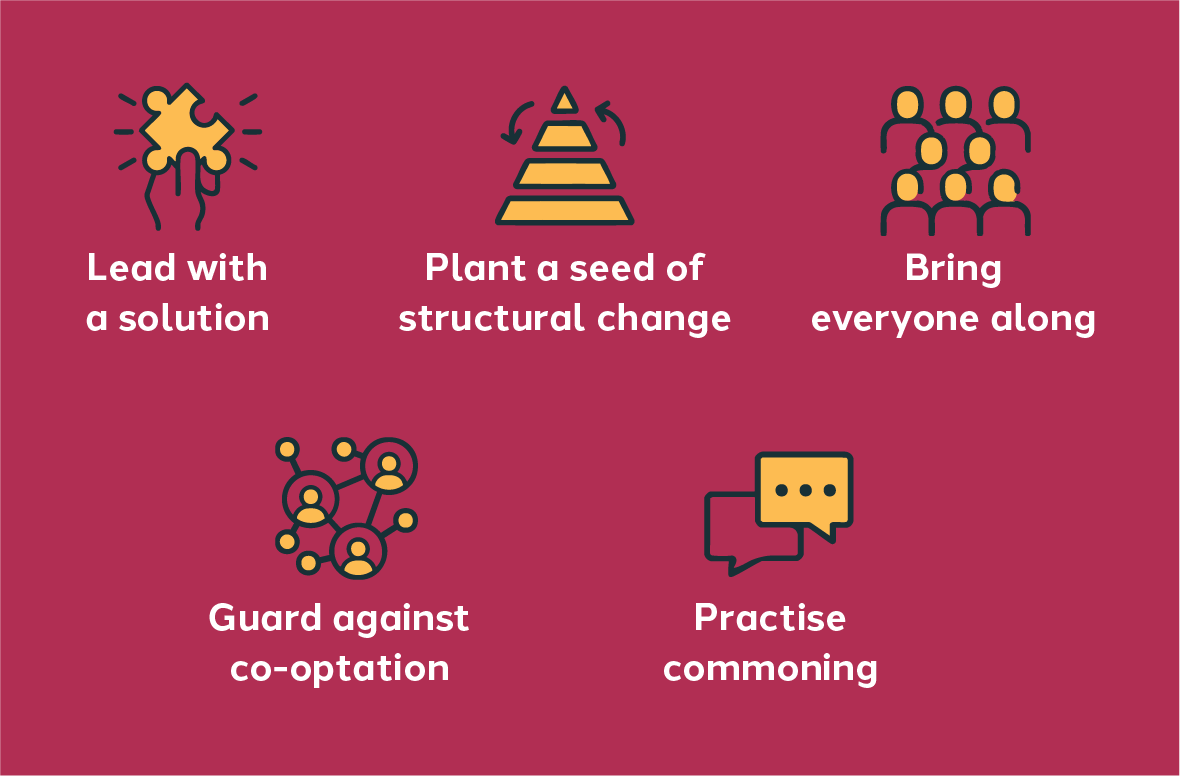
But a poor business model may be a great social one. Enlarging the knowledge commons reduces the need for formal provisions from the state or markets. Communities can be better resourced because enabling assets are shared, and they can be more resilient, being more capable of self-organising and with fellow practitioners for support. An example of this principle at work is the open source movement that has helped accelerate software development and the IT revolution.18
How Do We Get There?
These different institutional paradigms or structural logics are not necessarily superior to any other, as each has their own limitations. Mutual aid or peer-to-peer efforts may be messy, duplicative and lack coordination. Communities may also lack deep technical expertise that professionals can bring in a more clinical context. Collective efforts and community decisions may also take a long time to realise, especially if there is a commitment to include marginalised groups. However, they offer alternative approaches well worth considering, particularly where service provision has reached the limits of efficacy.
When might one approach be considered over another? Where the citizenry is highly educated and capable of contributing meaningfully, it seems sensible to promote citizen empowerment, community building, and to distribute decision-making and agency.
We can experiment with diverse forms of citizen participation—so that enough low stakes deliberations at small-scale or local levels help prepare citizens when stakes are higher. Participatory Budgeting in our towns, if commonplace and routine, prepares residents with parochial interests to step up to the role of citizens making decisions of national significance. Perhaps with enough practice, the Ministry of Finance could eventually trust citizens to deliberate on a portion of the national budget through participatory budgeting.
Observers have often characterised society as a three-legged stool, for which the three pillars—the public and private sectors, and a third people (or civic) sector—need to be equally balanced.19 If 'nationalisation' means the transfer of industry or commerce from private to state ownership and control, and 'privatisation' is the process in the opposite direction, then we may need a third term—'communitisation'—to describe the transfer of private or public control to a local or user community for self-management.20,21
What we may need is a 'third sector' development strategy that intentionally focuses on meaningful community building, mutual aid and contributing to the commons. Indeed, Singapore's National Council of Social Service already acts as a membership body for non-profit social service providers, but there is no equivalent National Council of Voluntary Organisations to act as an associational body for charitable organisations across the larger third sector—arts, sports, health, education, social services and community.22 Issue-based networks and place-based communities could be formed to encourage voluntary organisations to connect with their peers. The goal would be to encourage the growth of a high solidarity third sector articulating and enacting the logics of communitisation and commoning.
What we may need is a 'third sector' development strategy that intentionally focuses on meaningful community building, mutual aid and contributing to the commons. The community can itself be a site of serious economic activity that is subservient to local community needs.
Indeed, when communitisation is strong, useful alternatives start to become more evident. The community and non-profit sector has been regarded as a 'cost centre' of Singapore Incorporated—markets make money and the state redistributes it to the third sector to be spent. However, the community can itself be a site of serious economic activity. Local communities could well operate enterprises dealing with large amounts of money: in Germany, one such trust operates a wind farm in which the proceeds go to meet local needs.23
If we are serious about addressing structural inequalities, we need to focus on building community (not individual) wealth. It is worth noting, however, that when such a venture is completed, the enterprise does not go around the country to scale up its operations. Instead, it looks to its local community to see what else it needs—a library perhaps, or youth centre, or some kind of social service. When economic activity is subservient to local community needs, it grows to an appropriate, sustainable size—never so large that it starts to exploit people or the planet.
NOTES
- The logic of administration and markets are powerfully twinned in what governance scholars call 'New Public Management' See C. Hood, "The New Public Management in the 1980s: Variations on a Theme," Accounting 20 no. 2-3 (1995), 93–109.
- The size of the social service sector has gone up in terms of the number of social and welfare charities registered as well as their total income, the diversity of client groups they serve, and the manpower profile they have. See National Council of Social Service, Social Service Sector Strategic Thrusts 2017–2021, https://www.ncss.gov.sg/press-room/publications/SocialServiceSectorStrategicThrusts4ST.
- Notable scholars have discussed this decades ago, in Disabling Professions (1977). More recently scholarship includes William Easterly (2014), The Tyranny of Experts: Economists, Dictators, and the Forgotten Rights of the Poor.
- Justin Lee et al., Survey of the Social Service Sector, IPS Exchange Series (Institute of Policy Studies, 2021).
- https://lkyspp.nus.edu.sg/ips/research/ips-policy-lab/learning-circles
- Justin Lee et al., 2020 "Nurturing Villages and Safeguarding Community: A Case Study of Beyond Social Services"
- Yishun Health 2022, "Caring Communities: Production & Participation by People".
- "Tools for Community Empowerment: Insights from Scotland Study Trip 2023"
- https://institute.coop/benefits-worker-cooperatives
- B. Wampler, Participatory budgeting in Brazil (University Park: Pennsylvania State University Press, 2007).
- Part of Future Ready Society Impact Fund, a partnership between IPS, LKYCIC and Toteboard.
- We call this process 'Citizens ReAssembled'.
- https://www.straitstimes.com/singapore/it-takes-a-village-to-raise-a-child-inside-a-bedok-estate-s-kampung
- CNA. 2021. Community Circles initiative to provide support for caregivers of persons with disabilities. 21 October; The Straits Times. 2021. New community initiative to support caregivers of persons with disabilities to be piloted in 2022. 20 October.
- https://www.unesco.org/en/open-educational-resources
- https://www.community-circles.co.uk/
- See E. Cinar, P. Trott, and C. Simms, "A Systematic Review of Barriers to Public Sector Innovation Process," Public Management Review 21, no. 2 (2019): 264–290. However, Fred and Mukhtar-Landgren point out that it is important to recognise that public sector organisations comprise agents who may resist innovation, not as a consequence of organisational conservatism or bureaucratic procedures, but because they—based in their professional knowledge and experience—consciously keep bad ideas out, see M. Fred, and D. Mukhtar-Landgren, “Productive resistance in public sector innovation—introducing social impact bonds in Swedish local government,” Public Management Review 26, no. 3 (2022), 793–810. https://doi.org/10.1080/14719037.2022.2123027
- See: https://opensource.com/
- Markets and the state remain indispensable, but "when the three pillars of society are appropriately balanced" … "society has the best chance for providing for its people, See Raghuram Rajan, The Third Pillar: How Markets and the State Leave the Community Behind (William Collins, 2019).
- See: R. S. Pandey, Communitisation: The Third Way of Governance (Concept Publishing, 2010).
- 'Communitisation' has been used to describe the formal transfer of control of government-owned public institutions to a user community, such as schools and health centres in Nagaland, India (see Pandey, Note 19). In the UK, ‘community asset transfers’is “an established mechanism used to enable the community ownership and management of publicly owned land and buildings”, see “Understanding Community Asset Transfers” (MyCommunity, 2020). ‘Commoning’ is a broader term that captures the act of collaboratively creating, sharing and collectively managing resources that can happen whether the commons produced has any legally recognised owners or not.
- Our National Voluntary and Philanthropic Centre shares similar aspirations of such voluntary apex organisations but is itself not an associational body that can claim to represent member interests.
- https://www.theenergymix.com/community-wind-farm-earns-support-generates-income-in-german-village/