

Practising Collaborative Governance: How the Public Service can Support a Democracy of Deeds
ETHOS Issue 28, Apr 2025

A New Social Compact: Collective Responsibility
What is the future Singapore that we want to build? How should we build it? These are key questions that over 200,000 Singaporeans discussed as part of the Forward SG exercise.1 Singaporeans aspire to build a vibrant and inclusive society where there are diverse opportunities for people to pursue different pathways to success and be respected for who they are and what they do. We all want to see a fair and thriving society where Singaporeans are supported with their basic needs in every stage of life, so that they can live fulfilling and dignified lives.
A key element of this new social compact is collective responsibility. Everyone—businesses, community groups, families and individuals—has a role to play to collectively build the future Singapore we want to see.
Building a Vibrant Democracy of Deeds: Three Cs are Key
To contribute to this national aspiration, we in the Public Service have to continually evolve our way of governance. Beyond consulting on policies and programmes and communicating policy changes well, we should be prepared to engage more deeply with citizens, involving them in policy development and in co-creating and co-delivering programmes.
The Public Service is operating in a much more complex, volatile and resource constrained world today. We benefit from learning how to engage the perspectives, creativity and resources of the people and private sectors, to deliver better for Singapore and Singaporeans. In doing so, we also deepen our relationship with citizens and stakeholders, so that collectively we continue to strengthen trust within our society. This is the glue that will bind us together in good times and difficult times. What is our picture of success? A vibrant democracy of deeds, where we have a robust ecosystem of active citizens and connected communities, working together to make life better for fellow Singaporeans.
How can the Public Service foster and nurture such a democracy of deeds? As a start, we have to build up three Cs—learning to Cede space, build Capability within and outside the Public Service, and strengthen Collaborations within the Public Service and in the community.
We benefit from learning how to engage the perspectives, creativity and resources of the people and private sectors, to deliver better for Singapore and Singaporeans.
Ceding Space for Collaboration
The Public Service must be intentional in identifying areas where we can cede space for citizens to play a bigger role in coming up with ideas or solutions. One example of this is the Partners Portal by the Singapore Government Partnerships Office (SGPO), launched in January 2024.2 The Portal lets citizens take the lead in proposing ideas, instead of the Public Service setting the agenda and consulting the public. SGPO will then support them in making their ideas happen: by providing information and resources, and coordinating the help needed across multiple public agencies. SGPO ensures that proposals are seriously considered and engages public agencies to bring the ideas to life. Thus far, the Portal has attracted a range of promising proposals, including an idea to fight misinformation with artificial intelligence, and an initiative to document kampung life in the past.
Youth Panels3 are another example of intentionally creating space in policymaking. Over 120 youth panel members have worked with public officers on issues that are important to our youths: financial security, careers and lifelong learning, digital wellbeing, and environmental sustainability. The Youth Panels were given the autonomy to decide what they wanted to focus on. With access to data, information and policy considerations provided by public officers, the youth participants developed policy ideas that were shared at an inaugural Youth Policy Forum in August 2024. More than 1,000 Forum participants were invited to listen to the Youth Panels' journey and contribute feedback and suggestions.
Beyond policymaking, the Public Service has also been empowering our Singaporean youths to lead and implement projects to make a difference in the community. The Young ChangeMakers4 and Youth Action Challenge5 programmes create space for our youths to be the positive change that they want to see in the world, supporting them with mentorship, networking and coaching. Ceding space for collaboration empowers our youths to take ownership of issues that matter to them, which in turn nurtures them to be active and contributing citizens.
Partnering to Grow Community: Woodlands Botanical Garden
SGPO recently worked with Ganesh Kumar, the founder of Woodlands Botanical Garden (WBG) in Marsiling. The gardening enthusiast first planted the garden in 2020 as a way to cope with the loss of his mother. His efforts soon caught the eye of fellow residents, and WBG quickly became a community spot where visitors came to socialise. Ganesh saw its potential to be a communal space for people to reconnect with nature, and for elderly residents to keep active.
Since 2020, WBG has blossomed with support from various groups to become a thriving ecosystem that both contributes to the biodiversity in the area and serves as a venue for local community events.
Ganesh has big dreams to grow the garden and the community spirit in Marsiling but was not initially sure which government departments to approach for support. In 2024, he submitted a proposal through the Partners Portal. SGPO came on board to facilitate his requests, linking him up with various agencies including the National Arts Council, Housing Development Board, National Parks Board, People's Association, National Library Board, and Ministry of Health, to explore and implement feasible programmes across domain areas.
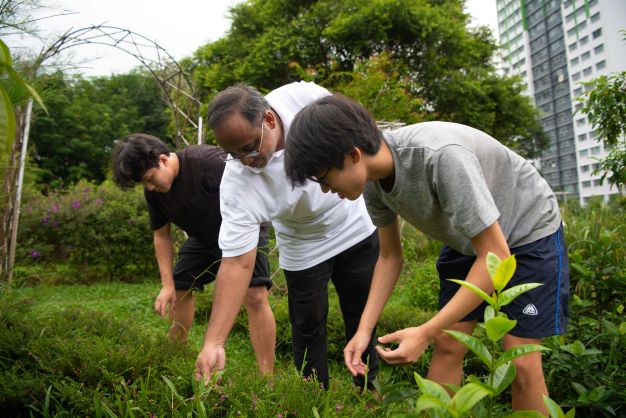
WBG is a prime example of what we can achieve when agencies and citizens work together to make a positive change. Ganesh himself says: "Both citizens and government must work together. The government cannot do everything alone. We need the community's passion and knowledge to drive change. If we as citizens want to see impact, we need to step up our game too."6
To play their part, public agencies must also stay open to citizens' ideas and support citizens in bringing their ideas to life.

Building Capability at Every Level
Working effectively with citizens and stakeholders is a competency we all need to individually build up to be effective public officers. This is already expressed in Our Core Competencies, which are foundational competencies for all public officers. For our policies and programmes to be effective, the Public Service must stay connected to the ground—not only to have a deep understanding of citizens' needs, but also to be able to rally stakeholders and citizens to develop and implement solutions with us, for the collective good of Singapore.
Officers who need to interact more frequently and engage more deeply with citizens and stakeholders need more specialised skillsets. For instance, if their daily work involves facilitating engagements, cultivating partnerships, mobilising partners and analysing data and insights on the impact of engagement efforts, they will need to develop specific partnership and engagement (PE) capabilities. The Public Service has designed a Partnership and Engagement Competency Framework that outlines the skillsets public officers will need to develop to do their work well.7
To support the development of these competencies, the Academy of Public Communications and Engagement (APCE) delivers a comprehensive suite of programmes or public officers.8 It offers:
- Programmes to cultivate partnership and engagement capabilities such as designing engagements, facilitation, and sensemaking. The foundational Partnership and Engagement 101 programme helps officers new to PE work to build capabilities, using key frameworks such as stakeholder mapping and engagement planning.
- More advanced courses targeted at more experienced officers. A Partnership and Engagement Network community of practice has also been set up.
- Hands-on opportunities, such as Short-Term Immersion Programme (STIP), gig work, and Structured Job Rotation. To practise ground engagement, officers can volunteer as mentors, befrienders and more through PSD's Public Service For Good initiative.9
Our Public Service Leaders must take charge of building these organisational capabilities, and they must lead by example. There are a range of structured ground engagement opportunities available for leaders to immerse themselves in frontline services and better understand citizens' lived experiences. These include the Engagement Immersion of Leaders (EIL) programmes,10 which have enabled directors to participate in ground attachments to gain insights into the operational challenges of implementing policies.
MCCY refreshed EIL programming this year to enhance its focus on developing openness, empathy, and citizen centricity in officers who are in middle management and above. The refreshed programme includes a community walk to meet different citizen groups, giving officers opportunities for ground-sensing and engagement so they can better design and implement policy.
Building relationships with citizens and seeking to understand their needs and aspirations must become a new way of working for the Public Service. Building this culture is not always easy and will require leaders to walk the talk and walk the ground. Leaders can be role models for deepening ground engagement experience by participating regularly in PSD's centrally curated hands-on opportunities, engagement STIPs or gig work, and even curating ground opportunities within their ministry families for fellow leaders and officers.
Strengthening Collaborations: Enablers for a Connected Society
To effectively build a democracy of deeds, we need an ecosystem of active community partners. They act as connecters to bring more citizens and communities on board the collective mission of building a cohesive and resilient society. We have to be intentional in developing collaborations among community partners beyond specific projects. We should also invest in building partners' capabilities and work with them to co-create new initiatives.
Through our Partnership Development Fund,11 MCCY supports public agencies in developing longer-term collaborations with their partners. For instance, MCCY supported the Early Childhood Development Agency (ECDA) in its partnership with Preschool Market (PSM), a social enterprise, to further expand the Start Small Dream Big (SSDB) Programme. The SSDB programme supports early childhood practitioners, children and parents through meaningful community projects and engagements.12
Through this collaboration, PSM galvanises other preschools and partners to scale up the SSDB movement. To date, it has made a meaningful impact on over 1,100 preschools, 210,000 preschool children, and 160,000 parents across Singapore.
Taking Singapore Forward, Together
By partnering and engaging our citizens, we can build a stronger, more cohesive Singapore for future generations. As we cede space and build capabilities, we can co-create better policies and programmes to meet citizens' needs and collaborate with strong partners to deliver these. Such efforts build trust between the Public Service and our citizens, enabling us to find common ground, connect with people from different backgrounds, and understand others' diverse needs and views.
Governing collaboratively offers unique opportunities to strengthen our community to move forward together as a nation. This is how we will lead the way as a Public Service, by taking the first step to work together with our citizens to build Singapore's future in a complex world.
NOTES
- https://www.forwardsingapore.gov.sg/
- https://www.sgpo.gov.sg/take-action/partnersportal/
- https://www.nyc.gov.sg/youth-panels
- https://www.nyc.gov.sg/programmes-grants/young-changemakers
- https://www.nyc.gov.sg/youth-action-challenge
- See: https://www.instagram.com/p/C9TogpcyeiV/?hl=en&img_index=1)
- Singapore public officers can find further information on the Partnership and Engagement Competency Framework on the Partnership and Engagement Network microsite (intranet access only, go.gov.sg/mccy-pen).
- Singapore public officers can find further information on the APCE training programmes on the Partnership and Engagement Network microsite (intranet access only, go.gov.sg/mccy-pen).
- The 'Public Service for Good' movement encourages public officers to go beyond traditional job and agency boundaries to 'be a force for good' in new and different ways for the benefit of Singapore and Singaporeans. Public officers can find further information on PSD's Public Service for Good on the Singapore government intranet. Also see: https://www.psd.gov.sg/newsroom/press-releases/publicservice-week-2023/.
- See: https://www.facebook.com/PSDSingapore/videos/engagement-immersion-forleaders/564156290752043/. Course offerings are outlined here: https://register.csc.gov.sg/registration?courseId=307911&classNum=0 (for middle managers) and https://register.csc.gov.sg/registration?courseId=307910&classNum=0 (for directors).
- Singapore public officers can find further information on the Partnership Development Fund on the Partnership and Engagement Network microsite (intranet access only, go.gov.sg/mccy-pen).
- See: www.startsmalldreambig.sg. The SSDB portal is a platform with stories of projects submitted by the preschools, as well as e-resources for educators' use from SSDB community partners.