

Participatory Design and Planning: Helping Citizens Make More of a Difference
ETHOS Issue 28, Apr 2025

The Challenges and Realities of Participatory Frameworks
Over the past decade, public participation channels in Singapore's planning and policymaking have proliferated, reflecting a global trend towards inclusive governance. This evolution presents unique challenges and opportunities within Singapore's approach to public engagement. It is timely to reflect on the purpose and practice of citizen participation: who benefits and whose interests are served?
The promise of citizen participation is to forge empowered communities, enhance the quality of public solutions and services, and align governmental actions with the varied and often nuanced needs of the people. However, the actual influence of such engagements on decision-making processes remains ambivalent. Globally, scholars have critiqued the effectiveness of participatory initiatives, noting that increased engagement does not automatically translate to greater empowerment or influence for the community.1,2,3
Imagine you are presenting findings from a rigorous public engagement process to attentive stakeholders. As you conclude, you learn a decision has already been made, rendering the participatory process a mere formality. In another scenario, recommendations from extensive citizen engagement appear to have been adopted, but the process continues without further including those previously involved. In the end, it is unclear how much of the citizens' input is reflected in the outcomes, leaving both citizens and facilitators in the dark.
Such scenarios may occasionally arise within participatory frameworks, including those used in public projects across Singapore.4 This prompts a critical question about the participatory design and planning landscape: what makes citizen participation meaningful, and what would it mean to have meaningful community participatory processes?
Defining Meaningful Community Participatory Processes
To address these questions, we draw on our decade of experience in Participate in Design (P!D)5 as intermediaries in the participatory process in Singapore. As a non-profit organisation, we provide consultancy and training to integrate participatory processes into urban space design and planning in Singapore. This involves navigating client-consultant relations and managing various stakeholders' interests, affecting our impact on local communities. In our work, we act as a bridge between the community stakeholders who are affected by a public decision (e.g., residents, local interest groups) and the institutional stakeholders who lead this decision-making (e.g., government agencies, Members of Parliament). We seek community stakeholders' views and ideas on the urban designs and plans affecting them, and translate them into proposals and recommendations for institutional stakeholders.
Through our ten years of applying our participatory approach, we have identified three pillars essential to making participation meaningful and empowering to local communities involved:
- Inclusion and access: Ensuring that diverse voices, especially those often neglected, are included.
- Co-creating agendas and influence on decisions: Giving communities power or influence over the agendas and decisions that affect them.
- Capacity building: Building the capacity of all parties involved to effectively implement and/or engage with the participatory process.
While these pillars may seem like common sense, they are easily overlooked. For example, institutional stakeholders may agree to include a participatory process because it is the politically correct thing to do, even though they do not genuinely intend to share their decision-making power with community stakeholders. It is critical to use these pillars to analyse and reflect on our roles as intermediaries executing citizen engagement work in Singapore.
Experimental Strategies for Enhancing Participatory Processes in Singapore
Inclusion and Access
Designing an inclusive engagement process means recognising that all affected members of the local community are stakeholders, and creating opportunities to involve them. Engagement sessions planned by intermediaries, including public officers, often employ technical jargon, which can make these engagement sessions intimidating and less accessible to the general public. Additionally, they tend to engage only a small group of community members, assuming they represent the interests of the wider community. This creates a barrier to inclusion and access for the everyday community.
To ensure participatory processes remain inclusive, and for the broader community to be able to give meaningful input, we must lower the barrier of entry for such engagement. We should reduce the use of technical jargon and rework communications and related materials to be more easily understood by the public. We must also look beyond only involving those who are typically invited to participate, and reach out to those who tend to be underrepresented. We should develop measures to ensure the community engaged in our processes is diverse enough to represent different demographics and viewpoints. These may include working adults who are often too busy to attend engagement sessions, or communities marginalised due to their socioeconomic status or disability.
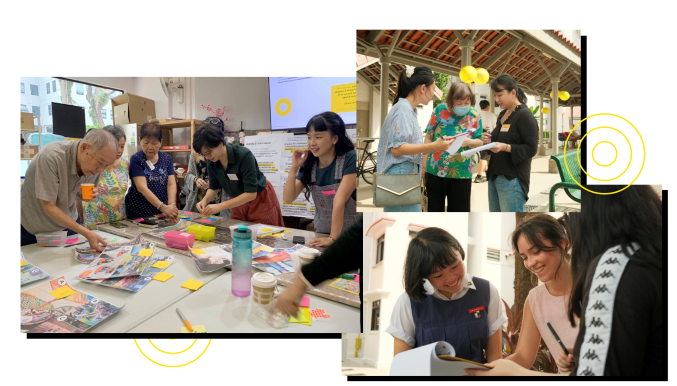
For example, in Neighbourhood Renewal Programmes,6 we often design our engagement strategies, after brainstorming with Resident Committee leaders, to include non-English-speaking seniors and working adults who do not frequent community events. This is to ensure that what we propose resonates with the wider community before implementation. We have found that doing so provides the grassroots and project implementation team with greater clarity, and gives those not in the Resident Committees a chance to share their perspectives, enabling the implementation team to make more informed decisions later in the project.
Co-creating Agendas and Influencing Decisions
A community's influence encompasses the impact they have on both agenda-setting and decision-making. Traditionally, institutional stakeholders (such as public agencies and their representative officials) have dominated these processes. Agenda-setting is about determining the issues and problems to be discussed or prioritised, while decision-making entails shaping the final policies or designs to reflect the needs, interests, values and priorities of the community. Empowering community stakeholders to co-create agendas and participate in decision-making significantly enhances their ownership. This approach ensures that the resulting outcome is more widely accepted.
Some questions that we need to constantly challenge ourselves with include: Are there opportunities for community stakeholders to participate in decision-making? After decisions are made, have we explained to the community our reasons for accepting or rejecting their views and suggestions?
In recent years, P!D has begun experimenting with power-sharing mechanisms in smaller-scale projects. These initiatives involve designing participatory processes where small groups of community stakeholders help co-determine the agendas and outcomes. These projects, often initiated through grants, provide the flexibility needed for experimentation.
For example, for a project in Toa Payoh West where we wanted to reimagine an underutilised public space, we collaborated with an artist and community stakeholders to collectively determine the project's focus and objectives. By openly sharing information about the project's progress, decision points, and the rationale behind decisions, we were able to build trust with the community. Based on our observations and conversations with the local residents who participated in this process, we found that this approach not only increased the project's relevance and acceptance but also fostered a sense of ownership and pride among residents. For instance, many residents volunteered extra time beyond their initial commitment to work alongside the project team in completing the artwork. Their dedication was further evident during the official launch event, where, despite heavy rain, residents participated enthusiastically, demonstrating their deep connection to and investment in the space they helped create.
Capacity Building
Next, building capacity for community facilitation and planning involves equipping both government and community stakeholders with the knowledge, skills, and resources necessary to effectively implement and engage in the participatory process. As intermediaries, it is our responsibility to provide communities with access to critical data (e.g., budget details and costs of building different types of amenities) and resources (e.g., access to key government officers) that can empower them, develop local leadership, and help establish stronger networks among themselves and with institutional stakeholders.
Capacity building also involves changing mindsets and attitudes toward participation, enabling both community and institutional stakeholders to see themselves as confident and valued participants in the process. A critical question to ask here is: Are we creating opportunities to strengthen the knowledge and skills of community stakeholders in our engagement processes?
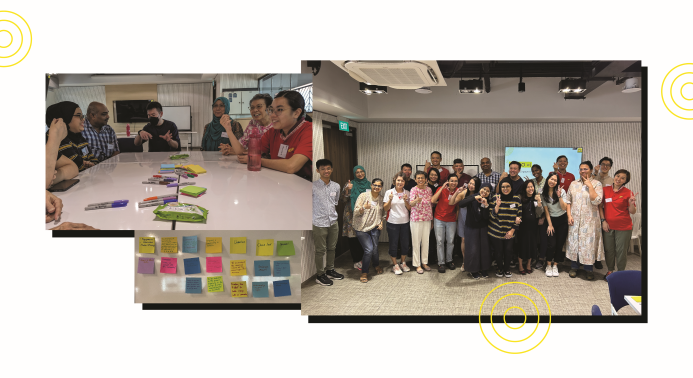
Recently, we partnered with the Fengshan community to co-create a soon-to-be-closed car park space. We trained a group of local residents and stakeholders in community facilitation, involving them in gathering opinions and making decisions alongside us. Some of the skills and knowledge they gained in this process included understanding benefits and trade-offs (such as of road closures) and facilitation skills to manage differing views. This integrated capacity-building into our engagement process, creating opportunities for both institutional and community stakeholders to learn by doing. By actively participating, they gained confidence in their ability to implement and sustain the participatory process. This approach enhanced their ability to listen and question their assumptions about people's needs, paving the way for a more successful exit strategy (i.e. handover of the project or process to the community and institutional stakeholder for further continuation).
Conclusion
Having worked with different government agencies over the past 11 years, we see the importance of having public officers who are open-minded towards alternative and experimental ways of implementing participatory processes. Our more innovative projects were often only possible with the support of public officers who were willing to: (1) include a diversity of voices for and against the project or plan; (2) allow community stakeholders to shift agendas and decisions towards the issues and interests that they prioritised; and (3) approach the participatory process as a capacity-building and learning opportunity for themselves as well as the community.
As the Singapore government continues to engage the public in future planning and policy processes, we believe in leveraging such progressive forces within the public sector to make participation more meaningful for all those involved. For participatory processes to give citizens a stronger sense of ownership over the city and nation, we must do more to foster spaces for people to openly debate and collectively define what constitutes the public good.
NOTES
- Yasminah Beebeejaun, ed., The Participatory City (Jovis, 2016).
- J. R. Levine, "The Paradox of Community Power: Cultural Processes and Elite Authority in Participatory Governance," Social Forces 95, no. 3 (2017): 1155-1179, https://doi.org/10.1093/sf/sow098.
- M. Mulder, "Power Equalization Through Participation?" Administrative Science Quarterly 16, no. 1 (1971): 31-38, https://doi.org/10.2307/2391284.
- For examples of such scenarios in citizen and civil society engagement in Singapore, see: Jan H. M. Lim, Qihao Lean, and Larry Yeung, Does participation make a difference? Critical reflections on 10 years of community-based participatory design practice (2013-2022) (Singapore: Participate in Design, 2024) and Grace Chua and Xueying Li, "Navigating a new terrain of engagement," The Straits Times, March 30, 2012.
- https://participateindesign.org/
- Housing and Development Board, "Neighbourhood Renewal Programme," Housing and Development Board, 2024, https://www.hdb.gov.sg/residential/living-in-an-hdb-flat/sers-and-upgrading-programmes/upgrading-programmes/types/neighbourhood-renewal-programme-nrp.