

More than a Feeling: Understanding Public Trust
ETHOS Issue 28, Apr 2025

The Global Decline in Public Trust
Trust is the lifeblood of any institution. But it is hard to earn and easy to lose.
Globally, the outlook for trust in public institutions has been bleak. The Edelman Trust Barometer found in 2023 that only 50% of survey respondents worldwide reported trusting their government.1 In a separate global survey, 45% polled felt governments were "untrustworthy", ranking among the lowest trusted sectors studied.2
Singapore bucks this global trend: trust in government has remained high, at 77% in 2024. It even increased during the COVID-19 pandemic (from 70% in 20193 to 76% in 20224). This finding differs from other countries, where the initial rise in public trust eventually reverted to lower pre-pandemic levels.5
Globally, there is a 'trust gap'6 between the haves and have-nots: those in the lowest income quartile are less likely to trust institutions compared to the top. This is also the case in Singapore: the average trust in institutions7 by low-income earners was 18 percentage points lower than high-income earners (55% vs 73%) in 2023, putting Singapore in seventh place in terms of the trust gap among 27 countries surveyed.
What are the key shifts affecting public trust in Singapore, what components make up this trust, and how can governments build meaningful trust with citizens?
Securing Trust in Institutions
Citizens may have different ideas of what constitutes 'government', which can impact trust building. They may think of government as the public service and institutions such as the courts, or solely comprising political actors, e.g., politicians and political parties. The actions of one part of government may inadvertently affect perceptions of another.8
Citizens may have different ideas of what constitutes 'government', which can impact trust building.
Securing institutional trust is critical for the public service. Strong institutional trust allows governments to secure process-based trust from citizens. Process-based trust means citizens can accept an outcome—even if it is not their desired outcome—because they believe the underlying process was fair and justly executed. This form of trust can forge stronger government-citizen relationships and mitigate the negative impact of unpopular decisions or policies.
Crucially, leaders representing institutions, as well as the individuals implementing institutional processes, must demonstrate respect for the process and its rules. When leaders and officials disparage systems, trust in systems erodes even if there are checks and proper processes in place.
Building Trust in a Digital Era
The rise of social media has impacted the trust dynamics between citizens and institutions. Social media can create 'echo chambers' that fuel social and public mistrust. Individuals increasingly access content and closed groups that reflect their own beliefs and biases. Recommendation engines then amplify individuals' choices by sending users down rabbit holes toward even more extreme ideas. This is how conspiracy theories and anti-vaccination beliefs spread amongst members of wellness groups during the COVID-19 pandemic.9 Disinformation that rises within online communities can be harder to stamp out as group members grow more insular in their information consumption habits.
Yet, social media also offers a platform to humanise public communications, foster authenticity and enable political leaders to speak directly to a viewer. Public officers must learn to use social media for positive engagement while mitigating the negative impact. This includes creating content that is short, snappy, and easily understood to catch the public's attention. Additionally, they must also be able to promptly detect and dispel disinformation that could sow distrust.10
Maintaining Trust in Divisive Times
Polarising forces in society can reduce trust. If citizens perceive that governments are ignoring or mismanaging fault lines in society, mistrust can breed. Below are some key trends, not unique to Singapore, that could contribute to societal divides and affect public trust:
- Income and wealth inequality can exacerbate tensions and fissions. Less well-off groups may feel disenfranchised by policies, perceive that the system is rigged against them, and feel that those in power are not working in their best interests. There is the risk of economic 'enclaves', where there is little understanding between different socio-economic groups. These forces can make it harder to build trust and corral a nation towards common goals.
- Identity politics can be powerfully divisive, and make it challenging for the government to effectively engage with and represent the interests of all citizens. For example, race and religion, as well as issues of gender and sexual orientation, are complex issues inherently tied to an individual's self-worth, sense of belonging, and lived experience. It can thus be difficult for individuals with strongly held views to compromise or cede space. Nevertheless, it is important for a society to continue having such difficult but salient conversations, rather than ignore or downplay their significance.
- Generational differences can impact how trust in government is built. In Singapore, the government enjoys large reserves of trust with an older generation of citizens who had experienced the radical post-Independence transformation of Singapore from a Third World country to First. However, younger generations, with different lived experiences, have yet to build up the same trust in Government. Younger Singaporeans may also place a higher value on different aspects of governance, such as robust processes, including checks and balances within the system, or fair and equitable treatment of all political parties. This shift in priorities means the government may have to adapt their approach to win trust among the younger generation.
Inclusive policies that foster an 'all of us matter' mentality will be vital.
Given Singapore's changing demographics, developing inclusive policies that foster an 'all of us matter' mentality will be vital. Doing this may well involve creating and maintaining physical and online communal spaces for people to meet and foster mutual understanding over time.
Framing policies in an inclusive manner is also essential. Presenting policies as mutually beneficial for the target group and the broader community, rather than exclusively benefiting a specific group, can garner greater support.11
What Makes Public Trust?
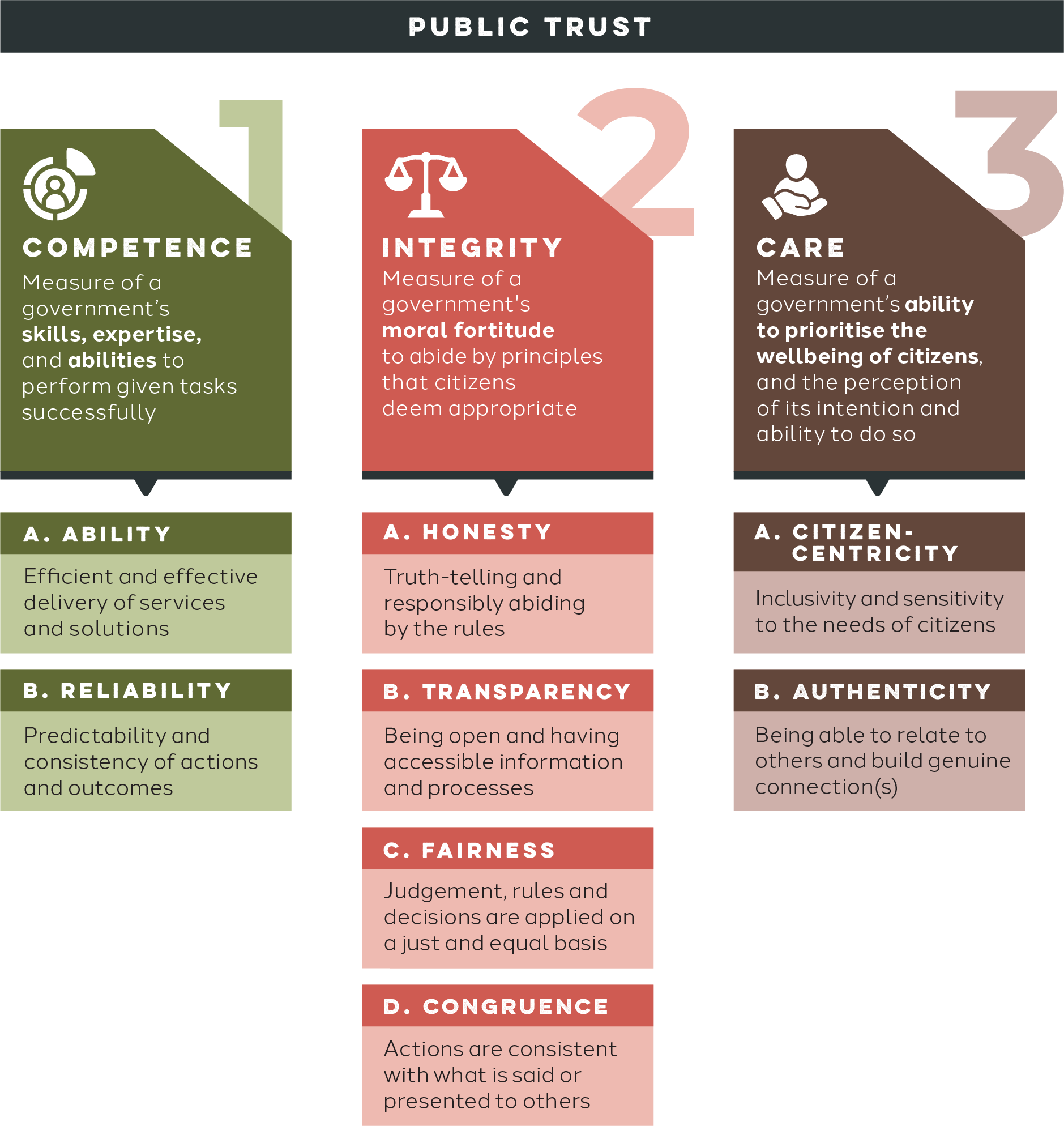
Trust can be a nebulous concept and may mean different things to different people. Research12 suggests that there are three key components to public trust: competence, integrity, and care.
| 1. COMPETENCE |
|---|
Competence comprises two dimensions:
However, public trust in one's competence is contextual. A trustee may be highly competent in one area and less capable in other aspects.13 Citizens' trust in one aspect of government may not always extend to other aspects. |
| 2. INTEGRITY |
|---|
Integrity comprises several dimensions—honesty, transparency, fairness, and congruence.
For public trust to thrive, processes, systems, and institutions must be created in a way that is just and fair, and the people behind these mechanisms must also be seen to be fair as well. |
| 3. CARE |
|---|
Care is an important component of trust but can be challenging to quantify. While competence can be measured by evaluating the outcomes of government policies, and integrity by tracking the prevalence of corruption and political scandals, the notion of care varies depending on individual preferences and perspectives. Research suggests two dimensions of care:
Citizen-centricity and authenticity can be strengthened through citizen engagement, which signals that the government cares about citizen perspectives. Co-creating and co-delivering outcomes fosters trust by giving citizens a sense of voice and stake. Effective engagements are inclusive and sincere. It is also important to close the loop with citizens after each engagement, to assure citizens that their input is valued, and that specific deliberations and actions resulted from the engagement. |
Managing Tensions between Components of Trust
Regardless of its competence and fairness, a government may still lose public trust if seen as uncaring.19 All three components of trust—competence, integrity, and care—are necessary. The challenge for government is when these key components come into tension with one another.
The ideal 'care' for citizens is service that is personalised and designed around the individual rather than an aggregation of individuals. However, governments must contend with resource constraints. Prioritising competence in service may mean delivering outcomes at scale, which may lead certain citizen groups to feel less cared for or included.
Another example is data privacy—where transparency may be at odds with competence. Governments have access to troves of citizen information and are entrusted to handle such information sensitively. However, a crisis or emergency may throw up dilemmas: in a pandemic, for example, how much private information should be disclosed to provide assurance and awareness, and how much should be withheld to protect individual citizens?
To balance these different trust-related priorities, governments must set clear principles and protocols for appropriate data disclosure, as well as clear processes and practices that ensure data security.
Looking Ahead
Singapore's government has built a strong reputation for its ability to competently deliver policy, and for maintaining a robust anti-graft and high-integrity system. As Singapore progresses, the focus may shift towards the 'care' aspect of trust. Core to this is a reflection on whether the public service's ethos of serving with heart has translated into a public perception that the government cares for its citizens and their interests.
Leaders should assess the public perception of their agency and the messages it conveys to the public. Agencies can cultivate a more open and empathetic 'institutional body language'20 through their communications, culture, and leadership practices.
Going forward, the public sector will have to establish and maintain trust within an intricate and unpredictable governance context. Proactive efforts to demonstrate competence, care, and integrity across various government functions, such as policymaking, communications, enforcement, services, and engagement, will be essential for upholding public trust amid evolving social dynamics.
NOTES
- Among four key institutions—business, NGOs, government, and media—only businesses saw more than half of the surveyed respondents expressing trust. Source: Edelman, 2023 Edelman Trust Barometer Report (Edelman, 2023), accessed 14 November 2023.
- Carl Phillips, Ipsos Global Trustworthiness Monitor (Ipsos, 2022), accessed 14 November 2023.
- Edelman, 2020 Edelman Trust Barometer Report (Edelman, 2020), accessed 14 November 2023.
- See Note 1.
- This may be explained by the 'rally-round-the-flag' effect—a short-term increase in public support of a country's government or leaders in times of crisis or conflict. Source: Bruce Chew et al., "Sustaining public trust in government", Deloitte, March 4, 2021, accessed 14 November 2023.
- Ibid.
- This was a measure of the average percentage trust in NGOs, business, government and media.
- However, trust in institutions can occur independently of trust in regimes. A 2021 Institute of Policy Studies (IPS) Exchange Series report on attitudes towards institutions, politics, and policies observed that trust in state institutions was higher (mean of 2.92 out of 4) compared to electoral institutions (mean of 2.55 out of 4).
- Eva Wiseman, "The dark side of wellness: the overlap between spiritual thinking and far-right conspiracies", The Guardian, 17 October 2021; and James Ball, "'Everything you've been told is a lie!' Inside the wellness-to-fascism pipeline", The Guardian, 2 August 2023.
- Research has shown that fact-checking framed as "confirmations" rather than "refutations" tends to see higher reader engagement. Confirmations are framed as "it is true that (correct information)", whereas refutations are framed as "it is false that (misinformation). Source: Natalia Aruguete et al., "Framing fact-checks as a 'confirmation' increases engagement with corrections of misinformation: a four-country study," Scientific Reports 14, 3201 (2024).
- Research has shown that emphasising the overall benefits of diversity, equity, and inclusion (DEI) policies for all employees can help reduce resistance and the zero-sum mindset.
- The framework in Figure 1 draws on organisational trust research and interviews with Singapore's public sector leaders. The two main research sources referenced are Mayer, Davis, and Schoorman's Model of Integrative Trust (see Note 13), and the World Economic Forum-supported think tank TIGTech's drivers of trust (see Hilary Sutcliffe, “Trust & Tech Governance”, TigTech, accessed 14 November 2023, https://static1.squarespace.com/static/5fc12cea2cf09257bd6dcc01/t/5fca5150a c031d3c8e89ff06/1607094623935/Trust_and_tech_governance.pdf.).
- Roger C. Mayer., James H. Davis, and F. David Schoorman, "An integrative model of organizational trust." Academy of Management Review 20, no. 3 (1995): 709-734.
- Onora O'Neill, A Question of Trust: The BBC Reith Lectures (Cambridge University Press, 2002).
- For example, UK officials reportedly used post-its, phone calls and private emails to avoid disclosures under Freedom of Information laws. Source: Ben Worthy, "From private emails to Post-it Notes: How politicians avoid scrutiny", June 29, 2021; Martin Rosenbaum, "FOI, fear and personal emails for public business", BBC News, September 11, 2012. https://www.bbc.com/news/uk-politics-19550952.
- David Chan, "Perceptions of Fairness", October, 2011, accessed 7 December 2023.
- William D. Eggers et al., "How government can deliver streamlined life event experiences", Deloitte, July 12, 2022, accessed 7 December 2023.
- This was adapted from an internal research paper by the Civil Service College. Source: Eugene Liow, "Who Cares: Caring about a Caring Government", May 30, 2023.
- Amanda Greene, "Competence, fairness, and caring—the three keys to government legitimacy," Centre for Public Impact, February 27, 2018, accessed on 7 December 2023.https://www. centreforpublicimpact.org/insights/the-three-keys-government-legitimacy.
- Virginia Hamilton, "Can a government be empathetic?", Apolitical, 3 October 2023, accessed 25 January 2024. https://apolitical.co/solution-articles/en/can-a-government-be-empathetic