

Mobilising the Public: Making It Work
ETHOS Issue 28, Apr 2025

Denise Low is Director, Service Delivery, Social Support Group, Ministry of Social and Family Development.
Soh Lin Liis Director, Partnership, Partnership & Strategy Group, National Library Board.
Woo Wee Meng is Coordinating Director, Community Partnerships, National Parks Board.
This conversation was facilitated by Dawn Yip, then Coordinating Director, Singapore Government Partnerships Office, Ministry of Culture, Community and Youth.
What does mobilisation mean to you and why is it important to your agency?
Woo Wee Meng: For the National Parks Board (NParks), mobilisation is the next level of citizen engagement and partnership. Whereas outreach is about raising awareness and helping citizens understand what we are doing, mobilisation is getting citizen volunteers to take action with us in different ways as community stewards. NParks has, over the years, created various platforms and touchpoints to enable this to happen.
One early example of mobilisation was the introduction of the Community in Bloom programme in 2005 to kickstart a national gardening movement. NParks rallied interested gardeners in the community and facilitated the setting up of community gardens island-wide. The movement started out as an effort to introduce Singaporeans to gardening and as part of the process, foster greater social connections and cohesion amongst residents in the community.
NParks introduced the Friends of the Park initiative in 2016,1 gathering people interested in specific park spaces and topical issues to come together—whether researchers, conservationists or parkgoers. The initiative was a platform for everyone to come together to take action, conduct programmes or just volunteer together, to promote stewardship and responsible use of our parks or champion certain causes. We also have separate touchpoints for youths to expose them to the work that NParks does, such as the Youth Stewards for Nature.2
Our early initiatives catered more towards particular interests, for example, in gardening, biodiversity and wildlife conservation or park-based interests. Today the context has evolved, and it has become even more necessary to get citizens on board if we want to mainstream and realise our vision for Singapore to be a City in Nature.3 Across NParks' different strategies and initiatives, Community Stewardship is an overarching horizontal where we partner the community and bring people together to be stewards for nature. Mobilisation and stewardship go hand in hand, because they both require Singaporeans to take action to nurture what we have. This was the key idea behind the Nature Kakis Network,4 which we are now trying to build.
While it is generally easier to mobilise those who are already bought into and support the work that we do, it is much harder to reach out to the rest of the general population—the everyday citizens going about their lives, who may not be aware of our work or interested in it. This is why we established the Nature Kakis Network, a new platform and touchpoint centred in the heart of local communities.5 It started when Minister for National Development Desmond Lee identified a few volunteers who were passionate about nature, and asked them to educate residents in his Boon Lay constituency and get more of them involved in nature. Calling themselves 'Nature Kakis', these volunteers took residents out for bird watching, kayaking and so on, on a regular basis. Through their efforts, they reached many different groups of residents. Given the success of the Boon Lay Nature Kakis, Minister Lee then challenged NParks to make this into a national movement for the rest of Singapore.
People are more likely to be inspired by hearing the experiences of peers who are passionate about the cause and have already taken action to run an event or programme, compared to just hearing the government narrative.
To build a sustainable movement, we knew we had to take a ground-up approach. We had to step up our mobilisation efforts and revolve them around a particular group — the kampung chiefs. These are individuals within the community who are mobilisers and influencers able to galvanise their fellow residents. The people who will stay and contribute tend to be those who feel mission alignment with the work we do; they are also more likely to be inspired by hearing the experiences of peers who are passionate about the cause and have already taken action to run an event or programme, compared to just hearing the government narrative.
Soh Lin Li: Community engagement is not new to the National Library Board. We have always worked to establish a common vision with the community for how we might create a learning ecosystem together.
To do this, we work with the community in different ways. For instance, when we open a new library, we engage our patrons, both to have them understand what the library needs, and to seek their inputs on the new design. At the same time, we also invite our volunteers to come to the new library and participate in activities they are interested in. One example is a ukulele club: people who like to play this instrument come together to share their hobby and also activate library resources about it, bringing others in. When we opened Central Public Library, we worked with sponsors such as Resorts World Sentosa to do cross-promotions on biodiversity.
We also consider the demographics of each library's location. For instance, since Bedok has relatively more senior citizens, we considered how the library system, services and programmes could be better tuned to that community. So, we have more health programmes in Bedok Library, and partnerships with polyclinics nearby. We also encourage senior volunteers to teach fellow senior citizens to use digital services, helping the community to build a sense of civic ownership and participation.
There are also ground-up groups, such as the Dyslexia Reading Club at Geylang Library, which started out as a group of parents who themselves wanted to help their children with dyslexia come together to learn and read together.
Denise Low: For the Ministry of Social and Family Development (MSF), mobilisation is about bringing together different groups in the community to work towards a common goal: that is, to uplift vulnerable families. It is about reaching out and rallying people together to join us in this common cause. To further this aim, we work with many different groups in the community, including non-profit organisations, social service agencies, grassroots organisations, and individuals.
Mobilisation is about bringing together different groups in the community to work towards a common goal.
This is important, because the government cannot do everything alone. Take financial assistance for instance: where the government cannot provide assistance because the affected person or family does not meet the criteria for some reason, we can turn to the community, which has more flexibility, to provide this help. Over the years, we have built up a number of community partners in this regard.
Indeed, in Singapore's earliest years, it was not the government who went about mobilising the community, but the community mobilising themselves to do something to meet the needs of the vulnerable in the society that had not been met by public services at the time. Many of today's social service agencies have their roots in that earlier era.
What has changed about the way ground-up initiatives and community groups are viewed by the Public Service?
Woo Wee Meng: Over the last decade, many agencies have stepped up our engagement efforts to get to know ground-up and community groups because there is so much value and synergy we can gain from the collective wisdom and energies. Ground-up initiatives and community groups are now viewed as important resources and partners for agencies to support and work with because our objectives are often aligned. With closer engagements over time, trust, mutual understanding, and relationships are also built up and these ground-up groups may also be more open to leaning forward to contribute to our vision.
In NParks, community and stakeholder engagement have become a part of our DNA. From horticulture to biodiversity and wildlife, there are plenty of common interests between the community groups and NParks. Through our long-term engagements, our stakeholders will see that we are similarly passionate about what they are championing, but just playing different roles within the ecosystem.
Denise Low: At MSF, we are used to groups on the ground taking initiative and taking the lead in many areas. The shift we now see is that citizens expect government to do more to help vulnerable families, rather than let non-profit organisations and social service agencies do the work.
Our challenge is to strike the right balance between government intervention and ground effort, because we do not want to take over all the community-led social services, or we will lose that citizen involvement. At the same time, we recognise that it is increasingly more challenging for non-profits to sustain their work in terms of fundraising and so on. I have had social service agencies ask, with the introduction of Comlink, why the government was taking over family care roles that they used to do.
I explained that our structure allows for proper tracking, and for a range of resources to be available so that even volunteers can help families more efficiently. To create an environment that can still support ground-up movements, it is important that the government does not do everything.
Soh Lin Li: Community involvement is a two-way street. We welcome ground-up activities—and our public libraries have always been a base for such initiatives. But sometimes they also need us to pull things together. For instance, we involve the communities in shaping our libraries. We do so by getting feedback from them on how the library can best suit their needs: for example, we invited the public to give us their thoughts on the new design elements when we built the library@orchard at Orchard Gateway to serve them better. Similarly, when we built the Punggol Regional Library, we worked with various communities, including persons with disabilities, to develop accessibility services. One change that has taken place is that the public can have very high expectations of our community volunteers and expect them to deliver the same standards of service as our professional staff, for example, during storytelling sessions.
How do you attract, retain, motivate and level up the volunteers you mobilise?
Woo Wee Meng: There are many avenues and touchpoints to volunteer with NParks. People can join us through different programmes highlighted earlier like Community in Bloom, Friends of the Parks or the Nature Kakis Network. They can also join us as citizen scientists through our biodiversity watches.
We generally follow a pyramid framework for volunteer engagement, where people may join our programmes first as participants, gradually level up as our volunteers, and eventually grow to become our activators and mobilisers. Through our various programmes, we try to provide opportunities for capacity building and training to level them up based on their interests and commitment levels.
We can mobilise and build up volunteer pools, but at the end of the day we must acknowledge that they are volunteers—many of whom wear many different hats. Our challenge is to keep our programmes relevant and top of mind for our volunteers. The onus is on us to make it engaging and meaningful for them, so that they will keep coming back to work with us. We try to be mindful not to overload our volunteers just because they are proficient or capable, and to appreciate them for all that they do.
Soh Lin Li: A good volunteer is also an advocate and spokesperson. At NLB, we have designed a recognition and reward framework to retain, sustain and level them up.
We do not rate our volunteers; our framework is based on the number of hours they put in: the more hours, the greater the recognition. We have an annual volunteer appreciation event for those with a certain tier of hours. Those at a higher tier are invited to special events such as a chat with our CEO, or exclusive tours.
A good volunteer is also an advocate and spokesperson.
We also make sure we listen to them, so they know that their feedback is taken seriously by NLB, and they are needed and appreciated. This strengthens their motivation to want to continue with us.
Denise Low: MSF also has a recognition framework with different tiers of awards, including some based on their contributions and numbers of years of service and so on. However, MSF not only engages individual volunteers, but also many agencies and organisations. We engage them to try to align their work with our policies. We do this by spending a lot of effort talking to them, understanding what concerns they might have about particular policies and working around and through them together.
How can public service agencies further support the community's ability to volunteer and contribute?
Soh Lin Li: The relationship we build up with volunteers must be based on trust. When we work with our volunteers, they need to know that what we do is aligned with what they believe in as well, and that the process can be trusted. This calls for continual reassurance and communication. On our part, we must be sure not to take volunteers for granted. If everyone understands this, it leads to win-win outcomes for both the organisation and the volunteers.
We may also want to work with fellow agencies to identify key volunteers who work across agencies, to prioritise their contribution based on our particular needs.
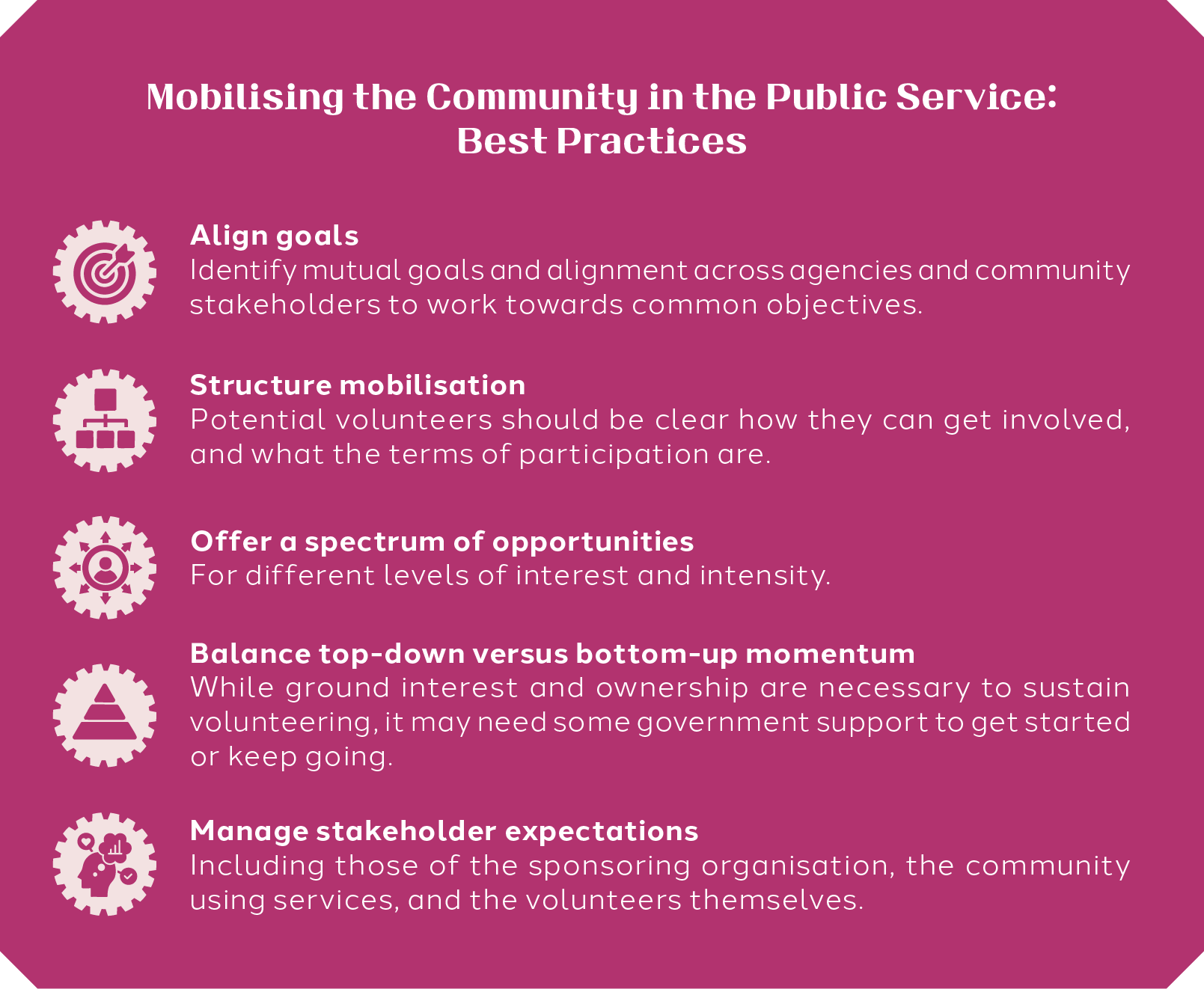
Denise Low: Without a proper structure in place, the community may duplicate efforts, which could mean leaving out areas no one is looking at. A proper structure that is shared with the community lets them know where they can step in, what is to be done, and where and how to do it in a most efficient way.
For instance, our Comlink+ initiative is structured in a way that encourages cross-agency mobilisation, because the needs of the families it serves span different agencies. We have been leveraging different agencies' programmes to help with our families. For instance, NLB's Kids Read volunteers read to the children. SportCares, from SportsSG, has volunteer coaches who teach the children to play various sports. Comlink+ thus acts as an aggregator, identifying needs and then reaching out to different providers, each with their own volunteers, to serve those needs. We serve as a single point of contact for people who want to help uplift the lower income.
Woo Wee Meng: In the volunteering landscape, different people have different and even multiple interests that can spread across different agencies. Our tendency as administrators is to try to streamline where we can. But to volunteers, it may be specific programmes they are interested in, rather than which agencies they are working with, or whether they are working across agencies in a whole-of-government way. So public agencies must understand our own volunteer base and cater to them, ensuring the programmes we set up are relevant and meaningful to them in the long run.
Even with a strong volunteer movement, it is still important for agencies to have a continuing presence on the ground. It is not just about getting people to come on board and then leaving them to do the work whenever we need them. For example, NParks has regional managers for our Community In Bloom gardens: these managers work closely with the community gardeners, building relationships and journeying with them. The relationship cannot be perceived as a transactional one. We need to show that we are here to walk the journey alongside our volunteers, as facilitators and partners.
If you want to grow a movement, it is not as simple as getting it started and then tapering off completely. As we grow the volunteer pool, we will need to sustain and grow the relationship, and that takes continuing effort and investment of our resources.
NOTES
- https://fotp.nparks.gov.sg/
- https://www.nparks.gov.sg/learning/youthsgnature/youth-stewards-for-nature
- https://www.greenplan.gov.sg/key-focus-areas/city-in-nature/
- https://www.pa.gov.sg/our-programmes/sparks-bukit-canberra/nature-nurturer-network/
- https://naturekakis.nparks.gov.sg/