

Kitchen Table Conversations: Challenging Assumptions About the Community
ETHOS Issue 28, Apr 2025

There is considerable room for innovation in the world of community1 and stakeholder engagement today. The fields of communications, marketing, consultation, co-design, deliberation and community development offer a plethora of tools and methods across different engagement modalities.
When engaging on any given problem or opportunity, government agencies should consider using a range of different tools or methods. This is important because:
- Different people will engage in different ways—so we maximise the opportunity to hear from people with different perspectives, ensuring that everyone who wants to be heard, will be heard.
- Engagement at different points in the policy cycle will have a different purpose—and therefore will require the use of different methods
- Different methods will provide government with different insights into the community's knowledge and perspectives—including their lived experience, individual opinions, the considered judgement of individuals or even where groups can reach common ground (where individuals can compromise and find a place where they can 'live with the way forward').
Different Methods Provide Different Insights
Individual Views and Lived Experiences
Traditional consultation methods such as surveys, town hall meetings and some workshops are useful when governments want to understand individuals' opinions and lived experiences.
Informed Opinions/Considered Judgements
There may be times when we want to move beyond understanding people's 'opinions' to get a deeper perspective. We may want to understand what individuals think when they have had more time and information, enabling them to develop a more considered judgement.
Deliberative democratic engagement methods, such as deliberative polling,2 can help governments understand how people's opinions change once they have more information and have had a chance to discuss the issue with people with different perspectives. These approaches can also help shed light on 'why': what contributes to these opinions changing. Deliberative polling has been used by institutions such as Stanford University in the United States to explore a range of issues—including solutions to climate change and how views on addressing climate can change when people are exposed to more information.3
Finding Common Ground
Other engagement methods enable public agencies to go deeper still—and allow policy makers to better understand where diverse individuals can reach 'common ground', i.e. the 'sweet spot' which the vast majority can live with as a solution to an issue. Examples of such methods include deliberative processes, including Citizens' Juries and other panels (such as the Citizens' Jury for the War on Diabetes4), which have been used in Singapore since 2017 to enable public agencies to more deeply and meaningfully engage on complex policy topics. These approaches are generally small scale and involve very few people—often between 50 and 100 people.
However, there are deliberative methods that can enable public agencies to reach bigger numbers in the community and conduct an informed conversation where participants agree on the best way forward.
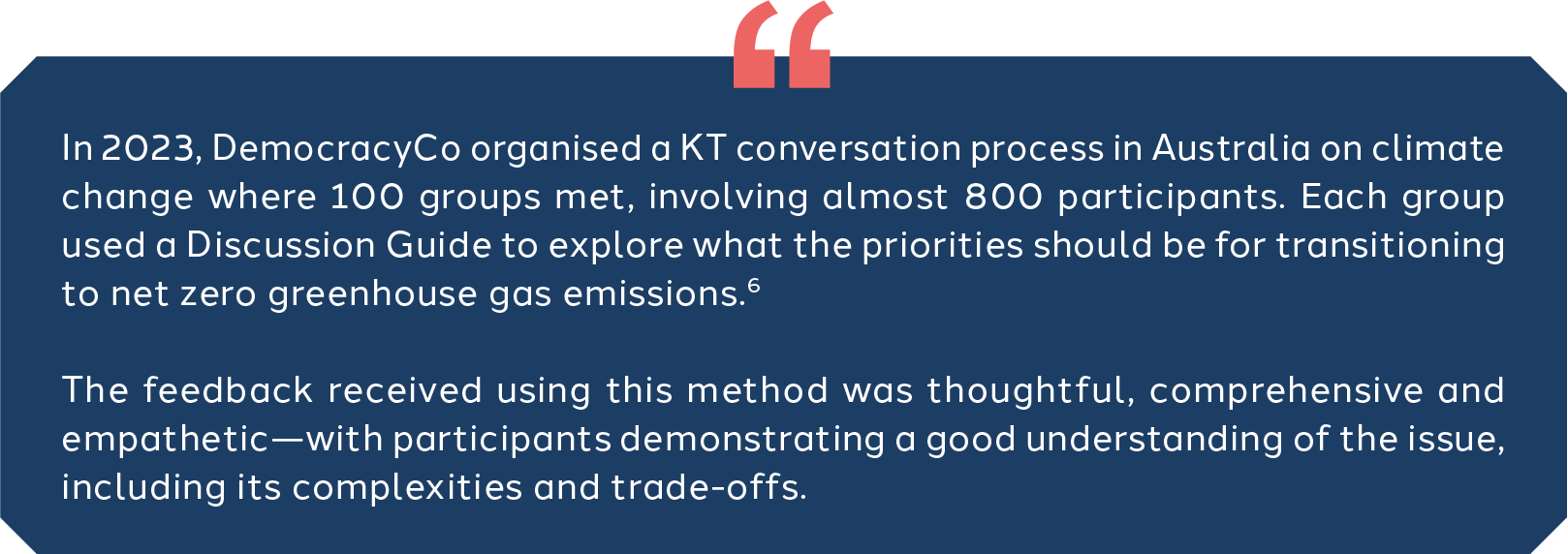
One such method is starting to build momentum in Australia, and it is known as Kitchen Table Conversations, or community conversations.
A New Deliberative Method: Kitchen Table Conversations
Kitchen Table (KT) Conversations5 empower small community groups to discuss complex and sometimes divisive issues whilst at the same time contributing to a broader conversation involving lots of community groups. KT Conversations involve these elements:
Evidence-based Information
A succinct Discussion Guide outlines the problem government wants community to discuss, along with possible solutions to the problem. To help community members grapple with the possible solutions, the Guide also includes an open assessment of the 'trade-offs' of each solution, informed by facts and research. The Guide can also link to other sources of information such as videos or research papers.
Clear Questions for Conversation
The Discussion Guide asks readers to consider key questions that government wants community advice on. These might include community views about the problem, or perspectives on which of the solutions community members support. The Guide is used as a central tool by small groups in the community to talk about the issue and proposed solutions, reaching agreement on their answers before providing their advice back to Government.
Instructions to Support Facilitation
Accompanying the Guide, a Hosting Kit helps community members organise their own community conversation with simple instructions about how to facilitate a group, how to collect feedback, and where to post the feedback.
Self-organised and Independent
KT Conversations are self-organised and independently hosted. Community members wanting to host a conversation may use an existing forum that they may be involved with (a sporting club, church group, workplace or community group meeting). They may also bring together a new group of friends, acquaintances or family members.
This process can also be used to support conversations in any policy area. It has been employed in diverse policy contexts including community resilience building, immigration, nuclear waste storage and environmental management.
KT Conversations can enable practical engagement on a grand yet cost-effective scale. If appropriate, the outcomes of all the KT Conversations can be used to feed into a smaller representative group (such as a citizens' panel) to look across the responses and decide the best way forward. In essence, this method allows public engagement to go broad, using a light deliberative process through the KTs, with deeper deliberation within a smaller group.
Making Sure the KT Process Succeeds
For KT Conversations to succeed, a number of factors should be considered.
Diverse Connections and Networks
Unlike many traditional engagement methods, KT Conversations involve community members 'self-organising' by setting up their own conversations. But today's citizens in countries such as Singapore and Australia are not used to self-organising: because they have not had to.
As governments become more competent and better resourced, public agencies often take the lead to solve problems for citizens, which can ironically weaken the community's ability to organise itself. This could make deploying the KT Conversation method harder—at least until the community becomes familiar with the approach. In such situations, the work for government agencies when adopting this method is in encouraging take-up and involvement from diverse members of the community, community groups and community leaders.
While not much work may be required from government to run or facilitate sessions, there is a lot of work behind the scenes in encouraging individuals and groups to promote and host the conversations. This takes time, so it is important when using this method to leave at least four months for the community conversations to take place.
We believe nevertheless that this work is worth it, because government is then investing in building up the self-organising muscles of the community, including:
- the ability to work together during times of hardship,
- skills in 'facilitation' to help groups overcome division, and
- community connectivity and relationships, improving wellbeing and mental health outcomes.
These are competencies critical for societal resilience in general.
Balanced Information
It is important for the initial Discussion Guide to provide balanced information: i.e. it should openly weigh up the pros and cons of different options and be evidence-based. The credibility of the KT process requires that the Discussion Guide not be perceived as 'selling' a particular pre-determined perspective or solution but that it trusts in the common-sense ability of members of the community to weigh up options for themselves.
Trust in the Ability of the Community
Most important to any engagement process, and particularly for KT conversations, is that the government be prepared to trust in the community: that it is able to self-organise, to work together, to work with government, to understand complex issues, and ultimately to meaningfully contribute to policy development for the benefit of the whole of society.
For the Public Service, the Right Mindset Matters
Data from training we have run with both Singaporean and Australian civil servants over recent years suggests that a significant proportion do not trust in community's ability to consider complex issues or to even have civil discourse on polarising issues:
- Less than half (48%) said that they trust in the community's ability to work collaboratively and effectively with government.
- Only a third (33%) said that they trusted in the community's ability to reach agreement with each other.
- About a quarter (24%) said that they trusted in the community's ability to move beyond self-interest.
- Less than half (49%) said that they trusted in the community's ability to understand complex policy issues.7
Our decades of engaging and listening to citizens tells us that the assumptions underpinning such views are unfair. If we assume that the community does not have the capacity to self-organise, consider complex issues or collaborate towards a practical solution, we will not create opportunities for the community to do so. The public service might then close the doors to community involvement that might contribute significantly to the process of policy development and successful implementation.
But if public officers create a respectful environment and meaningful process, citizens will collaborate positively with government. If groups of citizens are given balanced, thoughtfully presented information and time to consider the facts, they can understand complex issues. If we start with an open question and enable people to work collaboratively to build solutions together, community members can overcome their own divisions to develop effective policy responses that can be broadly accepted. If we bring diverse people in the community together, support them to build empathy and to understand the trade-offs in decisions, they can and do move beyond self-interest.
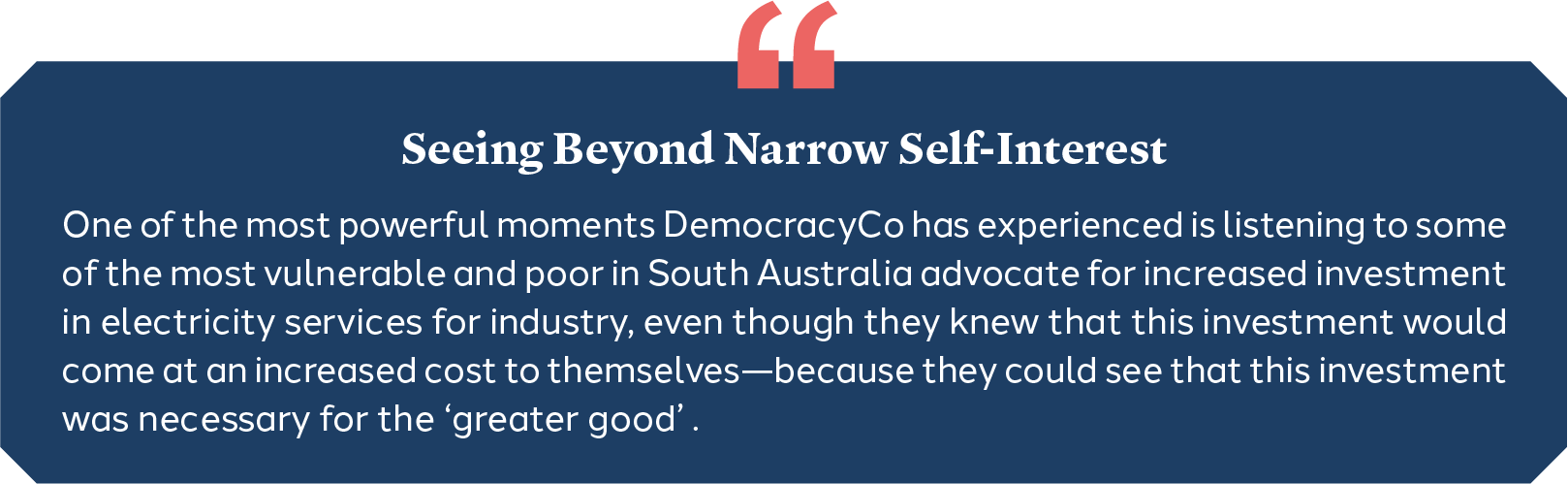
We know many people in public service may not have had such positive experiences; that they have often witnessed high degrees of division, conflict and negativity, with the community sometimes lashing out at government decisions, or showing complete disengagement and disinterest. In our experience of working closely with communities, both responses seem to come from a similar place: frustration with the lack of a meaningful opportunity to influence—a sense of powerlessness and a feeling of not being able to make a difference in the face of institutional authority.
The power to change this sits with public officers and the willingness to meaningfully engage. To move forward, those in the public service need to reconsider assumptions: but this means daring to trust in the community's capacity, doing so with a clear and informed understanding of "where community is at", and appreciating what is needed to get them to be ready, willing and able to engage meaningfully in policy issues.
NOTES
- Community means members of the public who aren't officially organised into identifiable groups.
- Deliberative polling is a method developed by Stanford University. See: https://deliberation.stanford.edu/what-deliberative-pollingr
- A really good example of a deliberative polling process is "America in One Room: Climate and Energy". See: https://deliberation.stanford.edu/news/america-one-room-climate-and-energy
- Ministry of Health, Singapore, https://www.moh.gov.sg/wodcj#:~:text=The%20Ministry%20of%20Health%20(MOH,manage%20diabetes%20as%20a%20nation.
- They are called Kitchen Table conversations because they are suited to casual, small conversations because they are suited to casual, small conversations — akin to conversations we often have around families around the kitchen table.
- Community Conversation Guide and Host kit along with other information about the process and project can be found at https://www.democracyco.com.au/climate-change/
- It is important to note that the bias in this group means that this data probably underrepresents the scale of the problem. As those attending the training have a bias towards being interested in community engagement, the group is more likely to trust in the public than public servants that have not opted to attend the training.