
ETHOS Issue 02
April 2007
Last updated on 30 July 2026
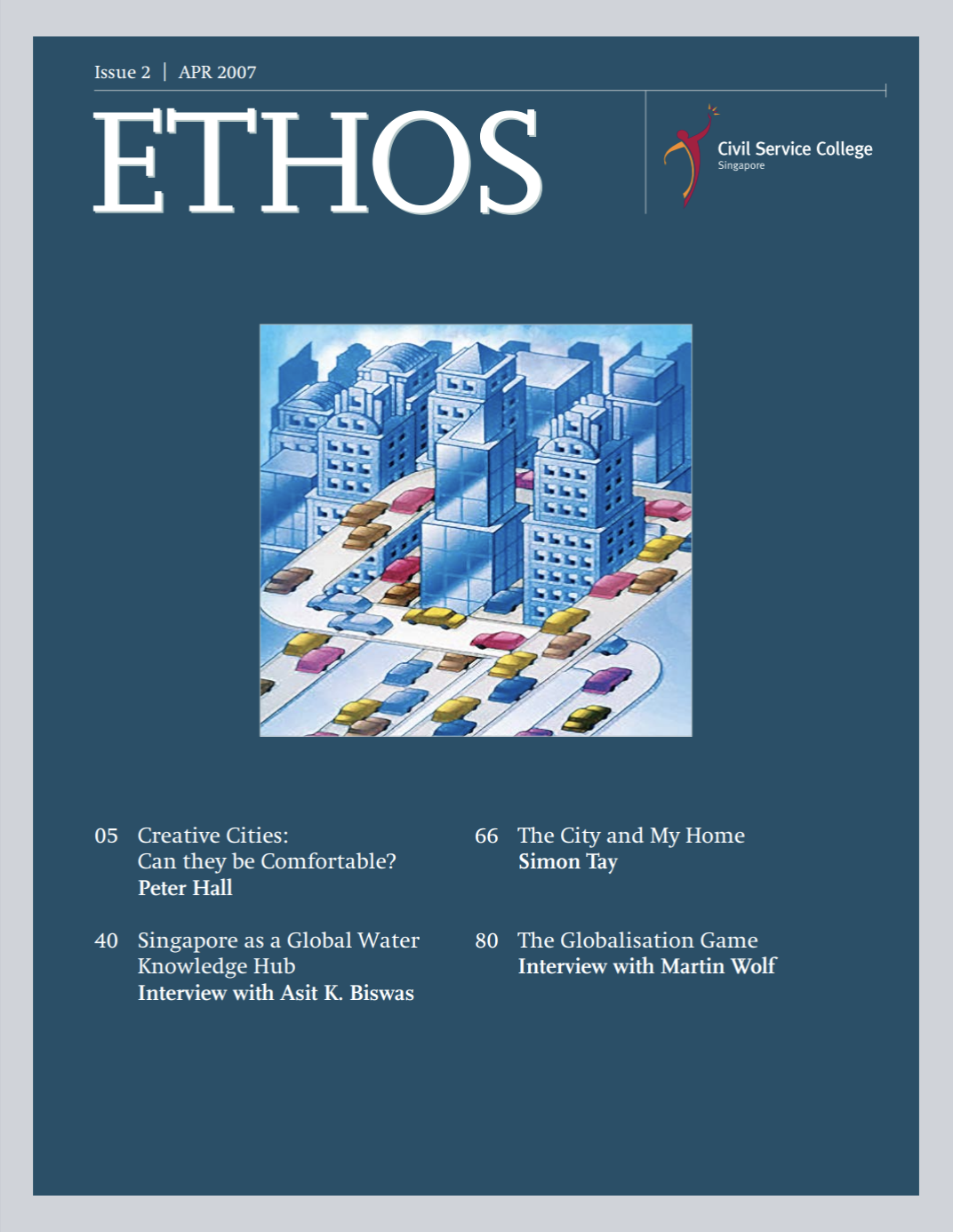
ETHOS Issue 02, April 2007
Urban planning and management strengthens a city’s capacity to respond to change. How might this capacity best be served? Featuring leading thinkers in the urban design space such as Professors Peter Hall, Asit K. Biswas, Simon Tay and Anthony T. H. Chin.
Download PDF (opens in new tab)
Editorial
Dr Alvin Pang
Editor-in-Chief Ethos
At heart, urban planning is about strengthening a city’s capacity to respond to change. The question is how this capacity might best be served.
Creative Cities: Can they be Comfortable?
Peter Hall
Many urban centres aspire to be creative global cities, but they should be prepared to embrace the tensions and turbulence of genuiue change.
Managing Singapore’s Land Needs
Melissa Sapuan
Visionary urban planning transformed a tiny island nation into a bustling business hub. Now Singapore has set its sights on becoming a distinctive global city.
Homes for a Nation — Public Housing in Singapore
Yap Chin Beng
To meet the changing needs and aspirations of a more affluent and diverse population, Singapore’s public housing will have to evolve in significant new directions in the coming decades.
Water Management in Singapore
Cecilia Tortajada
Singapore has developed from a water-scarce developing nation to a world leader in the field of water management in the space of three decades. Dr Cecilia Tortajada reviews the city-state's water practices and strategies in detail.
Singapore as a Global Water Knowledge Hub
Interview with Asit K. Biswas
One of the world’s leading authorities on water, Professor Asit K. Biswas is also the President of the Third World Centre for Water Management in Mexico. Speaking to Ethos, he argues that Singapore has the know-how and track record to position itself as the water hub of the world.
Implications of Prospect Theory on Road Pricing
Anthony T. H. Chin
While the economic costs of traffic congestion are well documented, the effectiveness of economic instruments, such as road pricing, in containing traffic congestion is less clear. Prospect Theory, a leading behavioural model in experimental economics, may explain inelastic driver behaviour in response to road pricing during peak hours. It may also shed light on the phenomenon of consumers who continue driving despite its higher economic cost relative to other modes of transport.
Wanted — An Ambitious Vision for Singapore’s Public Transport
Paul Barter
In order for public transport in Singapore to compete with the lure of private cars, a radical overhaul in regulation and organisation may be necessary.
Quality of Life in Singapore
Tan Li San
Can Singapore become one of the world’s most liveable cities in the 21st century?
Spaces and Scapes — Thoughts on Urban Planning
Aaron Maniam
Success in a changing world will demand more than technical skills: it will call for adaptability, empathy and a deeper sense of meaning.
The City and My Home
Simon Tay
Success in a changing world will demand more than technical skills: it will call for adaptability, empathy and a deeper sense of meaning.
Positioning Singapore in a New Asia
Andrew Tan
With the resurgence of Asian economies led by India and China, Singapore's economic prospects have never been better.
Strategic in Outlook, Nimble in Execution: Strengthening the Centre in the Singapore Government
Ng Chee Khern
To stay strategic in outlook and nimble in execution, the Singapore Armed Forces restructured its chain of command. Should the rest of the public sector follow suit?
The Globalisation Game
Interview with Martin Wolf
The award-winning financial journalist and author of Why Globalization Works discusses the role of government in a globalised world, and the impact of China’s rapid growth.
Discover more ETHOS issues
Explore our ETHOS collection for more insights on public service and governance.