

Leaving No Worker Behind: SkillsFuture and Singapore's Labour Movement
ETHOS Issue 29, Nov 2025

A Key Stakeholder in Workforce Transformation
At the heart of the labour movement in Singapore, NTUC advocates for the rights and well-being of every worker, striving to enhance their livelihoods. Beyond pushing for better wages, welfare, and job prospects for workers, NTUC strongly supports reskilling and upskilling, as training and career resilience are the best form of protection against global competition and economic disruption.
As Singapore navigates economic transformation in response to technological, demographic, and environmental shifts, the concept of a Just Transition becomes increasingly relevant.1 This is the idea that no worker should be left behind, and any change impacting them should be managed equitably. Labour unions play a pivotal role in this process, not only by anticipating industry disruptions and advocating for fair employment terms, but also by shaping training systems to be more inclusive and responsive.
Workers perceive labour unions as essential advocates — negotiating on their behalf and working with tripartite partners to implement supportive initiatives, including upskilling and reskilling opportunities.2 Strengthening these efforts will build an economy that is both future-ready and fair.
Over the years, NTUC has been at the forefront of workforce transformation, implementing initiatives to enhance employment and employability to ensure Singapore's workforce remains resilient, especially in the face of increasing uncertainties and evolving job demands. By proactively equipping workers with future-ready skills and enabling them to seize new, higher-value opportunities, NTUC continues to ensure they remain competitive in a knowledge-driven economy.
Continuous upskilling and reskilling are essential for sustaining employability, while businesses must evolve to harness the potential of a more skilled workforce. As Singapore transitions towards a more skills-driven economy, developing Critical Core Skills (CCS) such as digital fluency, global perspective, learning agility, creative thinking, and sense making become increasingly important for workers to navigate a fast-changing global environment.3 However, developing such adaptability hinges on active collaboration among stakeholders across companies, unions, and the Government, fostering a dynamic and responsive workforce system.
From the labour movement's perspective, Singapore's national SkillsFuture movement has laid important groundwork in building a skills-conscious society over the past decade. There has been growing awareness among both employers and workers of the importance of continual learning.
However, while structural systems have been built, the progress in worker-level outcomes remains uneven. Some sectors and demographics — particularly professionals, managers, executives, and technicians (PMETs) and unionised workers — have benefitted from more structured pathways. Non-PMETs, especially those in fragmented industries or without strong employer support, may not have seen the same level of advancement. Sectors with a large proportion of non-PMETs — such as manufacturing, construction, arts, entertainment, and recreation — could benefit from more tailored career and training pathways. In many sectors, upskilling remains difficult due to limited employer support, unclear training pathways, and practical barriers like time and cost.4 As a result, workers with the most to gain from training are often the least likely to access it.5 The COVID-19 pandemic further revealed how vulnerable non-PMETs are compared to their PMET counterparts.
While structural systems have been built, the progress in worker-level outcomes remains uneven.
Recognising these disparities, the labour movement plays a crucial role in advocating for policies and practices that safeguard and support affected workers and communities, and in representing their interests and shaping a more inclusive workforce strategy.
SkillsFuture: NTUC's Strategic Role
NTUC supports training that aligns with business transformation and future industry needs through a multi-level future-skilling approach to position Singapore for sustainable and inclusive growth, at various levels.6
At the national level, NTUC has extended its support in co-developing the Training and Adult Education Industry Transformation Map (TAE ITM) together with tripartite partners, providing access to critical and emerging skills by driving innovation, professionalising jobs, deepening skills, and increasing productivity.
At the employer level, NTUC's Company Training Committees (CTC) initiative aims to bring employer and worker representatives together to develop tangible, holistic transformation plans to ensure the workforce remains future-ready, relevant, and resilient. These CTCs can leverage support from the NTUC Job Security Directorate. From March 2020 to November 2024, CTC skills-based initiatives benefitted nearly 200,000 workers.
NTUC's Job Security Directorate (JSD)
NTUC's JSD supports worker training and upgrading and business transformation for a stronger Singapore workforce. With CTCs at the heart of the ecosystem, JSD is an integrated NTUC effort with integrated elements:
NTUC's Employment and Employability Institute (e2i) is an empowering network for workers and employers seeking employment and employability solutions. Recognising that targeted interventions are needed to effectively support workers, NTUC's e2i offers a range of employment facilitation, career matching services, and training and placement programmes, including career coaching and advisory services, job redesign, business training and transformation, and Career Conversion Programmes (CCPs).
NTUC's Industry Training & Transformation (IT&T) Department supports companies in workforce training and business transformation. It identifies critical skills gaps and develops targeted training programmes. These include training companies to conduct strategic business planning using tools to determine the training and learning gaps needed to position them for the next phase of growth.
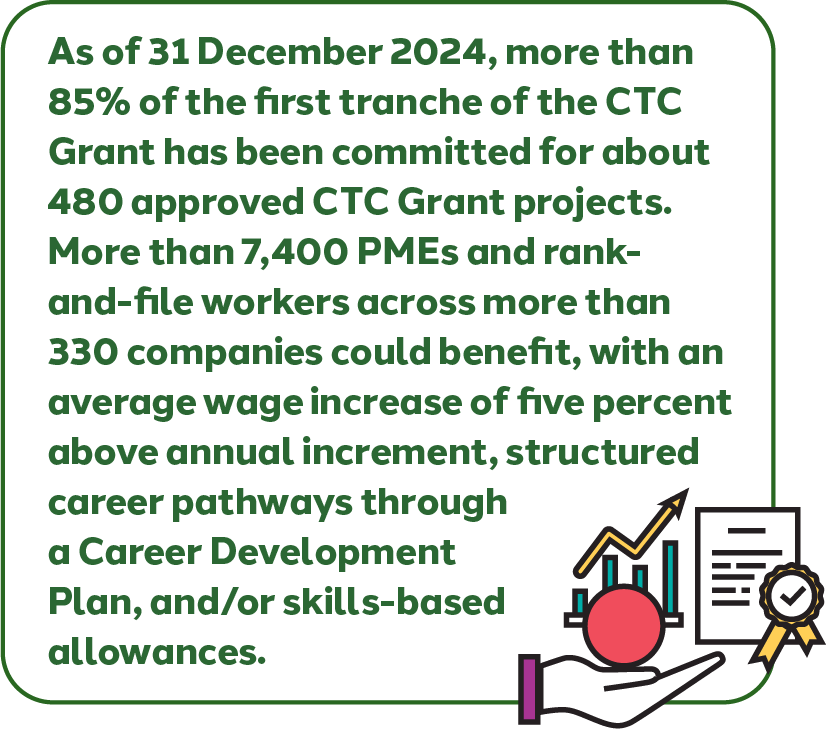
Companies can also drive business and workforce transformation by leveraging the CTC Grant and the Operation and Technology Roadmap. The CTC Grant, administered by NTUC's Employment and Employability Institute (e2i), is funded from the $300 million set aside by the Government to scale up NTUC's CTC initative. To help enhance business capabilities and worker outcomes, it funds up to 70 per cent of the qualifying cost for companies' transformation projects or training tied to a transformation project.
At the worker level, having a job is the best form of welfare. NTUC advocates for accessible, affordable, and industry-relevant training for all workers across industries and age groups to ensure continuous career development and employability. NTUC works to overcome challenges in reskilling and upskilling by providing both financial support (like Union Training Assistance Programme or UTAP) and structural workforce transformation programmes (such as NTUC's e2i and LearningHub) to make these opportunities easier to access.
Using AI to aid in job-matching
NTUC e2i's AI-powered Virtual Career Coach (VCC) is a sustainable and scalable digital assistant for matching jobseekers to appropriate roles and identifying skills deficits. It supports NTUC's e2i's career advisers by consolidating job listings from national and prospective job banks, as well as skills upgrading courses, in a single location.
The VCC delivers targeted job insights by rapidly analysing resumes and RIASEC-5 profiles (a profiling tool that assists candidates in understanding their personality, strengths, and work values to better identify suitable career options). It also spots skills gaps and makes tailored recommendations of relevant upskilling courses, helping job seekers better prepare for new job opportunities.
Since its launch in August 2024, VCC has helped more than 3,000 job seekers.
UTAP is an NTUC initiative that specifically complements SkillsFuture Singapore (SSG) by providing financial support to union members to encourage lifelong learning and skills upgrading. It makes upskilling more affordable for workers, especially those from lower-income groups or those transitioning between careers. NTUC union members can claim up to 50% of unfunded course fees, capped at $250 annually (or $500 for eligible senior members) for SF-approved and NTUC-supported courses. This complements the use of SF Credit, reducing out-of-pocket expenses for workers seeking training.
NTUC LearningHub (LHUB), together with SSG, collaborates with academic institutions to bridge the gap between theory and practical application within the Continuing Education and Training (CET) landscape. It contributes by enhancing the curation, development, and delivery of industry-relevant training programmes and short-term attachments that align with real world demand, continually improving trainer quality and pedagogical standards to address evolving training needs. Initiatives such as the Career Agility Hub app further demonstrate this role — supporting adult educators in identifying skills gaps and receiving tailored career development guidance.
Skilling Up Hope for Inmates and Ex-Offenders
LHUB and NTUC's e2i have worked closely with Yellow Ribbon Singapore (YRSG) and the Singapore Prison Service to support the reintegration of ex-offenders into the workforce.7 NTUC provides one-stop pre-release training and placement, including employability workshops before job interviews, career coaching, and job matching services.
In 2007, LHUB and YRSG jointly introduced the Digital Citizenship with Coding Fundamentals programme to equip inmates and ex-offenders with essential digital literacy skills, enhancing their employability in a technology-driven labour market.
The NTUC FairPrice Foundation has also pledged substantial financial support to the Yellow Ribbon Fund to advance lifelong learning and career development initiatives for ex-offenders, extending assistance also to their families. The Foundation also contributes to aftercare partners such as The New Charis Mission, the Industrial & Services Co-Operative Society Limited (ISCOS), and the Singapore Anti-Narcotics Association (SANA), supporting programmes that directly benefit ex-offender communities.
Collectively, these initiatives reflect a broader commitment to inclusive workforce development and fostering a society where no worker is left behind.
Challenges and Strategies for the Future
While NTUC's contributions to the SkillsFuture movement in collaboration with tripartite partners has borne some fruit, more can be done in the next bound to ensure that SkillsFuture will have a positive impact for all our workers.
First, as Institutes of Higher Learning (IHLs) evolve to become Institutes of Continuous Learning (ICLs), distinct pedagogical approaches and tailored learning designs will be needed to more effectively engage adult learners with work experience. Fostering a resilient and adaptable workforce calls for the adoption of andragogies that can equip workers to navigate dynamic work environments by prioritising curiosity, adaptability, and engagement with complex challenges.8 These frameworks could be leveraged to build learning cultures that promote proactive engagement, peer-driven knowledge exchange, and critical thinking in response to industry transformations. Both adult learners and employers also expect practical, outcome-driven education from ICLs.9 To ensure relevance and applicability, the labour movement can support ICLs in forging stronger ties with industry practitioners to co-develop CET, integrating practical insights and industry-specific expertise as part of their capability development framework.
Second, the pace of business transformation is accelerating, and the half-life of skills is shortening.10 Workers must sustain the validity and relevance of their knowledge and skills, and believe in a skills-first approach. Government institutions and the labour movement must support vulnerable segments of the workforce in their career transitions while also assisting small and medium enterprises (SMEs) as they strive to keep pace with skills development. However, Singapore's training participation rate fell to a nine-year low of 40.7 percent in 2024. This decline may partly reflect a shift in learning preferences, as more individuals — particularly those outside the labour force — appear to favour full-time education or deeper training engagements. This trend suggests a growing preference among some learners to prioritise in-depth skill development by fully committing to longer training programmes, rather than balancing training alongside active employment.11
Fostering a resilient and adaptable workforce calls for andragogies prioritising curiosity, adaptability, and engagement with complex challenges.
Third, marginalised and disadvantaged groups still face challenges having equal access to training and learning opportunities. Despite significant national efforts to promote lifelong learning and build a future-ready, career-resilient workforce, these groups continue to face barriers to equitable access. Participation in job-related training tends to decline with increasing age and lower levels of education attainment. Singapore's older adults show lower participation rates compared to the OECD average. Our part-time employed adults are also much less likely to participate in adult learning.12
More mature workers often encounter difficulties engaging in training and development, due to digitalisation and new technologies in the workplace.13 In Singapore, a survey revealed that 57% of participants reported a decline in training opportunities with age. This trend may contribute to career stagnation among mid-career workers, whose average age is 48.14 Moreover, training resources are often prioritised for employees perceived as 'high potential', rather than those with evident skills gaps.15 This presents a paradox: individuals already excelling in their roles are given further opportunities to improve, while those who may benefit most from upskilling are often overlooked. Individuals with prior training experience are also more likely to invest additional time and resources into future learning opportunities, compared to those who have not previously engaged in training.16 This suggests a learning inequality loop, where those who are already ahead continue to move further ahead because they are more engaged and better positioned to benefit from additional resources. Meanwhile, those who are behind may remain stuck without targeted interventions to break that cycle.
To disrupt this cycle, inclusive learning strategies must intentionally target and support first-time or hesitant learners, particularly among disadvantaged groups. This could involve increasing the recognition of skills acquired through flexible, short, and timely training. In parallel, encouraging employers to adopt a skills-based approach to hiring helps organisations tap into a more diverse talent pool of hires. Effectively implementing such inclusive strategies require more than financial incentives. Research indicates that strategies to incentivise both workers and employers in participating in training-related initiatives must extend beyond monetary rewards, as these are not always the primary barrier.17,18
Inclusive learning strategies must intentionally target and support first-time or hesitant learners, particularly among disadvantaged groups.
Fourth, the labour movement can cultivate a multi-way mentoring ecosystem that offers a flexible, network-based approach to support learners of diverse profiles and backgrounds across the workforce.19 Unlike traditional hierarchical mentoring models, each participant can assume a dual role as both mentor and mentee, depending on their strengths and areas of need. These peer-based exchanges facilitate knowledge transfer beyond job-specific competencies, encompassing digital literacy, career navigation, and entrepreneurial skills. By fostering reciprocal relationships, this mentorship model lowers the entry barrier to skills development and supports vulnerable groups who may otherwise lack access to formal training opportunities. NTUC's mentoring ecosystem complements structured training by embedding learning into everyday interactions, enhancing the relevance, accessibility, and uptake of continuous education across all segments of the workforce.20
Fifth, the labour force is seeing a growing proportion of mature workers, alongside a slowdown in younger workforce entrants. Mature workers and women with caregiving responsibilities continue to face barriers such as unequal access to employment, skills gaps, and difficulties in balancing personal and professional demands. The labour movement should continue to raise awareness of caregiving responsibilities, champion the protection of mature workers' rights, and advocate for fair and age-inclusive hiring practices. Additionally, bridging the gap between skill acquisition and employment is essential for this group: incorporating internships and apprenticeships into upskilling programmes can provide hands-on experience and enhance job readiness. These efforts will enable organisations to adopt more inclusive workforce strategies and contribute to a diverse and equitable labour market.21
The NTUC Mentorship Ecosystem
Beyond supporting workers in training and career placement, NTUC also supports workers' need for mentorship — an essential tool for career development, particularly for fresh graduates. The NTUC Mentorship Ecosystem empowers mentees to navigate their careers and provides mentors with opportunities for personal development and to pay it forward.
Since its launch in January 2025, over 1,100 mentors have joined the NTUC Mentors Network, across three programmes: the NTUC Executive Mentorship Programme, Women Supporting Women Mentorship Programme, and the NTUC Youth Career Mentorship Programme. NTUC partners with Republic Polytechnic to develop a structured career mentoring competency framework, reinforcing consistent mentoring standards and nurturing mentoring competencies across different domains and industries.
Looking Ahead
Tripartite partnerships play a crucial role in sustaining a future-ready workforce by ensuring access for workers to continuous skills development.22 In Singapore, this collaboration is centred on our CTCs. Through the vehicle of CTCs, companies and unions future-proof the workforce by monitoring industry talent demands, identifying jobs vulnerable due to digitalisation, and develop targeted training strategies.
There should be further efforts to support an increasingly multigenerational workforce, ensuring that training remains inclusive and accessible. Training solutions should also be responsive to evolving industry needs, emphasising long-term workforce resilience over short-term upskilling efforts.23 A resilient workforce will depend on a responsive and well-developed skills ecosystem. Strengthening collaboration with trade associations, professional bodies, and unions is essential for building a future-ready reskilling framework. Sustaining and scaling these capabilities over time will call for continued commitment.
The labour movement will continue to serve as a bridge between transformation and workforce adaptability. By driving innovative skills development initiatives and expanding collaboration across sectors, NTUC ensures that workers remain not just employable but empowered to thrive in an evolving economic landscape.
NOTES
- Chng, S., Neo, H., Tan, A., & Li, B. (2023). The Role of Labour Unions in a Just Transition: Insights From the Workers. Singapore Labour Journal, 2(01), 39-53.
- Ibid.
- Fang, B. X., Zhen, T. B., & Freebody, S. (2022). Critical core skills profiling in Singapore. Institute for Adult Learning Singapore.
- Osman, M. F. (2023). Upskilling for Non-PMETs: Challenges and Opportunities in the Policy Landscape. Singapore Labour Journal, 2(01), 107-116.
- Yang, S., Kang, R., Seah, Z., & Seet, D. (2022). Continuing education and training: Looking through the lens of business leaders in Singapore. Singapore Labour Journal, 1(1), 20–32.
- Gog, S. J., Tan, E., & Tan, K. (2024). Future-Skilling the Workforce: SkillsFuture Movement in Singapore. In Creating the University of the Future: A Global View on Future Skills and Future Higher Education (pp. 515-528). Wiesbaden: Springer Fachmedien Wiesbaden.
- Tay, P. (2023). Addressing employment challenges for ex-offenders. Singapore Labour Journal, 2(01), 89-95.
- Bound, H. (2024). Future-oriented learning in workplaces and company training committees. Singapore Labour Journal, 3(1), 47-64.
- Refer to Note 6.
- Refer to Note 6.
- Manpower Research and Statistics Department, Ministry of Manpower. (2025). Labour force in Singapore 2024. Ministry of Manpower.
- OECD (2025), Trends in Adult Learning: New Data from the 2023 Survey of Adult Skills, Getting Skills Right, OECD Publishing, Paris, https://doi.org/10.1787/ec0624a6-en.
- Ogg, J. (2021). Embracing a culture of lifelong learning: lifelong learning in ageing societies: Lessons from Europe. Hamburg, DE: UNESCO Institute for Lifelong Learning.
- Randstad. (2020). The prevalence of ageism in the workplace in Singapore. Randstad. https://www.randstad.com.sg/workforce-insights/workforce-trends/ageism-in-the-workplace-singapore/
- Yang, S., Seah, Z., & Chow, R. (2023). Fostering learning opportunities for workers: Looking through the lens of a practitioner. Singapore Labour Journal, 2(01), 96-106.
- Ibid.
- Yang, S., Seah, Z., & Kang, R. (2021). Upward mobility of workers [Unpublished manuscript]. National Trades Union Congress.
- Refer to Note 5.
- Lim, S. M., & Ibrahim, Y. (2024). Empowering the Next Generation: Navigating Challenges and Opportunities in the Modern Workforce Through Coaching and Mentorship. Singapore Labour Journal, 2024(1), 123-132. The authors highlight bridge mentoring—an innovative approach to mentoring and coaching, that connects workers across generations and industries—as an effective way to address cultural differences and knowledge gaps.
- Refer to Note 15.
- Chua, S., Kang, S. H., Sim, N., Shan, W. V., Fang, Z., & Han, S. M. M. (2024). Slowing Workforce Growth: Predicting Labour Trends and Investigating Perspectives of Mature Workers and Women With Caregiving Responsibilities. Singapore Labour Journal, 3(01), 6-30.
- Harvard Business Review Analytic Services. (2024). Training Workers for the Future Through Tripartite Partnerships. Singapore Labour Journal, 3(01), 90-100.
- Loh, C., & Yeo, W. S. (2024). Forward Singapore: Strengthening SkillsFuture. Singapore Labour Journal, 3(01), 114-122.