

Learning & Evolving Together: NLB's Transformation Journey
ETHOS Issue 29, Nov 2025
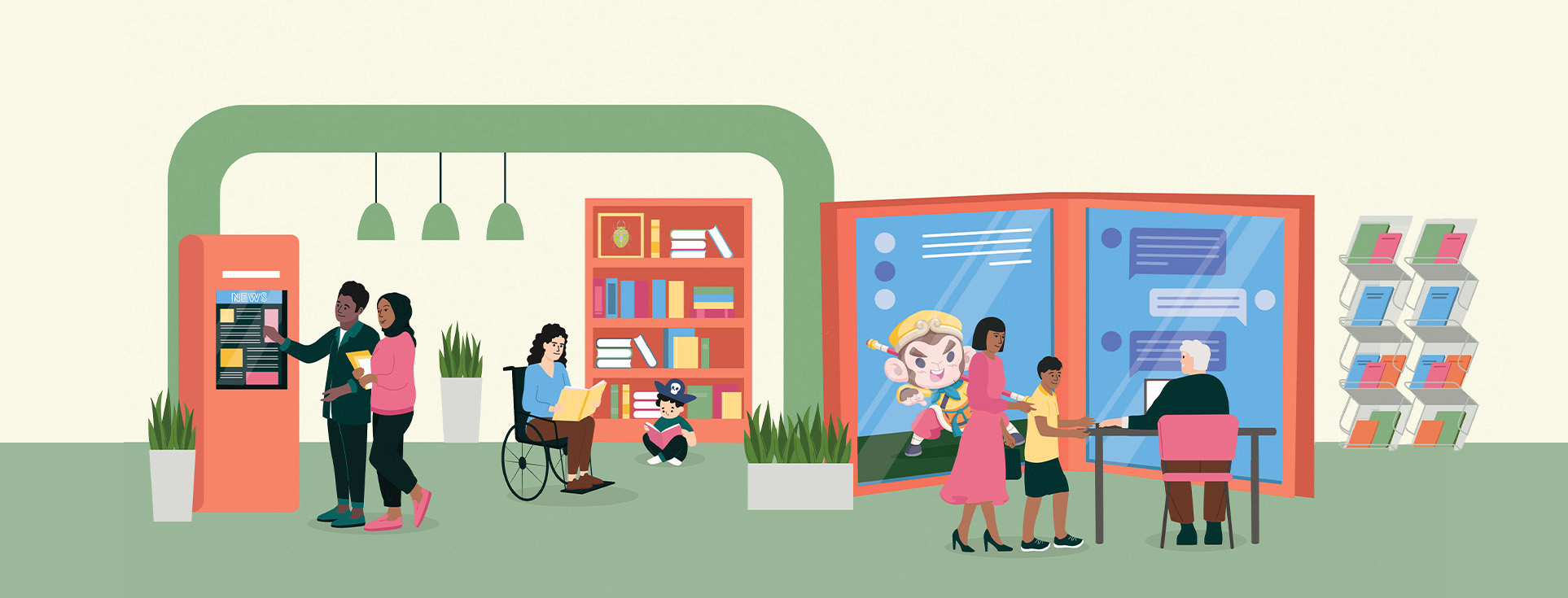
Singapore's National Library Board (NLB) is a thought leader in the international library and archives community, with many countries seeking to gain insights from our innovative approaches in transforming library and archival services. In our 30 years as a statutory board, NLB has continually reinvented itself: from our digitalisation drive to current efforts bringing new experiences in reading, learning and discovery to Singaporeans.
Every phase of our transformation has been driven by one overarching consideration: to better serve our patrons in their reading and learning. This is especially pressing today in a fast-changing environment that is constantly being reshaped by technological advances.
But even as we pivot and adapt, we take pains to ensure that we bring everyone along, from our patrons to our NLBians. Some colleagues have even suggested that "NLB" stands for No one Left Behind!
Transformation at the heart of NLB, In and Out
The first decade after NLB was established as a statutory board in 1995 saw us pursuing cutting edge innovations in library redesigns and processes. We set out to make our libraries a 'third place' with technology as an enabler, and worked towards delivering efficient business and excellent customer services.
To support this business transformation, we needed more staff with librarianship skills. Staff were encouraged to attend professional qualification courses to equip themselves with the necessary skills, including collection development and management, cataloguing and classification, as well as mastering specialist systems such as the Online Public Access Catalogue (OPAC) and the library circulation system that support all library transactions. As a result of these efforts, physical library spaces and library membership doubled, collection tripled, and visitorship quadrupled in six years.
Beyond championing reading and learning, we were also tasked with the preservation of Singapore's documentary heritage. To achieve greater synergy with the National Library in documentary heritage preservation, the National Archives of Singapore (NAS), previously under the National Heritage Board, became part of NLB in 2013.
When I became Chief Executive Officer of NLB in 2019, organisational transformation was at the top of my priority list, albeit with a different emphasis: to ensure that amidst the widespread disruption across different industries, NLB continues to be relevant to our patrons. At the time, NLB was already working like a well-oiled machine. However, having been involved in the SkillsFuture movement and the national push for continuing education and training (CET), I knew disruption from technological advancement and changing societal preferences would leave no sector untouched, including libraries and archives. The COVID-19 pandemic further upended any complacency we might have held: it sharply accelerated NLB's expansion into the digital space as a platform for both content and experiences.
Our response to these disruptions was LAB25 (Libraries and Archives Blueprint 2025), developed through rounds of brainstorming and visioning exercises with various stakeholder groups such as our patrons, partners, and communities. We looked at not just the libraries and archives space, but other related industries as well, such as the retail and content sectors, to see the innovations we could tap.
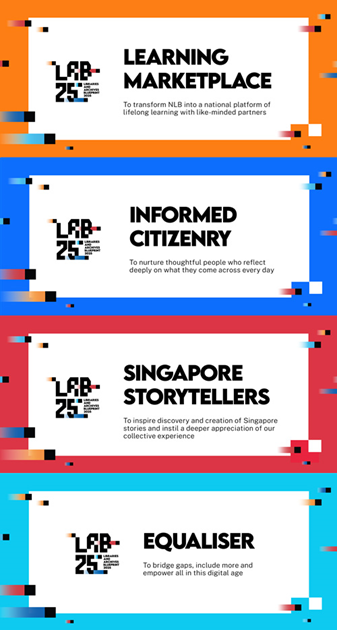
With its four main pillars, LAB25 was not so much a detailed roadmap laying out what ought to be done step-by-step, but instead it set broad directions for where we should be headed. Unlike NLB's past masterplans, LAB25 embraced an agile approach of continual experimentation and refinement, prompting us to prototype solutions, gather user feedback, and iterate our services in response to evolving community needs. It was an open call to all our partners and patrons, and our staff as well, to reimagine the future of libraries and archives together.
Transforming Team NLB
To achieve NLB's LAB25 ambitions, we had to get the entire organisation on the same page, and to move as one. Critical structural changes had to be made.
The first was to change the way we worked, which was easier said than done. While divisions already worked together on various platforms, these joint efforts could be further optimised for higher efficiency and productivity. We worked with our divisions to categorise and prioritise initiatives and projects according to our strategic objectives. Functional restructuring was implemented to prime and configure our work environment for greater agility across teams and divisions. NLB's three core business functions — the Public Libraries, the National Archives of Singapore and the National Library — came together as one to facilitate stronger synergy in content and platform sharing. We created enabler divisions, such as the Data Office, Partnership Division and Innovation Office, to optimise interdivisional collaboration and project coordination.
The second change was to transform every member of our staff. We recognised early on that our staff were our most important resource, and the largest champion of our efforts. As early adopters, they would be the faces of change in our libraries and archives. Our people had to share the LAB25 vision, embrace how their jobs would change, and learn new skills to enable them to fulfil our shared aspirations.
We undertook a major change management effort to help staff identify knowledge gaps and skillsets, providing ample space, opportunity, and mentorship for learning.
An example of such shifts was the job redesign exercise for Library Officers. Technological advances, and our library patrons' increasing familiarity with new technologies, meant we had to significantly transform job roles for our library and archives staff to stay relevant. Beyond their daily operational tasks, our Library Officers had to learn how to use new technologies and to take on some of the work traditionally undertaken by professional librarians. Some of them were apprehensive about this, doubting their own professional capabilities despite having good knowledge of our business from their years with NLB. We undertook a major change management effort to help staff identify knowledge gaps and skillsets, providing ample space, opportunity, and mentorship for learning.
Today, our Library Officers are confident in content creation, storytelling, curating book displays, as well as partner and community engagement: broadening their contribution to the library system. At the same time, this frees up our librarians to better support discovery and learning in bringing relevant content to the public in engaging ways, nurturing learning communities and building deeper engagement with partners to deliver learning programmes. Similarly, archivists have moved from collecting and preserving our documentary heritage to using digital technologies, affording the public greater access to Singapore stories.
Job redesign will need to be an ongoing effort, to ensure that our library and archives workforce continue to have relevant skills and capabilities in a rapidly changing environment. To give our colleagues greater clarity on the skills they needed to grow professionally and to implement LAB25, we developed a Libraries & Archives Competency Framework. This framework highlights the skills needed to grow as a NLBian, including areas like data analytics, learning & experience curation, omni-channel platform design, user-centric design and behavioural insights, among others. We also appointed Learning Champions experienced in each of these competencies to help drive this capability building effort.
This is a framework all NLBians can use. It includes tracks for generalists, as well as library and archives specialists, who want to develop the deep expertise to implement the transformation we need today, and introduce new ones in the future. The generalist and specialists career pathways have been made porous, so that our staff have wider opportunities to pursue across the organisation. Everyone at NLB is now the driver of their own professional destiny.
We have also introduced the Learning and Archives series, a regular internal session where respective Learning Champions and HR curate sharing sessions to learn from experts, such as teamLab (an international art collective renowned for creative immersive digital experiences), and companies like Singtel and Changi Airport Group, to share their expertise on omni-channel development.
To improve in data maturity towards more data-informed decision-making, we wanted to level up all our staff for the key competencies of data literacy and analytics. The newly formed Data Office led this drive. It developed a Whole-of-NLB approach to grow data analytics capabilities across the organisation based on how different roles would be expected to use data. This three-tiered strategy would:
1 |
Enable all staff to be able to support analytics work with good data collection and basic data numeracy |
2 |
Develop a group of Data Associates with data wrangling, analytics and visualisation skills to take on medium-complexity projects in their divisions, and |
3 |
Equip business unit leaders with skills to understand how to fully incorporate data collection and analysis into their business processes. |
To promote workforce agility and resilience, we encourage our officers to explore rotation opportunities, gigs and attachment programmes within NLB and in the wider Public Service. To support this, we even offered taster programmes: we created a Project Marketplace where officers could try to learn more about other roles and build their breadth of skills by volunteering to work on projects put up by other Divisions. This gives NLBians a better sense of new roles within the organisation that they might pursue in time.
To further grow the pool of library and archives professionals in Singapore, we established the NLB Academy (NLBA) in September 2024 to develop dedicated contextualised learning and development programmes. An immediate focus was growing internal staff capabilities, including in emerging areas such as the use of Gen AI in libraries and archives. The longer-term vision is for the NLBA to become a global thought-leader in training those in the libraries and archives world.
To enable change at such scale across NLB, regular internal communication has been critical. We have made deliberate efforts to share the LAB25 vision on multiple platforms, tailoring communications to our audience, to help staff see how their work relates and contributes in tangible ways to our LAB25 ambitions. This includes going to each of our libraries and archives sites regularly — I conduct CEO walkabouts at least once a year, in between two Townhalls and a Staff Forum — and to every division, to share my thoughts on LAB25, as well as hear their views, concerns and feedback and address them.
To date, the pool of Data Associates has successfully grown to over 116 strong.
I have reiterated the DNA all NLBians will need to deliver LAB25 successfully:
Ambition to aim high, set ambitious goals and push us further
Boldness to explore and try new technologies, new operating models and ways of working across the organisation
Clarity in knowing what we want to achieve and how it connects to the larger picture.
We have conducted multiple engagement sessions to help staff better associate with what the ABCs mean and how they can demonstrate these in their own ways. We update staff regularly on the progress of LAB25 projects, celebrate achievements, and extract valuable insights from sub-optimal outcomes — because it is equally important to learn from failure.
A National Partner for Evolving Learning Needs
In transforming Team NLB to pursue our LAB25 vision, we have embodied the SkillsFuture spirit of continual learning as an organisation. In the process, we have also enhanced NLB's capabilities as a partner for lifelong learning in Singapore.
NLB offers a wide range of programmes and services for individuals and groups to learn together, and at their own pace, regardless of age or educational background. Under LAB25, we made a deliberate effort to organise librarians according to user age groups to facilitate planning and deliver tailored programmes to their user segments. This two-pronged approach of going by age and learning has helped us build competency in content, audience preferences, and collaborations with partners.
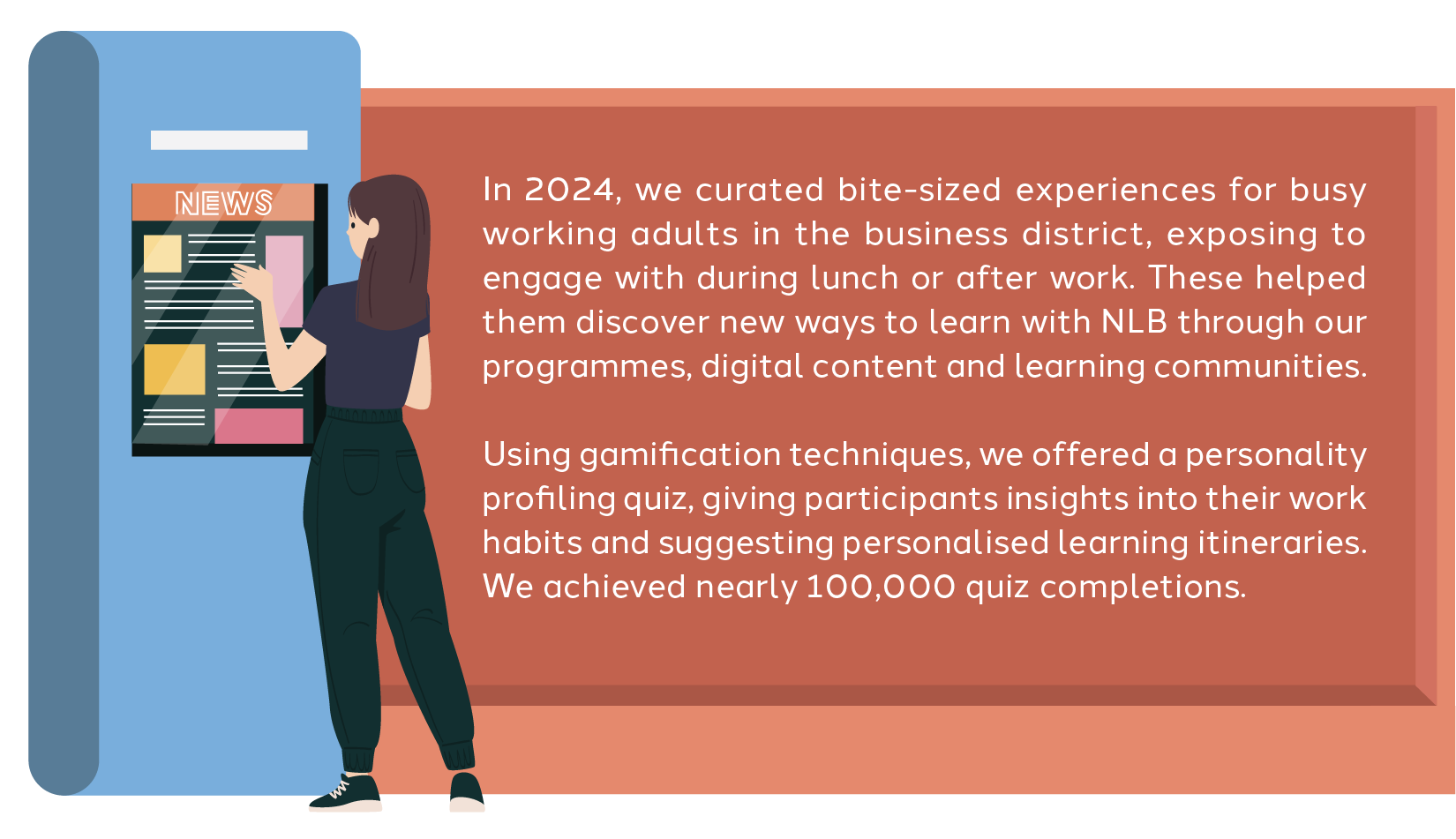
Based on users' interests, we have developed a framework comprising eight Learning Focus Areas: Digital, Careers, Sustainability, Reading, Science, Singapore, Wellness, Arts. We also support groups of learning communities by connecting patrons of similar learning interests, who can learn from one another in areas such as programming, Gen AI, dancing, upcycling, and history, to name a few.
It is now easier for library users to chart their own learning journeys. Through partnerships with the Institutes of Higher Learning, we have also curated tasters of SkillsFuture-funded programmes, enabling adults to learn practical knowledge and skills in under two hours, while signposting further learning opportunities with our institutional partners.
NLB has always taken pains to ensure that our learning resources are accessible to all. Some of our efforts to bridge societal gaps and empower people in this digital age include expanding existing outreach efforts to children from lower-income families to share the joy of learning. With our rapidly ageing population, NLB has also rolled out more innovative ways of engaging seniors less inclined to traditional reading formats, while helping them to equip them with digital skills.
With the opening of the Punggol Library in 2023, we also formally launched a comprehensive suite of programmes for Persons with Disabilities (PwDs). Taking on the spirit of LAB25, these services are co-designed and co-delivered by PwD users, caregivers and disability organisations. This collaborative approach has led to a remarkable increase of over 100% in the number of programmes led by persons with disabilities in the libraries from 2023 to 2024, and a significant 700% increase in the number of participants for these programmes.
Changes in content consumption patterns, in particular the move towards digital, has impacted not just the way we deliver our services, but also how our readers are consuming the written word. With LAB25, we are developing an omni-channel network of library and archives services that will make our content and services, including online learning resources, even more accessible to all.
With reading and learning possible anywhere and anytime, we have also bolstered our digital learning resources to include online platforms such as LinkedIn Learning, Infobase Learning Cloud, and Lightbox Learning Digital Platform. These cater to learners at various life stages.
Conclusion
It has been five years since we launched our LAB25 transformation journey. As we look ahead, NLB remains committed to embracing continuous transformation, recognising that organisational evolution is not merely a singular event but rather an ongoing process essential for sustained public sector excellence.
We have sought to embed this adaptive mindset within our institutional fabric, to ensure we continue to be ready to meet future challenges in an increasingly dynamic operating environment. This is not an easy task. We have been courageous so far to take the leaps we did. We are open to ideas and willing to try things outside our comfort zone. Where there were difficulties, we persisted in our pursuit of objectives, until we saw our efforts pay off.
NLB continues to embed new digital elements, including generative AI, cloud tech and virtual reality, in our LAB25 experiments — giving Singaporeans at all ages and abilities many opportunities to interact with emerging technologies in a less intimidating way.
NLB's transformation would not have succeed had NLBians not all recognised that we needed to reprioritise, and reorientate ourselves for the future, both as an organisation and to serve Singapore. Change does not sit easy with many. By making sure everyone in the NLB family is a part of the change, and working together through the challenges along the way, we have come closer as an organisation, and are the stronger from it.
We are still a work in progress. But as we mark our 30th anniversary this year, we will take the opportunity to turn the page and strive for a new chapter in NLB's evolution.