

Integrating Workforce Development with Enterprise Transformation through the SkillsFuture Movement
ETHOS Issue 29, Nov 2025

What is the role of WSG in the SkillsFuture movement?
SkillsFuture Singapore (SSG) and WSG work in close collaboration to lead the refreshed SkillsFuture movement to enable individuals to take ownership of their career health, and employers to invest in their employees' skills and career development, to drive business growth and transformation in a changing economic environment.
At WSG, our mission is to ensure that Singaporeans can access good job opportunities and build their careers at every stage of life. We strive to cultivate a culture of career planning, where every Singaporean is empowered to take charge of their career health. At the same time, we support employers in workforce transformation through job redesign and reskilling, enabling them to create good jobs for Singaporeans and develop an agile workforce.
Why are enterprise and workforce transformation crucial today?
Technology has been accelerating change and disruption in the economy for some time. Employers have traditionally carried out business change in phased approach: implement a new technology, train employees, observe results, then adjust job roles. However, this waterfall approach is no longer viable in today's environment. Today, tech is implemented with agile methodologies, and process improvement and business model innovation cannot succeed without concurrently having workers acquire new skills and take on new job roles. As enterprises adopt new technologies and business models, their workforce and job roles must also develop in tandem, or risk suboptimising the benefits these advances can bring.
Consider how artificial intelligence (AI) is reshaping business operations, creating both opportunities and challenges for workforce transformation. The Burning Glass Institute's report The Expertise Upheaval1 analysed GenAI's impact on the career pathways of over 200 occupations and revealed a critical challenge: as AI reduces demand for entry-level positions, employers must fundamentally rethink how they build expertise that was traditionally acquired through learning on the job. Employers must redesign existing roles to focus on value-adding tasks that complement AI adoption, while concurrently developing new career pathways for professional growth for their workforce. The challenge lies in workforce planning — identifying the transferable adjacent skills that individual workers can leverage in new roles, finding alternative positions that will make use of their expertise productively, or helping them reskill to perform new tasks. While technology creates opportunities, only through redesigned jobs, alternative career pathways and strategic workforce planning, can organisations drive productivity gains while ensuring their employees remain central to business transformation rather than displaced by it.
Another factor to consider is the changing workforce demographics. Although our resident labour force participation rate has increased from 63.2% in 2003 to 68.2% in 2024,2 with the largest increases observed among seniors aged 65 and above, our workforce participation rate for those aged 40 to 59 still lags leading OECD countries.3 Some of these individuals may choose to shift to different roles at this stage in life, requiring employers to move beyond conventional talent strategies and rethink careers and workforce development. Employers should support older individuals seeking new ways to contribute their professional expertise while balancing work, life and personal aspirations. Workplace practices must also evolve to meet younger workers' expectations for more dynamic or multi-stage careers and meaningful integration of work with personal priorities. The challenge for businesses lies in meeting these diverse aspirations while managing a multi-generational workforce effectively.
Organisations no longer have the luxury of hiring skilled workers when needed, nor waiting years for educational institutions to generate the required talent.
Finally, the breakneck speed of change, Singapore's vulnerability to geopolitical tensions and trade disputes, and stiff global competition for skills mean organisations no longer have the luxury of hiring skilled workers when needed, nor waiting years for educational institutions to generate the required talent. Instead, they must reskill their existing workforce, optimise adjacent skillsets, and encourage on-the-job learning as the business landscape evolves.
How is WSG helping employers and employees develop in tandem?
Enterprises need targeted support to navigate these complex challenges effectively. However, enterprises are not all alike. They may be at different stages of development or have different business priorities. Additionally, some may be willing to invest in their workforce as part of their business growth but lack the resources or know-how to do so effectively.
To address the critical need for a more integrated enterprise and workforce transformation, WSG is introducing an Enterprise Workforce Transformation Package (EWTP)4 to spur workforce and jobs transformation and strengthen its nexus with broader business transformation efforts. We want employers to think of their local workforce as an important component of business success, as they pivot their strategies to meet rapidly changing marketplace challenges. Through a single channel with holistic, end-to-end support, EWTP seeks to help employers adopt relevant workforce transformation solutions to meet both business and individual needs. These should translate into both business objectives, and better worker outcomes.
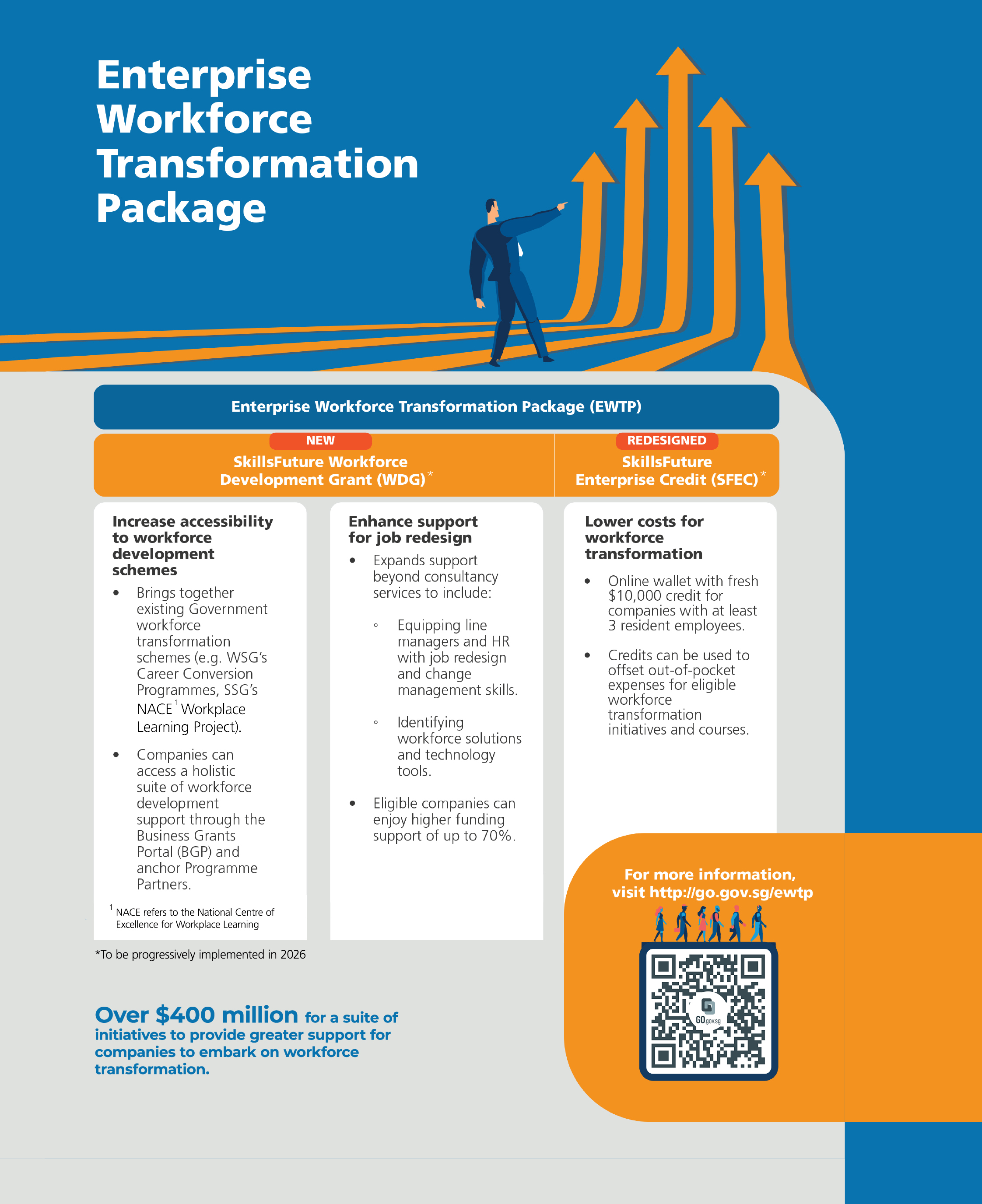
At the broader level, the Career Health SG initiative, led by MOM, WSG and SSG, encourages individuals to take ownership of their career journeys and build their career health, while working with employers to create environments and opportunities that enable such workforce growth. As skills requirements evolve faster than formal qualifications and career pivots become the norm, employers must adopt skills-first practices to expand their talent reach across attraction, hiring, development and redeployment. This approach delivers mutual value: workers can leverage their existing capabilities to access broader opportunities, while employers tap into deeper expertise and more diverse talent pools.
In essence, employers must recognise the symbiotic relationship between individual career resilience and business sustainability. By making the nexus between enterprise transformation and workforce transformation a business priority, organisations become more agile and ready for future disruptions.
Who can we work with to drive this integration?
Recognising that different sectors face unique transformation challenges, WSG has been working closely with sector agencies (SAs) to develop tailored approaches to workforce development. Our partnerships with SAs have yielded concrete outcomes, including sector-specific Jobs Transformation Maps (JTMs), which examine the impact of key trends such as artificial intelligence, automation, digitalisation and sustainability on sector-specific jobs and skills. The JTMs provide recommended pathways for employers to reskill their workforce in growth job roles and redesign jobs to align with rapidly evolving industry developments. They also offer customised programmes that address industry pain points such as the Career Conversion Programmes (CCPs). However, we recognise the need to further deepen these handshakes with our counterparts. Moving forward, we will work more closely with SAs to embed workforce transformation considerations into their sector development strategies from the onset, ensuring that business transformation and workforce development are planned and executed in tandem.
Employers must recognise the symbiotic relationship between individual career resilience and business sustainability.
How is WSG gearing up to become more effective in supporting enterprise and workforce transformation?
To effectively deliver integrated support to employers, WSG itself must transform. In the past, WSG's primary mission was keeping Singapore's unemployment low: matching jobs with workers. Moving forward, WSG will have a stronger focus on quality employment and meaningful careers. Individuals must proactively career plan and acquire relevant skills to secure suitable good jobs, whereas employers must invest in job transformation and workforce development. Done well, this translates into good job matches and positive outcomes for both individuals and employers.
Achieving this focus requires WSG to evolve from direct service provider to a leader of the career and employment services ecosystem. While previously WSG provided career matching services directly, we will increasingly work with industry players with the necessary reach on the ground. Our fellow public agencies can be allies, as they are embedded in their respective sectors, and have influence over the players involved.
We will work with more private sector players to enable the development of a vibrant career and employment services ecosystem, with a variety of qualified service providers working in concert to help individuals and employers identify and access relevant support. For instance, to enable more employers to engage in job redesign, we will curate capable providers who can support employers: including trainers, consultants, tech developers in the HR space, and others with relevant expertise. Employment agencies, with the right incentives, could also do more to optimise matching, be it through encouraging employers to redesign jobs or prepare jobseekers to acquire necessary job-ready skills.
Collectively, we need an urgent, shared imperative to build up a skilled local workforce, given the sweeping changes across the labour landscape. For our public service colleagues, this represents an opportunity to directly impact the economic resilience and social mobility of Singaporeans: a chance to improve lives directly and lay a foundation of opportunity for future generations of Singaporeans.
The Benefits of Job Redesign
WSG initiatives have catalysed and supported the transformation journeys of many enterprises in Singapore. Mrs Bernadette Giam, Director of Corporate Affairs and Human Resources of local catering firm Creative Eateries, shares how WSG efforts such as the Career Conversions Programme (CCP) have made a difference to their business and industry.
Job redesign has been a critical enabler in our transformation journey, allowing us to broaden our employees' scope of work and equip them with skills beyond their day-to-day roles.
For example, when we tapped on the CCP in sustainability, our employees attended courses that provided a deeper understanding of sustainability frameworks and their practical applications. This knowledge enabled the team to explore areas such as carbon management and food rescue, and their application to our food and beverage industry. They learnt to understand how consumer expectations are shifting towards sustainable practices — from sourcing and packaging to waste reduction — and how to use this these insights to better tailor our offerings. Ultimately, these initiatives gave our employees the confidence and knowledge to support the company's growth in more future-ready directions.
Job redesign has delivered tangible benefits for us in several areas:
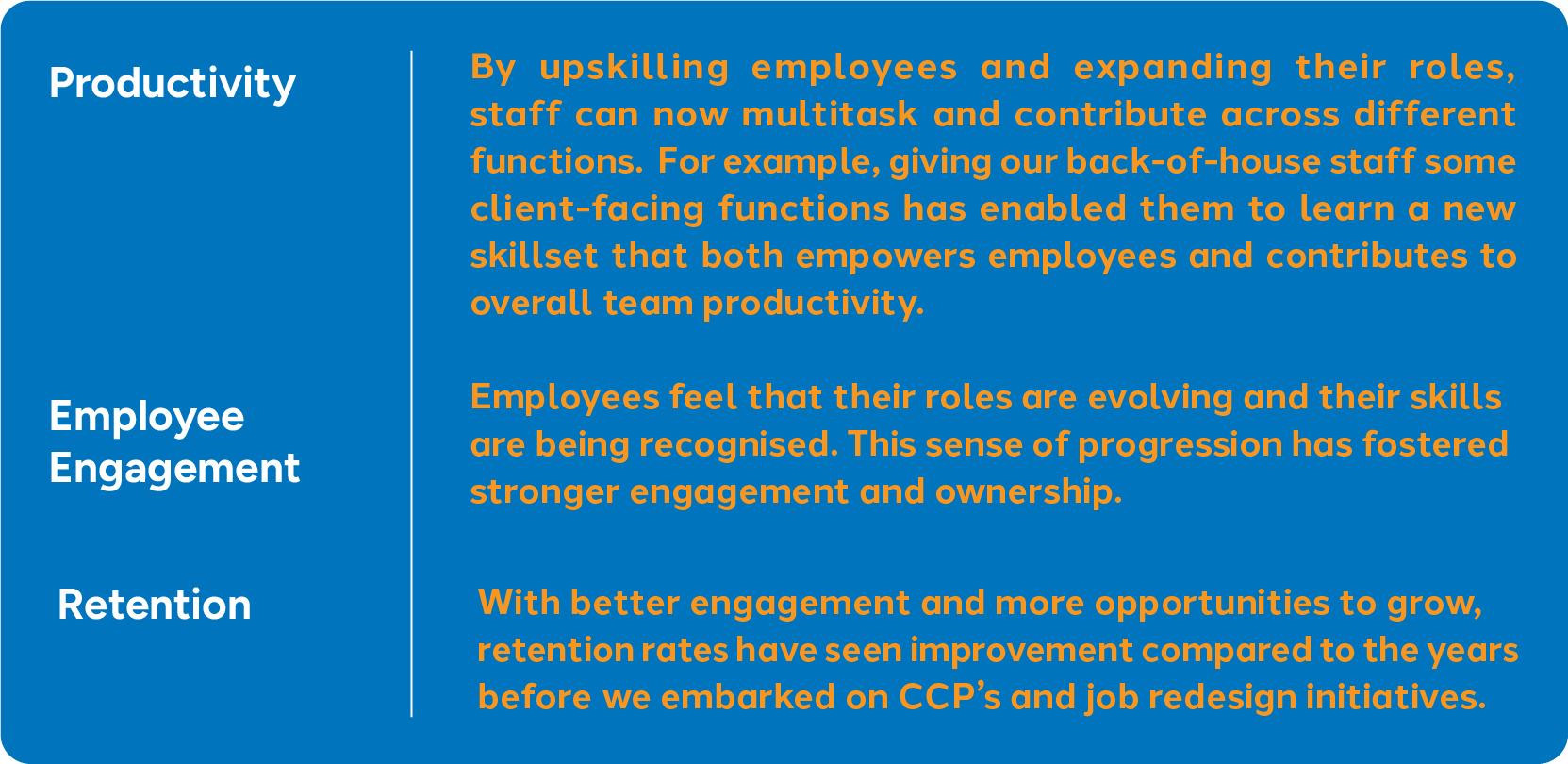
Overall, job redesign has helped us build a more adaptable, motivated, and resilient workforce while enhancing business performance.
In strengthening employer-employee partnerships in our industry, we have also found several factors to be vital:
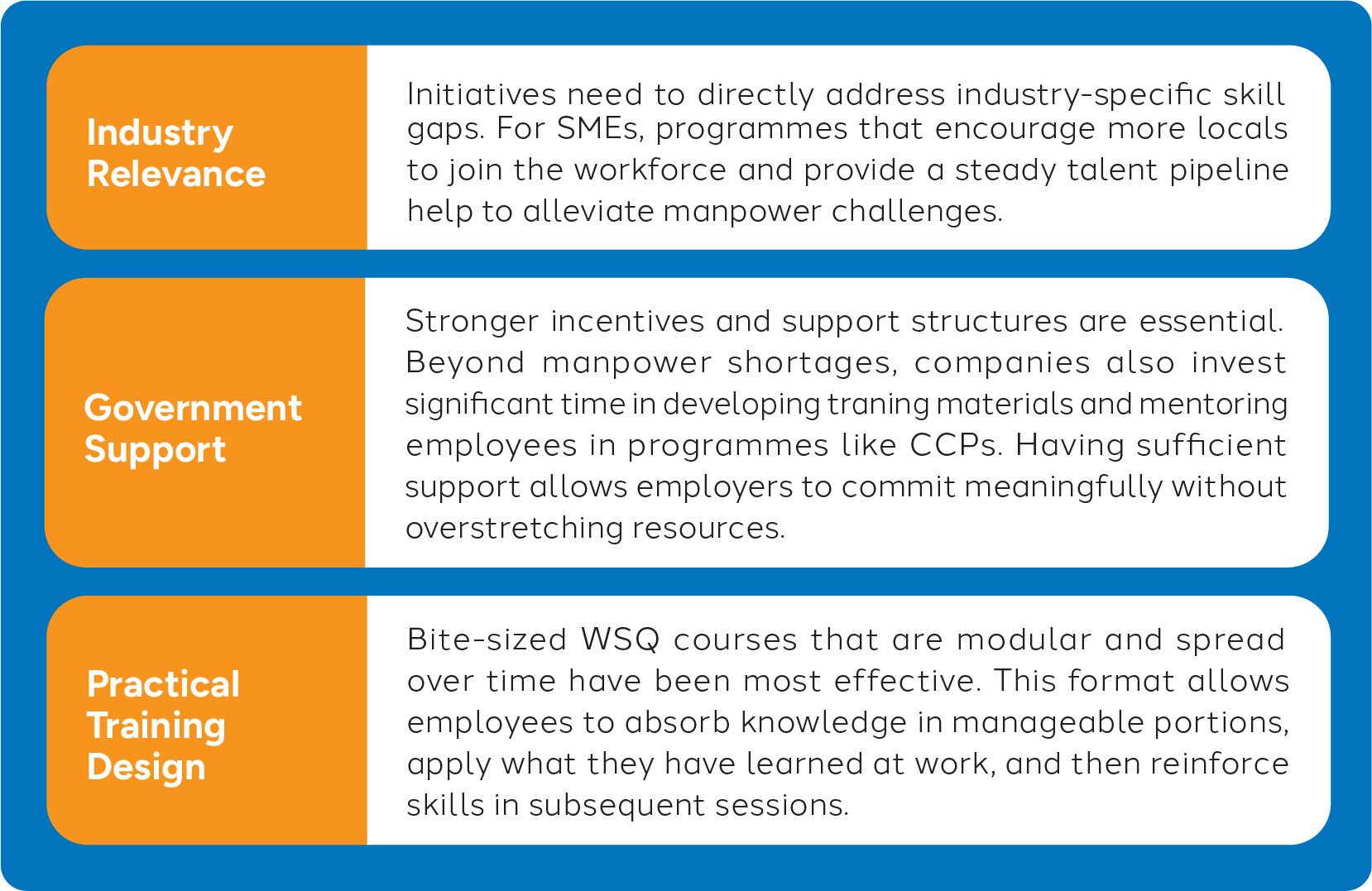
Together, these factors nurture an ecosystem where both employers and employees can succeed in workforce development.
NOTES
- The Expertise Upheaval. https://www.burningglassinstitute.org/research/the-expertise-upheaval
- According to the Ministry of Manpower's Report on Labour Force 2024
- According to MOM's Labour Force Survey 2024 and OECD's 2023 data
- EWTP is a multi-agency effort led by the Ministry of Manpower (MOM) and WSG, together with Ministry of Education (MOE), Ministry of Trade and Industry Singapore (MTI), Enterprise Singapore (EnterpriseSG), and SkillsFuture Singapore (SSG).