

Building a Skills First Society
ETHOS Issue 29, Nov 2025

Singapore's Whole-of-Nation Pursuit of Human Capital Development
The fundamental difference in Singapore's policy position towards upskilling and reskilling lies in our commitment to our people. As a small country, people are our only resource, so we invest in our people from their formative years through tertiary education and beyond. This approach is unique because whilst many societies front-load their educational investment in the early years, or focus training resources on those with fewer means or who are unemployed, we make a continual investment in every Singaporean throughout their lives.
Building the Foundation to Move from a Skills-Based to a Skills-First Society
Singapore's workforce development journey has always been about staying ahead by equipping our people with the skills and competencies needed to drive productivity, growth, and competitiveness.
In the early 2000s, we began articulating skills requirements at the sectoral level through initiatives like the National Skills Recognition System (NSRS) and Workforce Skills Qualifications (WSQ), our first foray into skills-based credentialing. During the first ten years of the SkillsFuture movement, SkillsFuture Singapore (SSG) partnered with tripartite partners in developing sectoral skills frameworks as part of the Industry Transformation Maps. We had the foresight to couple talent and skills needs with industry transformations.
An important foundational element of the sectoral skills framework was clarifying what kinds of jobs and skills we need for the sectors and the Singapore economy, and how they are changing — the development and regular updating of sectoral skills frameworks is used to shape Continuing Education and Training (CET) design and delivery.
Skills as a Common Language
Building on the thirty-eight sectoral skills frameworks, SSG has developed a comprehensive national jobs-skills intelligence engine, which is powered by big data, advanced analytics, and algorithms. Today, we have a common taxonomy of jobs-tasks-skills that allows us to adopt a data-driven understanding of how jobs, tasks, and skills are evolving, and where new opportunities emerge.
In early 2025, SSG launched the Job-Skills Portal with the aim of democratising job skills data, insights, and dashboards. Anyone can now use this data, which is updated on a quarterly basis: for planning or comparison purposes, to aid decision-making, or to build their own apps. Individuals and enterprises are using the dashboards and insights to make informed decisions on skills development requirements. Education and training institutions are using the data for course planning. So are career development professionals — they use the insights and dashboards to guide their clients who are exploring career choices. Sector agencies are using the data and SSG-developed algorithms for sectoral talent and skills planning.
For the first time, we have a dynamic system enabling individuals, enterprises, professional bodies, trade associations and chambers, the labour movement, as well as educators, to speak the same skills language — making decisions with clarity, agility, and foresight.
The Urgency of Our Times
The need for this shift to skills first has never been more pressing. Between 2019 and 2024, every job in Singapore experienced changes in skills requirements, with 43% seeing major shifts in tasks performed. This reflects the profound transformation underway as businesses evolve their models and talent strategies.
Our demographic realities compound this urgency. Individuals will need to remain economically active for longer, often navigating multiple careers. Lifelong skills renewal has become essential, not optional. With digital tools, artificial intelligence, and automation reshaping work at an unprecedented pace, qualifications alone will no longer suffice. It is skills being current, demonstrable, and transferable that will determine employability and competitiveness.
Skills-First Practices: Opportunities for Collective Action
Internationally, momentum is building. LinkedIn has become a skills-based marketplace connecting talent with employers. Coursera and Pluralsight highlight in-demand skills and recommend relevant courses. Major technology firms are hiring based on competencies, not just degrees. The World Economic Forum, together with PwC, has published framework to accelerate skills-first adoption. The message is consistent: in our fast-changing world, skills-first practices are essential to unlocking talent and opportunity.
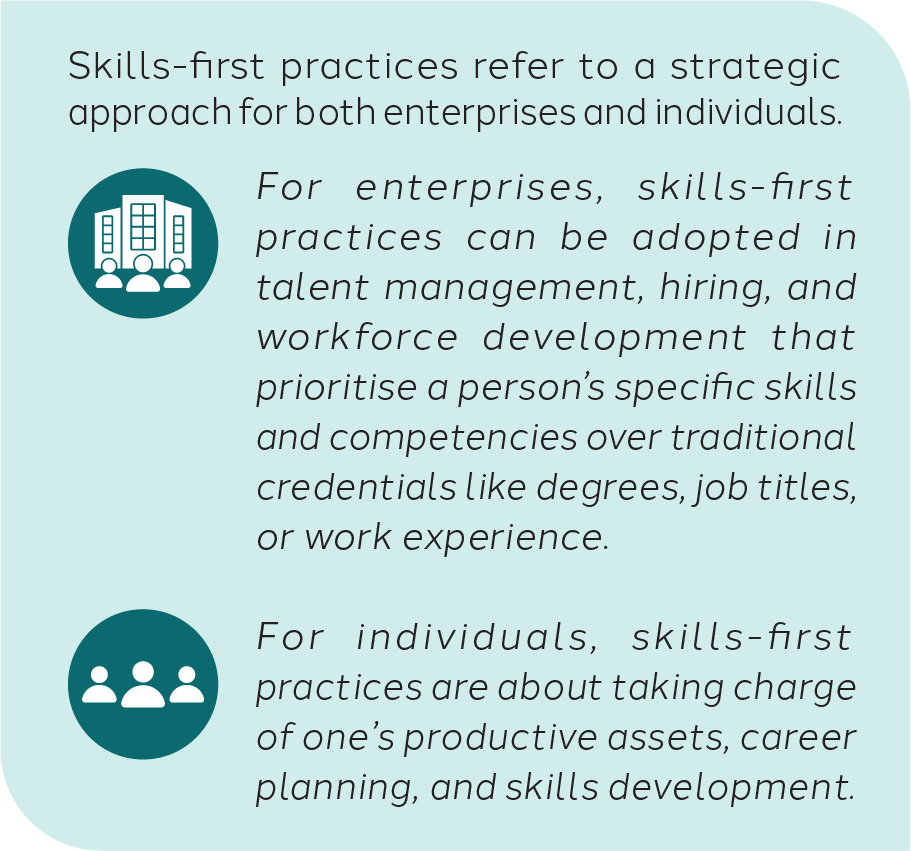
To support Singapore's move towards a Skills-First society, the Centre for Skills-First Practices (CSFP) at the SUSS Institute for Adult Learning was set up to help build capacity and mindshare across Singapore's skills ecosystem. It helps develop analytical methods that provide insights into skills demand, supply, gaps, and solutions, and champions collective efforts, both globally and in Singapore, to optimise human capital development and the effective use of skills.
Among CSFP's key initiatives are its Skills-First Working Papers and roundtables series,1 designed to catalyse dialogue, surface fresh perspectives, and encourage the co-creation of practical solutions:
>Paper 1: "Skills-First: Are We There Yet?" investigates structural inefficiencies that hinder systemic change towards a skills-first economy and attempts to identify the critical questions that key stakeholders — individuals, employers, and policymakers — need to examine closely. The paper calls for deeper reflection and joint action to enable skills to function not as a peripheral consideration, but as a central organising principle for inclusive and responsive labour markets.
Paper 2: "Skills-first: What Does It Mean for Me?" focuses on individual agency by delving into the potential barriers that hinder individuals from managing their career planning and upskilling. The paper further calls for an individual-centric career paradigm to redefine success in education and work, and highlights crucial questions to be addressed from an individual's perspective.
Paper 3: "Skills-First: What Does It Mean for My Organisation?" examines how employers understand and engage with skills-first practices in real-world conditions. It supports employers in kickstarting their own journey towards a skills-first organisation that enables greater performance and resilience by sharing ideas from the ongoing experimental practices of forward-leaning employers.
CSFP and the OECD have also developed and published the world's first Skills-First Readiness and Adoption Index.2 The index provides a multi-dimensional view of readiness and adoption across 30 OECD member states and Singapore. The index provides comparative analysis for the participating economies to review their skills-first practices.
Reducing Friction for a Skills-First Future
There are several challenges that we will need to overcome in order to fully realise our vision for a skills-first Singapore.
First is the issue of signalling. A skills-first approach does not mean traditional qualifications are redundant. Qualifications are in fact a form of signalling: individuals who have earned qualifications have certain abilities and a base set of skills that can be assumed. The issue is that certification is often subject-based and does not clarify the skills that are involved in earning the qualifications they bear. To address this, SSG has implemented a skills extraction algorithm for all courses we fund, which will automatically tag training programmes with the skills they will inculcate, subject to the training provider's or educators' review. This will help ease the transition process so that anyone who goes through these courses can be expected to have the associated skills.
A thornier issue arises when there is signalling failure, such as when an employer does not know or cannot articulate what skills their business will need, and so cannot activate training to develop the right skills for their workforce in good time. This is a challenge particularly faced by small and medium enterprises (SMEs) with limited resources. To assist them, we are piloting a job skills profiling tool for 1,400 SMEs, with a drag-and-drop interface to help them quickly associate a job role in their business with related skills. We are also looking into ways to help employers verify the skills individuals declare in a workplace setting. After a pilot trial, TalentTrack/TalentTrack+,3 a subscription-based skills profiling tool, was introduced to SMEs in August 2025.
Individuals face signalling difficulties when they are not able to articulate the value of their capabilities.
On the other hand, individuals face signalling difficulties when they are not able to articulate the value of their capabilities. They may have significant skills not reflected in their qualifications or job experience. Over the years, SSG has continually enhanced the Careers & Skills Passport, which is an employment and skills registry. The Careers & Skills Passport hosts verified skills of individuals. An upskilling recommender linked to the Careers & Skills Passport is available to support skills development decision-making.
A second challenge is that of risk asymmetry. Many employers today are reluctant to invest in training their staff only to have them leave before the business recoups a return on their investment. In turn, individuals may be reluctant to go for extensive training when the expected outcome is unclear. How then can we help both employers and employees change their mindsets to see the gains from investing in training more quickly and explicitly, perhaps by more directly relating training to application in the workplace? The Centre for Skills-First Practices is currently prototyping a work redesign solution to help businesses leverage skills and work redesign to evaluate the new skills requirements for their employees.
A Vision of a Skills-First Future
Skills-first practice is needed to support our whole-of-nation SkillsFuture movement. Over the next five years, we will expand these efforts. Our vision is for Singapore to become the most progressive economy in applying skills-first practices, where both enterprises and citizens reap the benefits.
We envisage a Singapore where individuals have career self-planning capabilities and can chart personal growth pathways and effectively demonstrate their competencies at work, rather than leaving career decisions solely to employers. Where employers adopt skills as a core business strategy, maintaining clear sight of their organisational capabilities and aligning skills needs with business goals, rather than leaving skills out of business decision-making. Where education and training institutions deliberately shape learners' competencies, focusing on employment outcomes and the practical application of knowledge and skills at work.
These new behaviours require our entire ecosystem to embrace skills-first practices. During recent roundtable discussions, participants identified four key groups as movers and shakers in realising this vision: business leaders, human resources professionals, career coaches, and adult educators.
Encouragingly, Singapore Business Federation and Singapore National Employers Federation are leading skills-first adoption among their members. The Institute of Human Resource Professionals has launched new programmes equipping members with capabilities to implement these practices. Career development professionals are stepping forward to use jobs-skills resources to support their clients.
Now is the Time to Act
SSG is developing enabling capabilities and platforms, supported by technology, to support this shift in perspective for both employers and individuals and help them make better decisions for the present and the future.
The cultural change we seek is a long-term effort. We must build the tribes — the stakeholders and tripartite partners — that can help sustain this effort in the coming years. These will include those in the labour movement, institutes of higher learning, training providers, and the career coaching community. We will need first movers and firestarters among our SMEs to show the way and grow enough in numbers to be able to multiply impact. We should engage with employment agencies because they have a direct influence on recruitment behaviours and need to also adopt the language and mindset of a skills-first approach. Such efforts will need to take place one individual, one company, and one organisation at a time, until the mindset takes root.
The Public Service also has an important role to play. As a multigenerational workforce and significant employer, it can set the tone in supporting individual officers taking ownership of their own productive assets, giving them time and space to tend to their own interests and skills needs, and to realise what it is they want for themselves. The HR community within the Public Service can also contribute by helping to clarify what skill stocks they have. Leaders can encourage their staff to set aside time to use the career skills passport to document and verify their skills, role-modelling this self-reflective behaviour for other organisations. Our workplaces can also generate authentic innovation opportunities for staff to participate in and to develop new ways of doing things.
Singapore is already a Blue Zone for longevity in the world. If Singapore succeeds in developing a culture where each of us is empowered to take charge and take care of our career health — and indeed, our lifelong skills health — we may become the first Blue Zone for skills in the world. This will mean that regardless of the rapid changes the world is undergoing, we will not be anxious but instead have confidence that we can learn, grow, and adapt, managing our own best productive assets whilst supported by a strong and capable ecosystem. We have made a promising head start towards this future.
NOTES
- Institute for Adult Learning. "Skills-First Papers." https://www.ial.edu.sg/resources/publications/skills-first-publications/skills-first-papers
- Institute for Adult Learning. "Skills-First Readiness Adoption Index." https://www.ial.edu.sg/resources/publications/skills-first-publications/skills-first-readiness-adoption-index
- SkillsFuture Singapore. "TalentTrack." https://skillsfuture.gobusiness.gov.sg/support-and-programmes/talenttrack