

Embracing Skills Development: The Employer’s Perspective
ETHOS Digital Issue 14, Dec 2025

Changing Mindsets on Upskilling
The push for skills development was not new even back in 2015, when the SkillsFuture movement was launched. It had been a consistent theme throughout Singapore's economic development since independence. However, while employers broadly recognised the importance of lifelong learning and workforce upskilling, implementation varied. Understandably, transformation requires investments and carries risks. Therefore, some businesses would naturally maintain a more cautious and cost-conscious approach. Furthermore, we must recognise that sustainability of the business comes first and this could mean that businesses sometimes had to prioritise immediate operational demands over longer-term investment in workforce development.
Larger firms such as those in high-skilled industries tended to be more proactive in training, whereas other companies, particularly the SMEs, were hesitant to allocate time and resources for training due to internal constraints. Smaller companies had voiced concerns over talent outflow to more established competitors which could negate the resources invested on employee training and development. The SkillsFuture Queen Bee (SFQB) programme, started in 2020, has helped to engender a mindset shift — bigger companies started undertaking training not only for their own businesses but for the entire sector. Over time, this should create a collective good — talent is retained within the sector or profession, ensuring that businesses have a ready access to a stable talent pool.
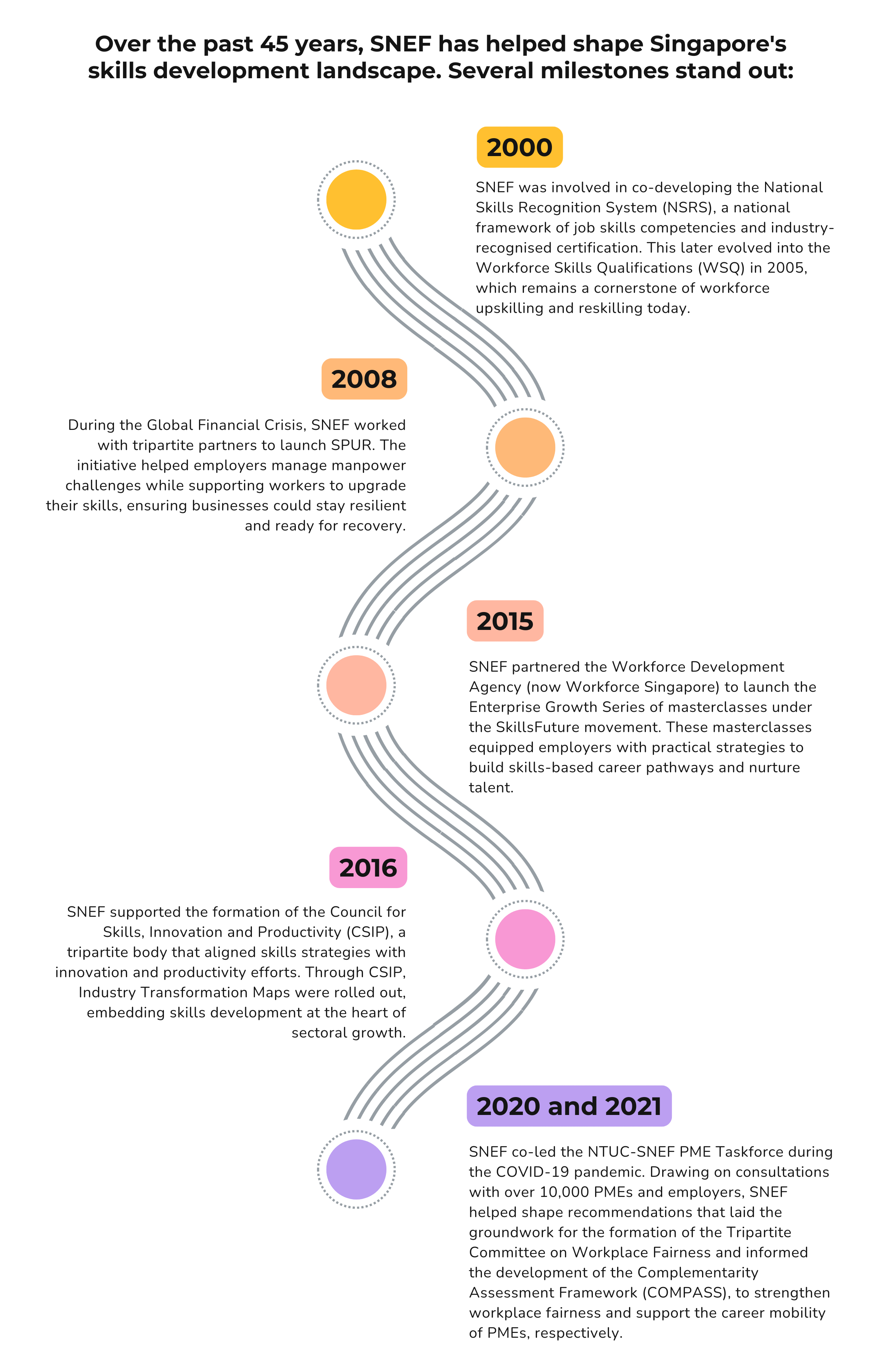
Other than companies taking the lead in training, Government's financial support is indispensable, helping to secure employers' commitment to drive workforce development at both the national and sectoral level. This was demonstrated during the Great Financial Crisis of 2008-2010, when the tripartite partners — the Ministry of Manpower (MOM), National Trades Union Congress (NTUC) and Singapore National Employers Federation (SNEF) — co-developed the Skills Programme for Upgrading and Resilience (SPUR) which offered substantial funding and subsidies, absentee payroll compensation and wide access to sector-specific training courses. Designed to leverage the downturn in business activity, SPUR enabled companies to retain and retrain employees in preparation for the eventual economic recovery. This strategic use of crisis as a window for capability-building underscored the strength of Singapore's tripartite model — a collaborative framework that continues to underpin national skills development efforts in the SkillsFuture era.
Partnering for Change: The Jobs and Skills Ecosystem
Tripartism has long been the bedrock of Singapore's competitive advantage, underpinning key national initiatives such as the SkillsFuture Movement. By bringing together the Government, the labour movement and employers in close partnership, tripartism ensures that skills and workforce initiatives are not only forward-looking but also pragmatic and responsive to evolving business needs.
A common conviction underpins the efforts of all tripartite partners: that sustained investment in training and skills will generate better returns for businesses in the longer term, ensure competitiveness of our industries with global peers and ultimately create good jobs for Singaporeans. This alignment keeps the ecosystem dynamic and forward-looking, enabling initiatives — from skills upgrading to career development — to meet both enterprise needs and the evolving aspirations of Singaporeans.
As the national trade union of employers, SNEF plays a dual role within this tripartite framework — advocating on behalf of employers for greater support from the Government and the labour movement, and helping the Government implement upskilling and reskilling initiatives. Through this trusted partnership, employers are better equipped to anticipate emerging skill demands, plan workforce development strategies, and support employees in navigating their career pathways.
Singapore's competitive edge in workforce transformation lies in the strength and cohesion of its tripartite partners. In contrast to other countries where differing interests can hinder progress, the collaboration between Government, employers, and unions enables initiatives like the SkillsFuture movement to be rolled out efficiently and with broad stakeholder support. This approach strengthens business resilience and ensures that Singaporeans remain well-positioned to upgrade their skills and thrive in a rapidly changing economy.
Trust lies at the core of Singapore's tripartite collaboration — a trust forged over decades of navigating challenges together, both large and small. This enduring relationship empowers the tripartite partners to engage openly, address concerns constructively, and pursue win-win-win solutions that benefit all parties.
SNEF's Role in the Jobs and Skills Ecosystem
Representing more than 3,800 member companies with a combined workforce over 860,000, SNEF is the national trade union of employers. In close collaboration with tripartite partners, SNEF plays a pivotal role in strengthening Singapore's skills ecosystem — supporting employers in building a future-ready workforce through a number of initiatives, including:
- A partnership with the National Centre of Excellence for Workplace Learning (NACE). Led by Nanyang Polytechnic and supported by SkillsFuture Singapore (SSG), this reflects a shared commitment to empowering employers, particularly SMEs, to adopt structured approaches to learning at workplaces.
- The Structured Career Planning (SCP) initiative. Developed and led by SNEF, it supports employers in facilitating meaningful career conversations and guiding progression pathways for employees.
- The Support for Job Redesign under Productivity Solutions Grant (PSG-JR). Administered by SNEF as the sole programme manager, it incentivises employers to transform their business and create jobs that are more productive and attractive to workers.
Since 2016, SNEF has also played a key role in the annual SkillsFuture Fellowships and SkillsFuture Employer Awards as a nominating body. In this capacity, SNEF identifies, recommends and supports exemplary employers and individuals who demonstrate a strong commitment to workforce development and the pursuit of skills excellence. These awards are meaningful because they celebrate organisations that invest in their people and individuals who embody lifelong learning. Showcasing such role models sets benchmarks of excellence and inspires the wider community to embrace a culture of lifelong learning.
Additionally, SNEF partners closely with the Workforce Singapore (WSG) to implement key initiatives such as the Career Conversion Programmes (CCPs) and the Support for Job Redesign under Productivity Solutions Grant (PSG-JR). Through the CCPs, SNEF supports employers in reskilling new hirers or existing employees into new or enhanced job roles, enabling companies to stay competitive and retain valued employees. In response to strong employers demand, SNEF placed 450 trainees in new or re-designed jobs in the last financial year through its CCPs for Human Capital Professionals, Professional Executives, SME Professionals and Security Officers. Meanwhile, the PSG-JR programme helps employers redesign jobs to make work more attractive and productive for employees, strengthening talent retention and improving long-term competitiveness.
Recognising job transformation as the key enabler between skills acquisition and business transformation, SNEF deepened its partnership with WSG and SSG through the Jobs-Skills Integrator for Retail. As the dedicated 'integrator' for the retail industry since 2023, SNEF, in close collaboration with NTUC, industry partners and Institutes of Higher Learning, aggregated skills demand and supported retail companies with end-to-end solutions for workforce transformation, employee training and job matching services for the industry.
Global shifts such as the US tariffs and trade disruptions continue to test business resilience, while artificial intelligence and digitalisation are transforming the very nature of work. In the face of such changes, SNEF is committed to working hand in hand with the Government and labour movement, to help employers harness new opportunities, build future-ready workplaces, and ensure that every worker has the skills and career pathways to thrive in the economy of tomorrow.
Looking to the Future: Challenges and Opportunities
In every recent dialogue or conference on the 'Skills-First' approach in the workplace, there will be exaltations for employers to move beyond qualifications to hiring and rewarding based on skills. Much of this has already happened, necessitated by a tight labour market where employers have to look beyond their traditional hiring pool. For others, the slower move to a 'Skills-First' approach is probably due to the lack of tools or know-how to identify and assess the skills in demand by the business rather than any inertia to change. Some employers continue to rely on qualifications not because they are stuck in the old mindset but because qualifications, after all, have always been a proxy for skills and capabilities. The bigger question for us is whether we can help employers overcome these barriers to identifying and assessing skills.
While the Government has a remarkable job in establishing a robust national skills framework, this can be complemented further at the enterprise level through formal and structured skills development dialogues between employers and employees. Such conversations are essential to help employers utilise and integrate the skills framework into their daily operations. The first step for many employers would be to identify tools that could help them quantify the skills demand today and map out the skills demand for the future. With a clear current and future operating picture, employers can then properly plan out and execute their workforce transformation strategies. On our part, SNEF has developed a Structured Career Planning guidebook which provides a blueprint for HR and line managers to conduct formal, deliberate and forward-looking career conversations with their employees and better link employee skillsets with job redesign opportunities and business needs. For fresh hires, employers could also benefit from common tools developed by sectoral Trade Associations and Chambers that could help hiring managers assess the requisite skills before hiring. However, these discussions often remain retrospective in nature, typically linked to performance appraisals, rather than being forward-looking and strategic.
Another key challenge employers will continue to face is the alignment of expectations between their workers and the management. For example, gaps remain between employers' expectations and employees' preferences when it comes to reskilling and upskilling. Employers want their employees to take up skills that supports business and job transformation while employees may gravitate towards trending skills which do not necessarily align with organisational priorities. Thus, striking the right balance — between business priorities and individual career aspirations — is essential.
At the same time, it is important that employers are not too focused on short-term skill requirements, as it may hinder the development of long-term capabilities. Strengthening the link between skills acquisition, job redesign and business transformation will be key to sustaining competitiveness and ensuring that capability development leads to tangible business outcomes.
Over the first decade, SkillsFuture has built the strong momentum and impetus for lifelong learning and workforce transformation, with employers as key partners in co-owning the journey of skills, job and enterprise transformation. This approach — integrating upskilling, job redesign and workplace learning — remains critical to building resilient businesses and an adaptable workforce of the future. Employers' support for this remains strong: a 2024 poll of SNEF members ahead of Budget 2025 found that over 70% support continued initiatives for workforce reskilling and upskilling.
We, at SNEF, will continue to be a perpetual optimist about the promise, potential and impact of the SkillsFuture movement.