
Thought Leadership
Size is not the Answer: The Changing Face of the Global City
1 January 2014
Prepared by Joel Kotkin, with contributions from Wendell Cox, Ali Modarres and Aaron M. Renn
Publisher: Civil Service College
ISBN: 978-981-09-1640-4
Publication year: 2014
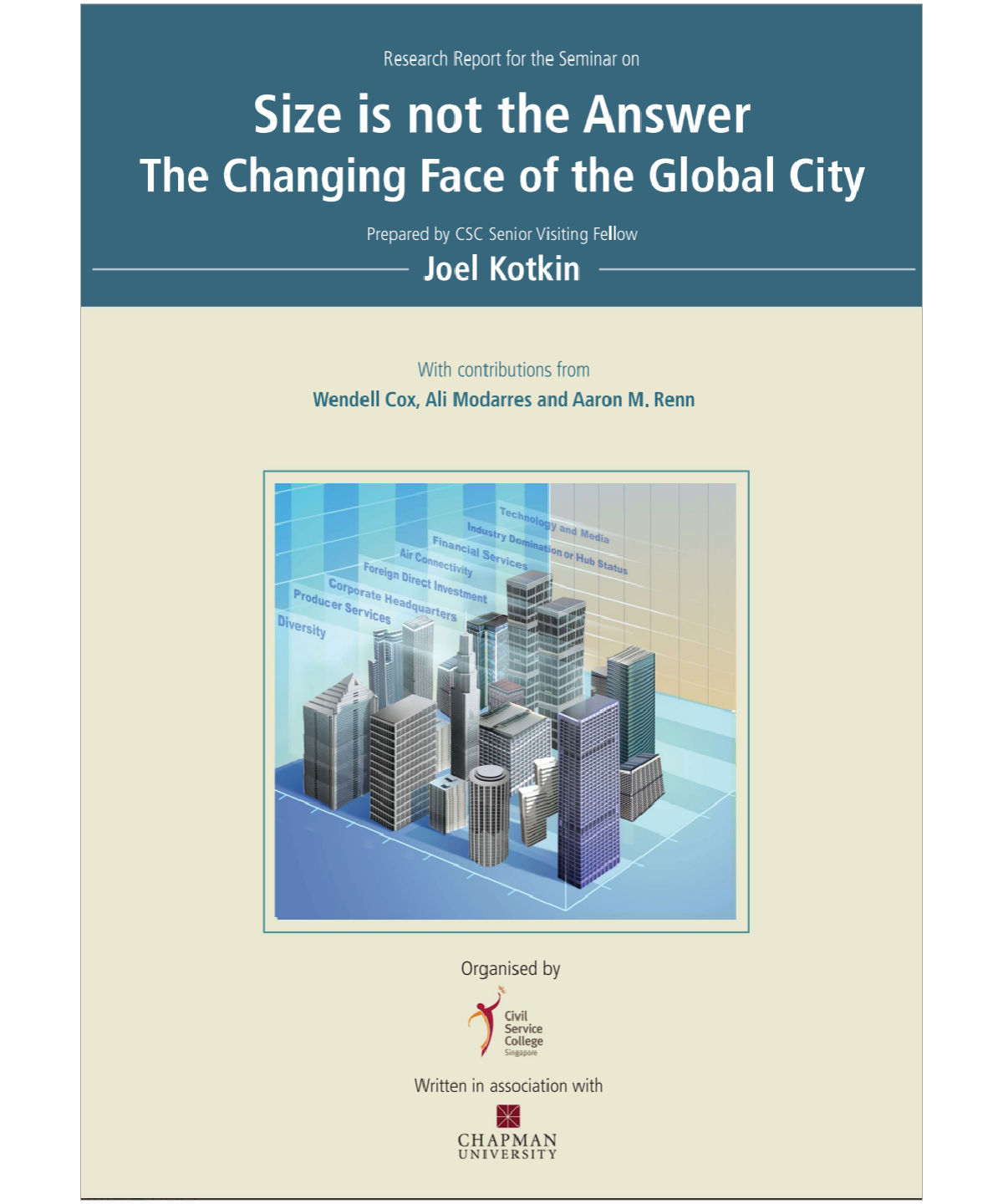
The research report, stemming from a collaboration between the Civil Service College, Singapore and the Center for Demographics and Policy at the Chapman University, shared the results of a study in which global cities were ranked based on eight categories: air connectivity; diversity; foreign direct investment; corporate headquarters; producer services; financial services; technology and media; and industry domination or hub status.
Contents
Introduction
Rethinking the Urban Hierarchy
The Just City versus the Luxury City
Forces Driving Greater Inequality in Global Cities
The Challenge to Emerging Megacities
Measuring Global Cities
Tracking the Rise of Efficient and "Necessary" Cities
Physical Connectivity
Human Connectivity
Globalisation and Its Discontents
Appendix A: How We Ranked Global Cities
Appendix B: Methodology
Appendix C: Summary of Findings
New York: Still the Wonder City
Fighting for the Future: The Battle for East Asia
Tokyo: No Longer Ascendent, but Still Important
Seoul Makes a Bid
Whither the Chinese Global City
Singapore: Asia's Premier Global City
Dubai Tries to do a Singapore
Other Middle Eastern Candidates
The Rest of the Developing World
Latin America Strikes Out, for Now
Africa: Fast-Growing but Not yet Efficient, or Necessary Enough
Europe Fades from View
Rising and Falling Stars in North America
Rising Stars